

|Annex Research | Annex Bulletins | Quotes | Workshop | | Feedback | Clips | Activism | Columns |

The copyright-protected information contained in the ANNEX BULLETINS is a
component of the Comprehensive Market Service (CMS). It is intended for the exclusive use
by those who have contracted for the entire CMS service.
MIDRANGE
An
Early Network IT Apostle Hits the Deck; Another Hits the Jackpot
Coffee Beans and Sun Spots
Java:
Delicious Internet Café Mocha; But How Long Will the Party Last?
PHOENIX,
Aug 26, 1998 -
Some early "network is the system" apostles hit the deck (DEC,
for example). Others seem to
rising on the horizon (Sun, for example).
Why the differences in fortunes?
Did DEC hit the deck against the backdrop of a rising or a setting
Sun? And is Sun really
rising, or is its glow actually a Sunset?
It all depends on the backdrop.
One can stand still and still appear to be rising into the heavens
- against a background scene of a crashing jet.
Or one can rise in a hot air balloon and still seem to be falling -
if another aircraft climbs faster behind it.
A case in point.
It took a Sun roast to make the Java applets
taste like real coffee to the bleary-eyed software developers - possibly
the world's greatest (stale) coffee and pizza consumers. Which, in turn, turned Java (applets)
and Sun (Microsystems) into IBM's and Wall Street's darlings.
But it took more than Java applets. After all,
Apple (Computers Inc.) had plenty of those.
Creativity and innovation were practically synonimous with the PC
company which gave the IT industry its first mouse.
Yet, Apple almost hit the deck itself.
And was nearly consumed by Sun two and a half years ago (see
"Could a Bad Apple Give Sun Some Spots" - Annex Bulletin
FB96-02, 1/24/96).
Java: Industry
Leader in "ROH"
It took innovation mixed with hucksterism to
accomplish Sun's Java marketing feat.
"Interest in Java had a 'halo effect' on Sun," the Investors
Business Daily noted in a February 1997 report.
It had to have been a very large halo serving as backdrop to a
rather small Java bean head. For,
Sun's actual revenues and profits from Java have been miniscule, while its
R&D expenses related to it have been quite substantial.
As of the end of FY98 (year end June 30), for
example, Sun had sold 140 Java licenses to various computer and software
companies around the world. We
estimate, therefore, that its aggregate direct revenue from Java was about
$18 million, a mere 0.07% of its total business volume in the three years
since its announcement of Java in May 1995.
Yet, Sun's R&D expenses, in which Java figures prominently,
have nearly doubled during the same time frame - from $563 million to over
$1 billion per year.
Which means that Java
has been a financial disaster for Sun if taken on its own merit.
But measured in terms of ROH ("return on hype"), it has
been a huge success. It would
not be an exaggeration to suggest that, in terms of perceptions, Sun's has
now replaced Apple as the IT industry's innovation foundry in most
people's minds. Which has
undoubtedly indirectly bolstered Sun's other businesses.
Buying an
Illusion of Prosperity
Who says you can't buy an illusion of prosperity nowadays on Wall Street? Just take a look at the above charts. Sun and IBM look like the Bobbsey Twins. Each company has spent tons of money on stock buybacks in the last three years. And each has been rewarded by Wall Street with substantial increases in their average share prices. Sun's stock is up nearly four-fold since 1995; IBM's is up more than 2.5 times.
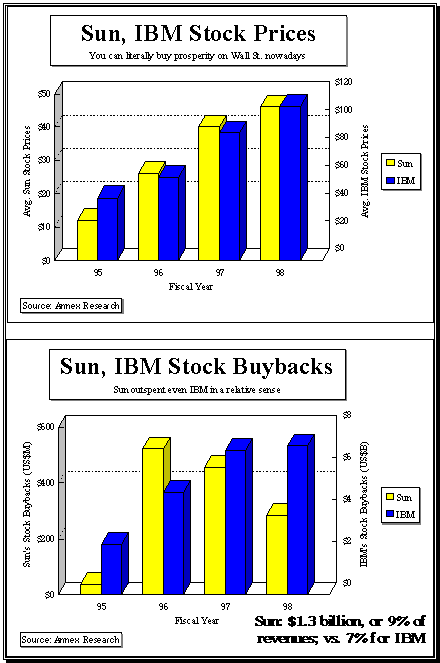
But the price of such perceived stockmarket
prosperity was quite high. Sun
has spent $1.3 billion on its share repurchases or 9% of its revenues
during the corresponding period; IBM over $21 billion or 7% of its
revenues.
Flat Earnings,
Big Write-offs
As to Sun's business fundamentals, unlike its soaring stock prices, Sun's FY98 net earnings were flat compared to the year before - at $763 million on revenues of $9.8 billion, up 14% from FY97. But Sun and Wall Street preferred to emphasize another net profit figure of $906 million, which is what the company's net would have been without the $176 million one-time write-offs for "in-process R&D."
The R&D write-off was a result of several Sun's
acquisitions during its latest fiscal year.
In its first quarter, the company wrote off $52 million when it
acquired Dina, Inc. and Integrity Arts. The
second quarter included the biggest R&D quarterly charge of $110
million, related to Sun's purchase of Encore
Computer's storage business, and the Chorus
Systems, S.A.
But some of Sun's FY98 deals which weren't
acquisitions held a promise of good business returns downstream.
During its third quarter, Sun licensed its Solaris
operating system for use on Intel architecture-based servers to Fujitsu
and Amdahl, the Japanese
vendor's subsidiary.
Business
Segment Analysis
Geographies. The U.S. market continues to be Sun's biggest business
segment, accounting for 52% of its worldwide revenues.
But it was Europe that recorded the fastest revenue growth in the
FY98 (up 24% to $2.7 billion). Now
take that IBM, DEC and a host of other computer vendors which have been
complaining about a sluggish European market and the strong U.S. dollar.
Sun has evidently faced the same odds and ended up w inning
- handily. And growing its
market share on the Old Continent.
inning
- handily. And growing its
market share on the Old Continent.
Even a better news for Sun's shareholders is that the
company has been growing its European business very profitably.
In fact, Europe has generated higher operating profits even in
absolute figures than the much larger U.S. operation.
If there is a "weakling" among Sun's
international segments, it is Japan.
Sun's revenues from the Japanese market have been declining for
several years now, although they are still over $900 million, and account
for about 9% of the company's business.
But even in its best years (e.g., FY96), Sun's Japanese business has only been marginally profitable. And although the company has not yet released its Annual Report for FY98 with the detailed breakdowns, we estimate that Sun's operating profits in Japan were break even at best. In other words, another example of "much ado about nothing" emanating from Japan; this time regarding a U.S. based competitor's business in that country.

Products.
Although Sun does not break down its business results by product segments,
its is now quite evident that its financials are starting to look
increasingly like that of a software company.
Its gross margins are much higher than those of its main hardware
competitors, but so are its SG&A and other expenses.
For example, Sun's gross margins in its FY98 were at
a record 52% level. Yet five
years ago, they were at 41% level. In
other words, while everybody else's gross margins have been dropping
(IBM's for example, dropped from 42% to 36% in roughly the same time
frame), Sun's has been rising. And
sharply at that. The only way
this can be done is by growing the share of a more profitable business,
namely software in Sun's case.
Similarly, while Sun's selling, general and
administrative (SG&A) expenses have climbed from 23.9% of revenue in
FY90, to 28.4% in its latest fiscal year, IBM's (and most other hardware
competitors) SG&A expense ratio had dropped from 30% of revenue to 21%
during the same time. And
IBM's gross margins plummeted from 55% to 36% since the start of the
1990s.
Mitigating against this trend is a parallel and rapid
growth in Sun's services revenues. Estimated
to be well in excess of $1 billion now (i.e., more than 10% of its total
revenues), services have been growing at roughly 40% per year.
Unlike software, however, services tend to carry
relatively low margins, along with lean SG&A expense-to-revenue
ratios.
For that reason, Sun is no longer the
mini-computer maker that it once was; it is not yet a software company
which it is striving to be; nor it is a major league IT services vendor.
Yet it is all three. Which
is why Sun's financial statements reflect a "multiple
personality" syndrome which such a business blend represents.
Happy bargain hunting!
Bob Djurdjevic


