

|Annex Research | Annex Bulletins | Quotes | Workshop | Feedback | Clips | Activism | Columns
Annex
clients click here

The copyright-protected information contained in the ANNEX BULLETINS is a
component of the Comprehensive Market Service (CMS). It is intended for the exclusive use
by those who have contracted for the entire CMS service.
IBM CORPORATE AFFAIRS
From
Annex Research'
Exclusive
Never-Before-Published
Diary Notes…
Gerstner: The Untold Story
How IBM Chairman Flunked “Globalism 101” in 1993, “Civility 201” in 1995/1996, While Passing “Obsequiousness 301” in 1994
PHOENIX,
Dec 27 - When word got
out last spring that the former IBM chairman and CEO, Lou Gerstner, was
writing a book about his years at IBM, some of our clients and friends
urged this writer to do a biographical juxtaposition.
Since we are not in the book-writing business, we passed on the
idea. Instead, by way of
closure of the Gerstner era at IBM, we are bringing you this exclusive
11,500-word year-end essay. Think
of it as a chapter of an unwritten book about the Era of Greed, if you
will.
Those
who have read Lou Gerstner’s new book, “Who Says Elephants Can’t
Dance,” have a pretty good idea about what the former IBM chairman
thinks of himself. Those who
are interested in learning what kind of a man he really was/is, should
read on.
What
you’re about to learn includes much information never before published.
That’s because this is more a human interest than a business
analysis story.
“Gerstner:
The Untold Story” is based on this writer’s diary notes from
several meetings and conversations with and about the former IBM chairman
in the 1993-1996 period. At
the time, we had many requests from the media and even from some senior
IBM executives for such information.
But we chose to hold it back because it wasn’t directly relevant
to IBM’s business strategy. Yet
it could have been easily misused for political purposes by both
Gerstner’s fans and detractors.
In
order to place this story in a proper historical context, we recommend
that you also check out “Gerstner
Spills the Beans… Unwittingly” (Dec 13), along with many links
within that article to related stories.
Of special significance as a preamble to this story are the
articles that reflected our early 1993 views of Gerstner’s suitability
for the top IBM job vs. his predecessor (John Akers - see “A
Nice Guy Who Lost His Compass”, Jan
26, 1993, and “Akers:
The Last Emperor?”, June 1991).
The
short of it was that we welcomed an outsider to the Armonk throne.
We felt such a leader would be less tempted to meddle in day-to-day
management of the business, and would act as a business architect and
visionary. That’s something
we felt IBM sorely needed at the time.
As
you take this journey with us down the memory lane, “Gerstner:
The Untold Story” will hopefully let you see how our expectations
gradually changed, as we got to know the real man in the top Big Blue job.
Throughout this story, we have tried to preserve the originality of our observations as contemporaneously written in this writer’s diaries, some almost 10 years ago. These notes are shown in navy blue typeface. We’ve only corrected some typos and made a few stylistic changes.
The First Meeting
ARMONK, May 27, 1993 - It was a beautiful spring day in Westchester County. The Big Blue Armonk “castle” on Old Orchard Road was sparkling in warm sunshine when I arrived for my first meeting with the new IBM boss, Lou Gerstner. I had been told by my Armonk handler (“XX” in the story) that I was the first and the only IT consultant with whom the new chairman and CEO was meeting at this point of his IBM career (he had been less than two months in the job).
Nevertheless, I decided to play it by ear, as I do in all of my meetings.
I carried in my breast pocket a short list of points that I had
jotted down the previous night at my hotel room as possible discussion
topics. But I never took it out during the meeting.
It was only afterward that I scanned my notes to see how much of
the ground we actually did cover. And
recall being pleased to be able to check off most of the points.
The
Entrance
I was met in the lobby by Stephanie Guff (sic), who had been one of John Akers' assistants, too.
She said she'd seen my name in the press many times, and was happy
to meet the person behind it. She
pronounced my (difficult) last name so beautifully that I complimented her
on it.
We walked up to the third floor corner office.
Stephanie asked me if I would wait in the elegantly furnished
"waiting office" while she announced me to Gerstner.
The office had four white-upholstered armchairs.
I noticed a copy of a large picture book on Russia on the table.
Right beside it was a magazine with a word "Bosnia"
splashed across its cover.
Just as I was about to pick it up, I heard a voice behind me saying,
"Hi, I am Lou Gerstner."
I turned around. In
front of me was a rather short man. I
could not help but think of Napoleon.
Gerstner wore a white shirt. His
initials (LVG) were embroidered on his shirt pocket.
Surprise
Greeting
I was surprised not only by the fact that Gerstner showed up so
quickly, but that he did so in person.
Other IBM executives, even those whom I know well, might have
waited in their offices for the guest to be shown in by an assistant.
IBM's new chairman obviously wanted to do it himself.
"I am pleased to meet you," I said smiling as we shook
hands.
He just nodded coldly and pointed the way into his office.
His abrupt mannerism seemed at odds with the description of others
who have dealt with him.
IBM chairman's office furnishings were a matching set to those in
the "waiting office" -- white upholstery armchairs and a large
sofa. Gerstner offered me a
seat on the sofa. He and XX
took the armchairs. "So,
what is ANNEX?" he asked abruptly, demonstrating intent to dominate
the conversation and eliminate any small talk.
[snip]
Our report then goes on to describe in detail various interactions we've had with Lou Gerstner and other senior IBM executives over the last nine years. Here are the headlines and the opening passages of each section:
The First Meeting (cont'd)
Users
vs. Customers
"Okay, I thought to myself, if that's the way you want to play it.... I've been there before..." I smiled as if he had said the nicest thing in the world about me, and proceeded to explain our business to him.
The
Only Consultant?
"Can now ask you a question?" I interjected, trying to get
at least an even, if not the upper hand in this conversation.
"Sure," he replied.
"I understand that I am the only consultant with whom you're meeting. Why?"
[snip]
Computer
"Industry Watchers"
Gerstner said that one of the things he had found fascinating was
that there a whole breed of "industry watchers" at work in the
computer industry which do not exist in other industries.
"You don't see that in banking, or insurance, etc." he
said.
[snip]
IBM
Mainframe Demise
I cited this as an example of the kind of work I did with the
various IBM LOBs. He seemed
totally unaware of what the February mainframe announcements were about.
"Are you talking about the new products we announced?" he
asked.
Global
Perspective
I then said to him that one of the things which distinguishes us
from many other consultants is that we look at things on a global basis.
I pointed out the U.K., as the test bed for pricing issues; and
Australia, as the test market for the Japanese computer manufacturers
before entering the U.S. market.
consultants is that we look at things on a global basis.
I pointed out the U.K., as the test bed for pricing issues; and
Australia, as the test market for the Japanese computer manufacturers
before entering the U.S. market.
He seemed astounded. "Australia?" he asked in genuine shock.
[snip]
Russia:
World's Fourth Region
I changed the subject to Russia as another example of an
oversimplified manner in which the Western companies look at the world.
I referred to my conversation with an Indian economist, who divided
the world into three major economic regions -- Europe, North America,
Asia/Pacific. Yet, when I
questioned him on the reasons certain countries were more successful than
other, he said that one common denominator was the quality of the work
force (i.e., technical education).
He pointed to France and Japan as examples.
[snip]
Apple's
Russia Venture
"Did you see that Apple is now entering the Russian
market?" Gerstner asked, almost bewildered, looking at me and XX.
"Yes, and that they've already raised the bar to a 20% market
share," I replied.
[snip]
Top
Five Priorities
As the time was running out, Gerstner asked me what I thought he
should do to revamp IBM.
I asked him if he had read the stuff I had been sending to him.
[snip]
IBM “Kremlinologists”
No
sooner was my meeting with Gerstner over, XX’s phone reportedly started
ringing off the hook, this IBM handler later told me over dinner.
Most of the calls came from other senior IBM executives, now
Gerstner’s sub-ordinates. All
wanted to know how the meeting went.
Reading
the Armonk tea leaves has been a part of the Big Blue culture. XX, who had spent several years at IBM Europe headquarters in
Paris, likened the process to the people trying to decipher the Soviet
Union leaders’ signals in the Cold War era.
The IBM “Kremlinologists” (XX’s expression) were evidently
fast at work after my first meeting with their new boss.
[snip]
Re.
Gerstner-Personal
XX said that he'd worked for John Opel; had been on Akers' staff;
and did not like many of the things that he had seen. But he thought Lou Gerstner "could not hold up a candle
to any of them, (not) even (to) Akers."
[snip]
Gerstner:
Not So Tough?
XX also told me that, before our meeting started this afternoon,
Gerstner was highly critical of my analysis of IBM's latest software
prices. "He doesn't know
what he is talking about," Gerstner said referring to me, prior to
the start of our meeting.
"Yet, he never brought this up during our meeting, much to my
regret," I said.
[snip]
Gerstner
- Summary
Overall, I got the impression that knives were out for Gerstner
among the worthy insiders. That
would not be surprising if he were indeed trying to dismantle the
"IBM culture." But,
if he merely keeps on doing the same things that sank the "old
IBM," he'll be "killed" by the insiders before the
outsiders ever get a chance! After
all, the insiders know a fake when they see one! Because they have seen so
many...
One
such IBM insider was Lucie Fjeldstadt, then a powerful software executive
at Big Blue. She evidently
shared XX’s disdain for the new Armonk boss.
Here’s what reportedly happened when she left IBM, shortly after
Gerstner had take over.
Lucie
Fjeldstadt: Abrupt Exit
John Akers apparently called Gerstner and asked him to try to prevent Fjeldstadt from leaving. So did some other former IBM executives. When Gerstner met with Fjeldstadt, he told her that he'd received all these calls, and that he wanted to know why it was that he should follow all these peoples' advice.
[snip]
Not a Visionary
Following
our first encounter, this writer continued to keep an open mind about the
new IBM boss, despite some questionable decisions Gerstner made during the
summer of 1993 (see Annex Bulletins “Bernard Puckett: Gerstner’s First
Blunder Raises Questions…,” June 25, 1993; “Gerstner’s First
Quarter…”, July 27, 1993; “Gerstner Reshuffles the Deck,” Sep 22,
1993; “Cannavino to Replace Puckett,” Nov 5, 1993).
Perhaps
the most revealing about what kind of a leader he was going to be was his
declaration in July 1993 that ‘the last thing IBM needs right now is a
vision statement.”
Gerstner took a lot of heat in the media over that comment.
But here was our reaction:
[snip]
The
Second Meeting
SCOTTSDALE,
Oct 26, 1994 - No wonder our second face-to-face get-together in
Scottsdale, Arizona, was like a “love in.”
Gerstner seemed to be in an expansive mood and was very
complimentary about Annex Research and this writer’s work.
Here are some excerpts from our diary notes about that meeting:
Preamble
The
Scottsdale Conference Resort was swarming with security.
There was a guard in front of Gerstner's door at all times, for
example.
"How
do you like being married to a celebrity," XX (the IBM handler) asked
my wife over dinner the night before (Oct 25).
"There are 400 people from here from Armonk whose job is to
ensure that Bob's meeting with Gerstner went off without a glitch.
Has any of that gone to his (mine) head?" he said.
We
all laughed at such pomposity.
Yet,
no one asked me to show an ID when I drove into the Conference Center.
Nor when I walked into the resort building.
Although XX had a name badge made up for me, he never gave it to
me. So I never used it.
And no one questioned my presence wherever I went - without
a badge! So much for the quality
of the IBM security!
[snip]
The
Lou Gerstner Meeting
(at the Suite 360 of the Scottsdale Conference Resort
- XX also present)
Introductory Greeting
Gerstner
greeted me very warmly and immediately commented about
my "southwestern tie."
I told him the tie actually came from Florence, Italy, but I agreed
with him that it looked "southwestern" (it was the same tie
that's shown in my pictures with Gen. Mladic in Bosnia).
Gerstner said that he regretted missing "all this great
weather outside," as he will be cooped up in meeting inside the hotel
all day. He sounded envious
of my (southwestern) lifestyle. I tried to console him by saying that this time of the year
was actually "my favorite" where he lived (in CT).
He agreed.
Lou and Consultants
I
reminded Gerstner of our first meeting (in May 1993), and asked him what
his view was today of the consultants' "sub-industry" which he
had noticed in May 1993 as surrounding, or being imbedded in, the I.T.
industry. He said that his
view back then was mostly "horizontal."
Over time, he got to appreciate the fact that, "there are
consultants, and there are consultants."
He
talked of the people who made their living by dealing in
"gossip." He also
mentioned consultants who sold their general "wisdom" from other
industries without really understanding what they were talking about.
And others, who are narrowly specialized in their fields (i.e.,
technical, or PC, or storage...).
"And
then, there is very small number of people who are truly knowledgeable
about the industry, and very insightful, like yourself," he said.
"You have a really good FEEL for the industry.
Perhaps that's because you used to be within the industry?" he
speculated. The bottom line, he said, was that he has learned to
discriminate between the various people who were trying to offer him
advice.
Gerstner
also said that the IT world is very complex, and the product cycle very
short, so that the margin of error is much smaller than in other
industries. "That's why
we need an outside knowledgeable third-party opinions, such as yours, so
as to validate our own rationale," he said.
Mainframe Recovery
Gerstner
brought up the subject of mainframes as an example of the kind of good
insight which, he thought, I was on the mark.
"When I was a customer, I just could not envisage running some
operations without a centralized mainframe," he said.
[snip]
New Customer "Buying
Standards"
Gerstner
then went on to talk about how the IT industry is in its relative infancy;
still lacking many standards as compared to mature industries.
I
agreed, but added that I assumed that, by "the industry," he
meant the standards which the vendors need to make the equipment.
"But, there are also the buying standards which need to be
developed," I said.
[snip]
Centralized Factory; Decentralized
Service
I
asked him if he also remembered another thing we talked about in our last
meeting - about the break up of services and the centralizing of the
factories. He nodded
affirmatively. I told him
that I was very pleased to see him follow through with such strategies.
[snip]
How High Is High Enough?
At
this stage, his EA, who had walked into the room a while back, was getting
quite antsy. "I guess,
that means that I have to go on," Gerstner muttered.
He apologized about the brevity of our meeting (even though by this
stage, it had gone on for more than double the planned amount of time).
[snip]
Personal, Vacations, South Africa
On
the way out, Gerstner thanked me for offering to meet with him
occasionally at Armonk. But,
he said that he'd been traveling a lot.
At one stage this year, there was a period of five weeks during
which he had not been at Armonk at all, he said.
He added, "and, therefore, not with my wife and children,
either." Eventually, he
managed a vacation with his wife in South Africa, he said.
[snip]
Just
as was the case after our first meeting in May 1993, as soon as this one
was over, the “IBM Kremlinologists” went to work again.
XX said his phone started to ring off the hook again, as various
senior IBM executives piped it to hear how my meeting with Gerstner went.
Here are some of my Oct 28, 1994 notes about it:
Epilogue
(XX’s
telephone call from NY at about 10:30)
John Thompson
XX
said that John Thompson (JT) approached him during the IBM evening
reception in Scottsdale to hear what XX's impressions were from my meeting
with Gerstner. XX told him.
JT said that he had also spoken with Gerstner after the meeting,
and that Gerstner had said some very flattering things about me.
Gerstner said that he was especially impressed with my grasp of the
international business issues.
[snip]
Bob LaBant
XX said that LaBant was ecstatic about the results of the Gerstner meeting. "Lou was in an expansive mood after his meeting with Bob," LaBant said. LaBant wanted to know how long the meeting was. "34 minutes exactly," XX said
[snip]
JJ
JJ,
XX's boss, was the person who walked in, broke up my meeting with
Gerstner, and took him to he had another one.
JJ and Gerstner don't really know each other, XX said, so it was
unlikely that Gerstner would confide in JJ with any substantial comments.
Nevertheless, XX probed JJ afterward to see if Gerstner had said
anything to him about the meeting. JJ
said that Gerstner's comment was, "Bob is a very smart guy."
JJ
also said that Gerstner was in a great mood after the meeting.
[snip]
The Man Who Is “Sir” to Potus
WASHINGTON,
DC, Jan 26, 1995 - It was a cold and wintry night when we sat down to
dinner at the “El Caribe” restaurant on Georgetown’s M Street.
My dinner companion, Peter Krogh, had been Dean of Georgetown
University’s prestigious School of Foreign Service (SFS) for over 25
years. He had just announced that he was planning to step down at
the end of that school year (1994-1995).
The
main purpose of our meeting was to talk global geopolitics.
So PK had this to say about one of GU’s famous graduates, then
the main occupant of the White House (Bill Clinton):
[snip]
Gerstner at Bilderbergers
Conference
When
PK learned that I know Gerstner, and have worked on and with IBM for
years, he told me about an unpleasant experience he had had with Gerstner.
The two were among the participants of a high-level conference (it
sounded something like Bilderbergers) which was held in Helsinki last
year. At one stage, PK
complained to Gerstner that he was having trouble getting an IBM ThinkPad,
and was wondering if Gerstner could help.
[snip]
Lou
Gerstner
(attempted telephone
conversations - 8:30 through 13:30)
I
first called Gerstner from the DC airport at about 8:30.
His Armonk staff told me that he was expected in the City today,
and transferred me to that office. But he had not yet arrived in Manhattan.
I explained that I was calling from an airport, and said that I’d
call again at about 9:00 (EST).
I
did. Gerstner had still not
arrived. So I said that I’d
call again from Dallas - roughly at lunch time (EST).
[snip]
Dennie Welsh
(telephone
conversation - at about 13:40)
Welsh’s secretary had to run to fetch him from the elevator, as Welsh was leaving the office to give a speech at some Wall St conference. I got right to the point and explained all of the above to Welsh. I repeated that I did not care about Gerstner’s personal reputation anymore, and said that he has now managed to insult two people, not just Dean Krogh. But I did care about the reputation of my client - IBM Corp., not Gerstner - and that’s why I called him.
[snip]
Gerstner’s “Loss Review”
NEW
YORK, Feb 6, 1995 - A few days after returning home from Washington, I got
a letter from PK (the GU SFS Dean) who said in part:
“I
was contacted by someone from IBM.
I thank you for your follow-up.
Unfortunately - when I got no response from Gerstner - I proceeded
to equip myself with an NEC Versa” (a Japanese laptop).
(see
Welsh letter/chart, Feb 6, 1995).
During
my next trip to New York, I broached the subject with Dennie Welsh, the
IBM executive who evidently was the only one to have really done something
about trying to protect his boss’s reputation.
Here’s an excerpt from my diary notes about that Feb 6, 1995
conversation:
Re. Gerstner/PK
I
then asked Welsh if he ever found out what happened in the Gerstner-PK
situation. “Yes,” he
said, “you got my boss mad at me.”
“Mad
at you?” I exclaimed. “That’s
preposterous! Weren’t you
the one trying to help him?” I
added that it would not surprise me if Gerstner were mad at me, “but mad
at you? That’s ridiculous!”
[snip]
Epilogue
LaBant
was right.
Gerstner was furious, especially after my Feb 6, 1995 faxed note.
But I did not find out about it until about a month or so later.
I recall being at a professional tennis tournament in Scottsdale
when my cell phone rang.
It was Dennie Welsh.
[snip]
And
then there was the final lie…
The Final Betrayal
On
New Year’s Eve 1996, XX and yours truly exchanged “happy new year”
greetings over the phone.
During the course of the conversation, XX shared with me some of
the information that a recent McKinsey report had concluded about IBM.
Which is basically your have been saying all along, XX said.
[snip]
In
June 2000, we published for the first time some excerpts from that 1996
Bulletin within our five-year forecast for IBM (“Stagnant
Revenues, Declining Earnings,” June 2000).
An Unpublished Bulletin
Over three years ago, on Dec. 31, 1996 to be exact, we wrote
an Annex Bulletin that was never published (see APPENDIX
A). “Spiked” is the
term media editors would use.
[snip]
At
the end of 1996, the IBM shares traded at about $38 (adjusted for
subsequent splits).
As of the time of our June 2000 forecast, the IBM stock was
hovering in the $110 to $120 range.
In August 2000, it reached $135, a high in recent years.
IBM shares are currently trading at about $77, after dropping to a
low of $54 in September.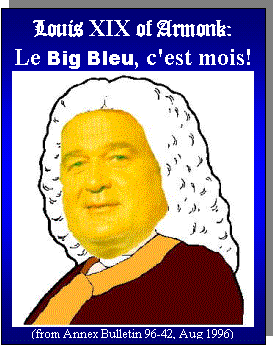
Lou
Gerstner is now history.
So it goes… What remains is his legacy - the Era of Greed.
And a $131 billion (market cap) slumbering giant could have been
much bigger and nimbler.
And now, “The
Untold Story” is also a part of the Gerstner legacy.
This essay isn’t a book, as some of our clients and friends have urged us to write. But it can serve as a juxtaposition-chapter of “Louis XIX” book about himself. So that the whole truth may be known about the man who would be king.
[snip]
"That's all she wrote," we're
afraid, for those of you who are NOT Annex
Research clients, and who are now
reading the complete Annex Bulletin (18
pages in print edition),
along with all charts which
back up our story. Qualified media
and friends of Annex
may request a TEMPORARY
User ID and Password by clicking
here and explaining why they wish to have access to this particular
Annex Bulletin. Or call Bob Djurdjevic at 602-481-7733
(cell) to
promise not to copy it or otherwise republish it. To find our how you can become one of our
clients, and read the rest of this and other Annex
Bulletins, click on
. Thank you.
Happy
bargain hunting!
Bob Djurdjevic
NOTE: The print edition of this report, of course, contains additional charts and tables not included here.
Can you afford not to know such things if you're a global competitor? To subscribe, just click on , or call us as (602) 824-8111.

For additional Annex Research reports, check out...
2002: “Gerstner: The Untold Story” (Dec 27), "Gerstner Spills the Beans" (Dec 13), "On a Wing and a Prayer" (Oct 21), "IBM-PwC Tie the Knot" (Oct 2), "IBM to Take $500M Charge" (Sep 3), "IBM Layoffs Confirmed" (Aug 14), "Half or Double Trouble?" (Aug 12), Wall Street/Main Street Chasm (June 25), “Wall Street Casino,” (June 21), Big Blue Salami (June 19), Sam's Dull Scalpel (June 4), Looming IBM Write-offs (May 23), "No New News at IBM" (May 15), "Looming IBM Layoffs" (May 14), "Sam Is No 'Change Agent'," (May 6), Additional Stock Buybacks Authorized (Apr. 30, 2002), "IBM 5-Yr Forecast: From Here to Eternity?" (Apr 2002), “Tough Times, Soft Deals,” (Apr 25, 2002), "A Disastrous Quarter," (Apr. 17), Industry Stratification Trend (Mar. 30, 1990), “Gerstner’s Legacy: Good Manager, Poor Entrepreneur” (Jan 2002), IBM Pension Plan Vapors: Where Did $17 Billion Go? (Mar 2002), "Big Blue Starting to Unravel," (Apr. 8, 2002), SEC Launches Formal Probe of Wall Street Research (Apr 25, 2002), “SEC to Tighten Stock Option Rules” (Apr 5, 2002), "Sir Lou OutLayed Lay!" (Apr 1, 2002), "IBM Pension Fund Vapors," (Mar 23, 2002),
A selection from prior years: Is IBM Cheating on Taxes, Annex Bulletin 99-17 (May 1999), IBM 5-year Forecast 2001: An Unenviable Legacy (June 2001), "Break Up IBM!" (Mar. 1996), Fortune on IBM (June 15, 2000), “Smoke and Mirrors Galore,” July 2000), "Slam Dunk of Bunk" (Jan 2000), Annex Bulletin 98-14 ("Wag the Big Blue Dog"), Armonk's Fudge Factory (Apr. 9, 1999), Where Armonk Meets Wall Street, Greed Breeds Incest (November 1998), Stock Buybacks Questioned: Is IBM Mortgaging Its Future Again?, 97-18 (4/29/97), "Some Insiders Cashed In On IBM Stock's Rise, Buybacks" 97-22, 7/27/97, Djurdjevic’s Forbes column, "Is Big Blue Back?," 6/10/97; “Executive Suite: How Sweet!,” (July 1997), "Gerstner: Best Years Are Behind", Aug. 10, 1999), "IBM's Best Years Are 3-4 Decades Behind Us" (July 1999), "Lou's Lair vs. Bill's Loft" (June 1999), "Corporate Cabbage Patch Dolls," 98-39, 10/31/98; Djurdjevic’s Chronicles magazine October 1998 column, "Wall Street Boom; Main Street Doom", “Louis XIX of Armonk,” (Aug. 1996), "Mountain Shook, Mouse Was Born" (Mar. 25, 1994), “A Nice Guy Who Lost His Compass” (Jan 26, 1993), “Akers: The Last Emperor?” (June 1991) etc.]
Or just click on  and use appropriate
keywords.
and use appropriate
keywords.


