

Annex Research| Annex Bulletins|
Index 2003 | Search| Feedback| Clips| Activism| Quotes|

The copyright-protected information contained in the ANNEX
BULLETINS is a component of the Comprehensive Market Service (CMS). It is
intended for the exclusive use by those who have contracted for the entire
CMS service.
An Open Client Edition
IT SERVICES
Analysis of Accenture’s FY3Q03 Business Results
Light at End of Tunnel
Accenture’s Shares Surge 9%, Buoyed by Solid Third Fiscal Quarter Results
PHOENIX,
July 15 - Wall Street acted today as if it finally saw the light at
the end of a long tunnel (the IT services industry slump) that wasn’t an
oncoming train. J
It was Accenture, beaming in with a 15% rise in earnings on a 2%
growth in its third fiscal quarter’s revenues.
What followed was a tide of exuberance that lifted nearly all IT
boats today, despite a 48-point drop in the Dow Jones Industrials index.
Accenture’s
shares led the way with a 9% surge, setting a new 52-week high ($20.80)
for this global IT services provider (eclipsing the previous high of
$20.47 reached on December 2, 2002).
IBM, EDS and CSC shares also rose between 1.2% and 1.6%.
With IBM due to report its quarterly results after the market
closes tomorrow, Wall Street will be holding its breath to see if the
momentum created today by Accenture will be sustained.
Many are hoping it would.
One
can almost feel the investors champing at the bit, despite the fact that
Accenture’s results were boosted by a weak dollar and a lower tax rate.
Wall Street also brushed aside some cautionary remarks by
Accenture’s top management.
“We
are not counting on the market to hand (us) as much in terms of demand
improvement for the remainder of this year,” warned Accenture’s
chairman and CEO, Joe Forehand, in a teleconference with analysts
following this morning’s earnings release.
Wall
Street shrugged it off.
“Given
the challenging market conditions, our performance in the third quarter
was satisfactory,” Forehand also said in a release.
Wall
Street shrugged that off, too.
Maybe just “satisfactory” is indeed how a prudent analyst or a
cautious executive would describe Accenture’s third fiscal quarter
results.
But the warning fell on deaf ears on a street that only seems to
pay attention to how much a company over- or under-performs the consensus
earnings-per-share estimate.
Strong Cashflows
Meanwhile,
we were buoyed by some of the things in Accenture’s release that neither
Wall Street analysts nor the media seemed to stress very much.
It was Accenture’s cashflow, a true measure of how well an IT
services company is doing (it was the fear of declining cashflows that
buried the EDS stock, for example, last year - see “EDS
Issues Earnings Warning,” Sep 18, 2002).
Accenture’s
total cash balance as of May 31 was $2.1 billion, up $423 million from
February 28, and up $717 million from August 31, 2002, its last fiscal
year end.
For the first nine months of its
current 2003 fiscal year (ended May 31), the company’s operating
cashflow doubled compare to that a year ago! (from $547 million in 2002,
to $1.08 billion this year).
Free
cashflow (operating cashflow less property and equipment purchases) went
up even more - 2.4 times! (from $391 million last year, to $945 million in
the latest fiscal period).
In
short, Accenture is starting to look today as IBM and Microsoft used to in
their heydays. The company is
a cash machine, just on a smaller scale than the two IT industry giants.
More than any other financial figure that we saw today, it is that
aspect of Accenture’s third fiscal quarter release that impressed us the
most about its future.
Outsourcing Surges
Of course, having signed $5.2 billion of new contracts in the quarter isn’t too shabby, either. The 6% increase in new consulting contracts ($2.2 billion) is also encouraging, especially as that line of business has been declining both within Accenture, and elsewhere around the IT services industry (see the chart).

Outsourcing,
on the other hand, has been growing by leaps and bounds.
It accounted for $944 million of Accenture’s third quarter
revenues, a 35% increase over the comparable period last year.
Overall, we estimate that outsourcing now represents about 31% of
Accenture’s revenues.
But
there is a caveat here, and a price to be paid for such a rapid growth of
outsourcing.
Partially as a result of it, Accenture’s gross margins are
shrinking.
They were 36% in the third quarter, down almost five points from
the 41% level in the same period last year.
Increased severance costs and competitive pricing pressures also
contributed to a decline in gross margins.
Geographic Segments
As
noted before, Accenture’s third quarter results were also boosted by the
weakness in the U.S. dollar. Revenues
in Europe ($1.4 billion), for example, increased by 11% as reported, but
were down 6% in local currency.
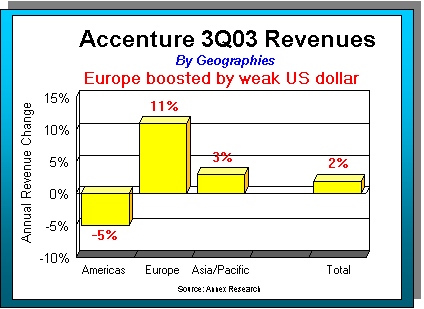
Similarly,
revenues in Asia/Pacific ($195 million) rose by 3% in U.S. dollars, while
declining 6% in local currency.
Revenues
in the Americas region, dominated by the U.S. market, were $1.45 billion,
down 5% both in U.S. dollars and in local currency.
But perhaps there is another unspoken reason for Accenture’s successes in international markets. Four of five group chief executives that run the company’s biggest industry operations are non-Americans! No other major multinational IT company we follow can boast about something like that. Yet the U.S. is its largest market accounting for 44% of global revenues.

In
other words, the best executive, regardless of nationality, color or
creed, gets the nod at Accenture.
Sound
like the American Dream?
It
does. Except that
Accenture’s example also shows that, on a level playing field, sometimes
foreigners are better at playing the American Dream game than we are.
Industry Segments
As we’ve been pointing out ever since the end of 2001, multinational companies are operating basically in a global war economy. Which means that the government vendors are heaps of business, and the government industry sector is booming in just about every market segment. The IT services market, and Accenture as one of the top five global leaders, are no exception.

Accenture’s government sector revenues
soared by 28% in the latest quarter, by far outpacing the growth of any
other industry unit. Although
the government unit still accounts for a relatively small piece of the
Accenture global pie (16%), it is certainly the most important when it
comes to growth. All other
major industry groups struggled to report revenue growth in low single
digits, while Communications and High Tech group actually had a 7% decline
from the year before.
For the full
fiscal yearn 2003, we expect the government unit’s revenues to reach
$1.6 billion, up from $1.3 billion the year before.
But its impressive growth isn’t all due to the “wars of the New World Order.” The newly created eDemocracy Services business is a case in point.
eDemocracy vs. ePlutocracy
Accenture eDemocracy Services will provide
strategy and planning, program management, election systems management,
voter registration systems development, and transformational outsourcing
services and solutions, Accenture said in a June 30 release.
“We created our elections practice in
response to the market need that emerged following the 2000 elections, and
we continue to see tremendous global business opportunities in the
election industry,” said Steven Rohleder, group chief executive of
Accenture's government group. “Formalizing
this practice as a business is consistent with our strategy to expand our
services into key areas of government where we have the experience and
capabilities to deliver high-value solutions that meet the needs of our
clients.”
And how big is this opportunity?
“It’s huge,” Rohleder told us an interview earlier this
month. “And this is just a
start.”
It began last month when the company acquired
election.com, previously Accenture’s strategic partner that
has implemented its election systems management software in more than 170
U.S. counties and several U.S. states.
Election.com has also implemented successful multi-channel voting
pilots U.K. local authorities. The
company also helped deliver the first legally binding public Internet
elections in France specifically for French expatriates.
The (voter Internet) penetration rate is
already over 50% in Europe, over 60% in Scandinavian countries, as
compared to only 25% to 30% in the U.S., Rohleder opined.
The Accenture executive is hoping that the
bottom line of his company’s drive to essentially bring the voting
booths to the voters’ homes will be higher turnouts, and therefore more
and fairer democracy. Given
our privacy laws and the rise of plutocracy in the U.S., it is not
surprising that Accenture expects greater success with its eDemocracy
offerings in Europe than in the U.S.
But even if the eDemocracy were to take off in
the U.S., can’t you just see an ePlutocracy product being launched as
well?
What would that be?
Think of ePlutocracy as a kind of a trump card
over eDemocracy.
Given the advances that the Big Brother has
made in the aftermath of 9/11, ePlutocracy could emerge as a new
electronic system that would be superimposed on the eDemocracy offering.
Its purpose would be to monitor and change eDemocracy’s voting
results, bringing them into line with interests of our politicians’
sponsors. Not much different
from the way things work today, only a little more sophisticated.
After all, “the only
honest politician is one who stays bought?” And eDemocracy won’t change that, will it?
Happy
bargain hunting! Bob
Djurdjevic For additional Annex Research reports, check out... 
2002: Boom Amid Gloom and Doom (Oct 10, 2002), Analysis of Accenture's 2001/1Q02 Results (Jan 11, 2002), Analysis of Stock Market Reaction to WTC (Sep 26, 2001), Annex Research’s Analysis of Accenture's 2000 results (Apr 11, 2001)
Last three Heptathlons: Annex Research IT Services Heptathlon 2002 (May 21, 2002); IT Services Heptathlon 2000 (May 11, 2001); 1999 IT Services Heptathlon (Apr 17, 2000)
2003 (IBM): “Save, Spend and Split” (May 8), “Shrunk by the Marketplace” (Apr 17), “Turnaround Continues...” (Apr 15), “Start of a Real Turnaround?” (Jan 17).
Or just click on  and use appropriate
keywords.
and use appropriate
keywords.


