

|Annex
Research | Annex Bulletins | Quotes | Workshop | Feedback | Clips | Activism | Columns

The copyright-protected information contained in the ANNEX
BULLETINS is a component of the Comprehensive Market Service (CMS). It is
intended for the exclusive use by those who have contracted for the entire
CMS service.
Confidential Annex Research Client Edition
IT SERVICES
Analysis of Cap Gemini Ernst &
Young’s 2002 Results
The Ten-year Glitch
Declining Profits Turns to Losses Amid Cutbacks and Restructuring
WESTERN AUSTRALIA, Mar 3
- Cap Gemini Ernst & Young (CGE&Y) seems to be afflicted with a
10-year glitch. Every decade
or so, the company bleeds “red ink.”
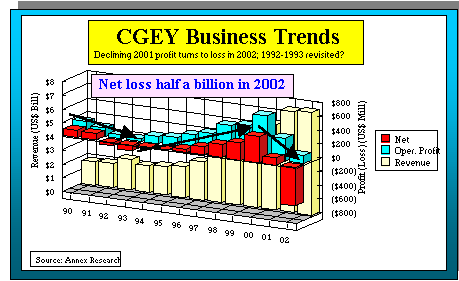
The last time around the management was forced into scratching a “red ink” (gl)itch was in the 1992-1993 period. Just as in 2002, declining profits had turned into losses (on the heels of the Gulf War and the ensuing 1991 recession - see the chart).
When CGE&Y released its latest 2002
business results on Feb 28, they contained a loss of €514
million ($549 million) on revenues of €7 billion ($7.5 billion).
Thanks to vagaries of foreign currency translations, however, i.e.,
the weakening of the U.S. dollar, the 2002 revenue amount was down 16% in
€uros from the comparable 2001 figure, but up 3% in U.S. dollars.
No such “miracles” were at work in terms
of net profits, or losses, as it turns out.
The main reason for the hefty loss was a €463
million restructuring charge. Of
that total, €359 million was related to 5,455 that were slashed in 2002.
The remainder (€104 million) was spent on “office space
rationalization” (read - reduction).
Mostly
as a result of the net loss, the CGE&Y equity declined from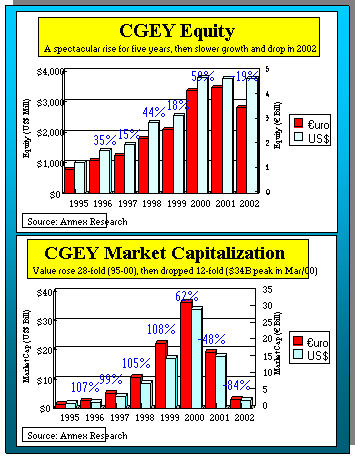 €4.3 billion in 2001 to €3.5 billion in at the end of 2002.
The CGE&Y market capitalization also dropped sharply (see the
charts).
€4.3 billion in 2001 to €3.5 billion in at the end of 2002.
The CGE&Y market capitalization also dropped sharply (see the
charts).
Despite its significant woes last year,
however, CGE&Y was actually a profitable company in 2002, at least
from an operational standpoint. Its
operating profit had shrunk from €703 million in 2000 and
€423 million in 2001 to only €114 million in last year. But at least it was a profit, rather than a loss.
The corresponding operating margins declined from 10% in 2000, to
5% in 2001 and 2% in 2002.
Geographies…
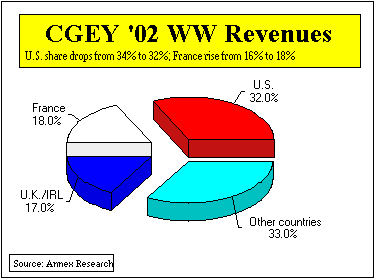
Of the four major CGE&Y geographic
segments, France turned in the best performance (meaning, France shrank
the least - by 9% from 2001). North
America and UK/Ireland revenues declined 16% and 13% respectively, with
the British Isles “distinguishing” themselves additionally with a €24
million operating loss (North America recorded a €42 million operating
profit).
The
worst business results, however, came from the smallest CGE&Y region -
Asia/Pacific. The revenues in
this area of the world dropped by 31% to €140 million, also producing a €12 million
loss to boot. The new A/P
management that CGE&Y installed in 2002, with whom we met during our
recent visit to Sydney, were optimistic that they can turn things around
this year. Time will tell…
The best European region was Central Europe,
the only CGE&Y area that actually produced revenue growth last year
(+3%). If only it were a
little bigger… Alas, Central Europe contributed only €466 million to the
company’s total 2002 revenues, thus barely making a dent in the overall
declining trends.
Furthermore, Central Europe’s growth came at
a price, and undesirable one at that.
The area lost money in 2002, as is often the case with relative
start-ups. Its operating loss
was €3 million.
Industry Segments
As most major IT services providers have been reporting, ever since 9/11, global competitors have been operating in a global war economy. As a result, the government sector has been booming while private enterprises languished.

CGE&Y was no exception. Its
public service and health care industry segment thrived in 2002 (up 37% to
26% of total revenues), while most of the others shrank. The
only exception was the “life sciences” sector that also grew (by 7%)
to 7% of global revenues.
Among the biggest
losers in 2002 were the “telecom and media” and “manufacturing”
segments, whose revenues declined by 37% and 26% respectively.
Horizontal Segments
Outsourcing was the only CGE&Y horizontal
business segment to show discernible growth in 2002. It grew by more than 30% to over $2 billion, or 27% of total
revenues.
The “project consulting” (including
systems integration) dropped from 72% of the total revenues in 2001 to
67%, while Sogeti, a newly formed entity in early 2002 (see Analysis
of CGE&Y 2001 Results, Feb 21, 2002), declined from 7% to 6% of
the total.
Summary & Outlook
Last year was clearly a period the CGE&Y
management and shareholders would rather forget.
But if you listen to their expectations in the future, it was also
the year that prepared them for weathering the continued tough economic
environment in 2003.
No, do not expect any “silver bullets,”
such as switching to “duct tape” production, or quick fixes and sudden
strategy changes. The
CGE&Y management sounded ready to slug it out in the trenches while
holding their basic course. Which
means trying to improve the “front end efficiency” (presumably the
sales productivity?), while increasing the service delivery productivity
“through a more systemic and better coordinated use of network
development centers.”
If things go according to plan, we can expect
continued modest declines in revenue during the first half of 2003, with
“stabilization” taking place in the second half. At
the bottom line, CGE&Y is hoping to return to about a 5% operating
margin that it enjoyed in 2001.
Don’t we live in interesting
times? (which happens to be an old Chinese curse - “may you
live in interesting times”). With
the present and the past being so awful, going “back to the future”
while scratching the 10-year (gl)itch seems an appealing proposition.
Happy
Bob Djurdjevic
For additional Annex Research reports, check out...
A selection from prior years:
Analysis of CGE&Y 2001 Results (Feb 21, 2002), Analysis of Cap Gemini Ernst & Young 2000 ... (2001), CGG 1999 Preliminary (Mar 10, 2000), CGG Annual Report 1998 (June 18, 1999), CGG: The Most Improved (1998)

Or just click on  and use appropriate
keywords.
and use appropriate
keywords.


