

Home |
Headlines | Annex Bulletins
| Index 2004 | About
Founder | Search | Feedback
| Clips | Activism
| Client quotes | Workshop | Columns
| Subscribe 
The copyright-protected information contained in the ANNEX BULLETINS and ANNEX NEWSFLASHES is part of the Comprehensive Market Service (CMS). It is intended for the exclusive use by those who have contracted for the entire CMS service.
Confidential Client Edition
IT SERVICES
Analysis of Cap Gemini’s 2003 Business
Results
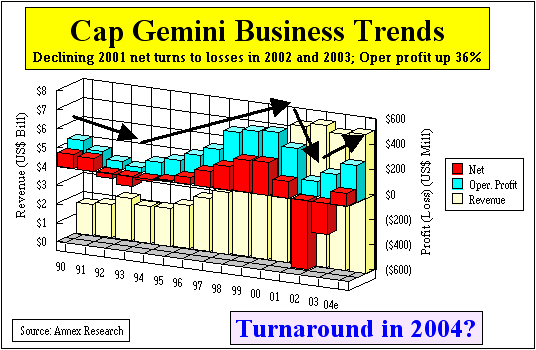
Another, Smaller Loss
PHOENIX, February 27
– Cap Gemini Ernst & Young (CGEY), soon to be renamed Cap Gemini
again, reported yesterday its second annual loss in a row on sharply lower
2003 revenues (down 18% in €uros;
down 4% in U.S. dollars) - also for a second consecutive year.
The
loss narrowed - from $549 million in 2002, to $248 million in 2003 (from €514
million to €197 million), and the operating margins improved (from 1.6%
to 2.7%). But the revenues
dropped more precipitously than the year before.
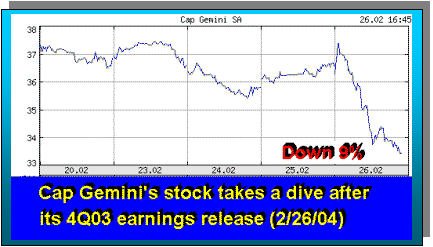
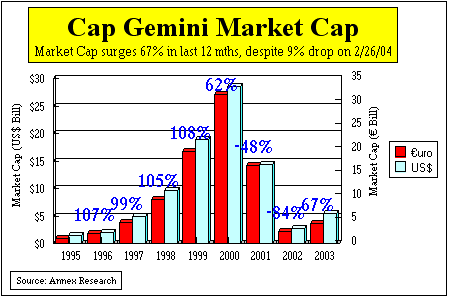
Not surprisingly, Cap Gemini’s stock took a dive. It was down 9% on the day to €33.35 (see the chart).
“It’s been a difficult year; a bit better
than expected, but not very good,” Cap Gemini’s CEO Paul Hermelin,
told the analysts in a teleconference that followed the earnings release.
Certainly the second half was better than the
first, but the company’s 10-year glitch seemed continue in 2003 (see “The
Ten-year Glitch,” Mar 2002).
Record New Contract Sales
To be sure, there were some encouraging sings in Cap Gemini’s latest release. New contracts record, for example, was one of them. The company set a new high in 2003, signing up €11.7 billion ($14.7 billion) of new business, thanks, in part, to its big win at Britain’s Inland Revenue (see “Biggest Feather in Cap’s Cap,” Dec 2003).

Unfortunately for Cap Gemini, the infusion of
new business came late in the fourth quarter, meaning that it had little
impact on its last year’s revenues.
But as the Inland Revenue and other new accounts come on stream,
especially in the second half of 2004, they will certainly boost Cap
Gemini’s this year’s revenues and profits.
Business Segment Analysis
Horizontal.
New contracts will also continue to boost the
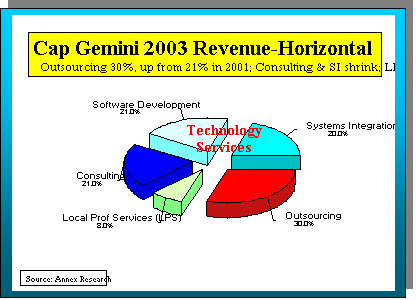
Outsourcing share of revenue. Its
share has already soared from 21% two years ago, to 30% in 2003 (see the
chart). By the end of 2004,
it will probably account for over one-third of the business.
Local Professional Services (LPS), Cap Gemini’s euphemism for small and medium business (SMB) market, was another bright light in 2003. With the Transiciel acquisition (in September 2003), Cap Gemini is now positioned well for expansion in a market segment with the greatest growth potential in the future (SMB).
That was evident even in 2003, when the LPS
segment revenues grew by 28% (from $452 million to $580 million).
The SMB market now accounts for 8% of Cap Gemini’s revenues, up
from 6% in 2002. That‘s
still well below that of some of the industry leaders (IBM’s is 23%;
HP’s is 29% - see “Nokia
Dials HP,” Feb 2004). But
it shows that the company understands where the best growth opportunities
lie, and is investing in them (by contrast to some of its major
competitors, such as EDS, CSC).
Which brings us to Technology Services and
Consulting segments, the two largest horizontal activities of the company
that account for a major (62%) share of its revenues. Unfortunately for Cap Gemini, both have been declining and
are likely to erode in the future, too.
Technology Services, which includes systems
integration type of work, is under pressure from many local and overseas
lower cost competitors. Its
decline is a result of a longtime trend that we first pegged 10 years ago.
We said that the Internet and the PC would empower individuals and
small companies to compete more effectively with
large enterprises
(see “Death
of the Corporation,” and “End of Western Dominance?”, Nov 1994).
Since that appears to be an irreversible
trend, the best the established large companies can hope to do is minimize
their losses by playing tough defense (i.e., cutting costs or even
shutting down the least profitable parts of their systems integration
businesses (Technology Services in Cap Gemini’s case).
Consulting, on the other hand, even though
also a declining business segment in the last two years, is vital to
carrying the “Holy Grail message” to corporate boardrooms (see “IT
Industry: Whither Goeth It?”, Jan 2004).
Without it, it is doubtful that big outsourcing or systems
integration projects are likely to be won.
Consulting is a low revenue, low profit-activity that nevertheless
can pay off big if it strikes a positive chord with the customer
executives.
So large IT services companies might as well
look at Consulting as a necessary evil, or putting it more positively, as
an investment into the future – their future.
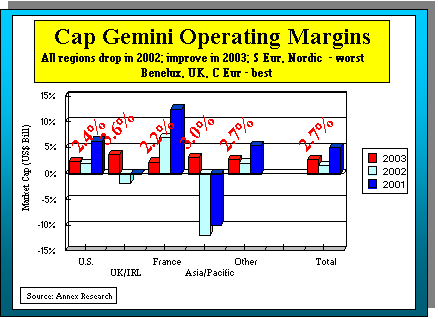
Geographies. One of the reasons for a sharp decline in revenues in 2003 was a deteriorating business climate for Cap Gemini in North America (read mostly the U.S.) and in France. Since these two regions are the two biggest geographic segments, they dragged down the performance of the rest of the company.

North America, for example, was down 13% in
the second half of 2003, compared to the first six months (in €uros).
The area was down 31% for the year (in U.S. dollars) to $2.1
billion. The U.S. operating
margin also deteriorated in the second half, from 3% to 1.7%.
France, Cap Gemini’s home country, was a
similar story. The second
half 2003 revenues were down 11% compared to the first half (in €uros),
while the full year total declined 16% to $1.2 billion (in U.S. dollars). The operating margin also slumped in the second half of 2003,
from 3.4% to 1%.
By contrast, the U.K. and Ireland, the Cap
Gemini region that’s been approximately the same size as France for a
number of years now, showed considerable improvement in profitability in
the second half of 2003. Its
operating margins rose from 2.9% to 4.3%, although the revenues declined
4% (in €uros). For the full year,
the U.K. revenues dropped 14% (in U.S. dollars).
The Benelux countries and Central Europe
showed the best performance in 2003 of all Cap Gemini geographic units,
both in terms of revenues growth and the operating margins. Unfortunately, their combined revenues are about the same as
that of France. So France’s
slump pretty well offset the improvements in these two European
territories.
Southern Europe, Nordic countries and Asia/Pacific continue to be among the geographic areas that will need a lot of improvement in 2004 if Cap Gemini is to meet its growth goals.
Industries.
As the company said in a statement that accompanied
the earnings release, “even if we were able to observe a slight pickup
in demand at the end of the year from telecom operators and the financial
services sector, it was only the public sector that significantly
increased its spending in 2003.”
In other words, in a global war economy only the government sector is a surefire growth business. It’s the same story that we keep hearing over and over again from each of the top six global IT services vendors.
Summary and Outlook
If Cap Gemini continues on the downward track
that is has been on for the last couple of years, one thing is likely –
the company will become a takeover target for larger and hungrier
competitors. Already there
have been rumors of CSC and HP, for example, supposedly having a taste for
Cap Gemini.
Seeking to dispel such gossip, Cap Gemini’s
CEO Hermelin told the analysts yesterday that he and Hewlett Packard CEO
Carly Fiorina “have regular contacts as part of strategic agreements.”
“But I don't have the feeling they have
(takeover) interests towards us,” he added.
We tend to agree. The two companies’ cultures are too disparate.
But some other predators might not be so bashful if Cap Gemini’s
stock continues to slide. So the best way to insure its continued independence is for
Cap Gemini to start growing again. The
company leaders seem to understand that.
“The management has set itself the priority
of growing the top line (revenue) in 2004,” they said in a release.
The executives also said that the growth would come in the second
half of the year.
That’s pleading for
patience and understanding – for a third year in a row now.
It remains to be seen how patient the investors will be.
Happy
Bob Djurdjevic

For additional Annex Research reports, check out...
2004: Cap Gemini: Another, Smaller Loss (Feb 2004); IBM: Greed De-clawed (Feb 2004); "CSC: Good Quarter Gets Boos" (Feb 2004); EDS:Hot Air Jordan" Flaunts Flop as Feat (Feb 2004); "Cronyism Is Alive and Well at EDS" (Jan 2004); "Five Most and Least Likely Forecasts for 2004" (Jan 2004)
2003
Cap: Biggest Feather in Cap's Cap (Dec 2003); The 10-year Glitch (Mar 2003)A selection from prior years
- Cap:Analysis of CGE&Y 2001 Results (Feb 21, 2002), Analysis of Cap Gemini Ernst & Young 2000 ... (2001), CGG 1999 Preliminary (Mar 10, 2000), CGG Annual Report 1998 (June 18, 1999), CGG: The Most Improved (1998)
Or just click on  and use "financial engineering" or similar
keywords.
and use "financial engineering" or similar
keywords.
|
Volume XX, Annex Bulletin 2004-06 Bob Djurdjevic, Editor P.O. Box 97100, Phoenix, Arizona 85060-7100 |
Home | Headlines | Annex Bulletins | Index 2004 | About Founder | Search | Feedback | Clips | Activism | Client quotes | Workshop | Columns | Subscribe