
Annex Bulletin 2006-17 April 26, 2006
A CONFIDENTIAL Client Edition
Click here
or on the symbol  for a PDF (print) version...
IBM CORPORATE
Updated 4/26/06, 3:45PM PDT, adds Supplementary Historical Charts
Annex Research'
Five-Year
Forecast for IBM
Steady
As She Goes
Emphasis on Quality Continues: Revenues to Rise in Single-; Earnings in Double-Digits; Stock Price to Follow?
SCOTTSDALE, Apr 26 - "Steer clear of incredible shrinking IBM," screamed a bombastic headline of today's Real Money (TheStreet.com) story. Such stone age thinking - that bigger is better - is sadly still omnipresent on Wall Street. Which is the reason the IBM stock is mired in the low 80s, as we pointed out in a quote in yesterday's Gannett Journal News story:
"If anyone wants to look at the quantum leap at IBM, they should look at profit margins," (Bob) Djurdjevic said. "Investors have to be savvy enough to accept the fact that sometimes smaller is better, but that's not the mentality on Wall Street. That may be why IBM is not getting the credit they deserve."
(from Gannett's Journal News, Apr 25, 2006)
Our just-updated five-year forecast for IBM reaffirmed our last year's conclusion - that "Quality over Quantity" (Mar 2005) is a new and welcome modus operandi at Big Blue.
The
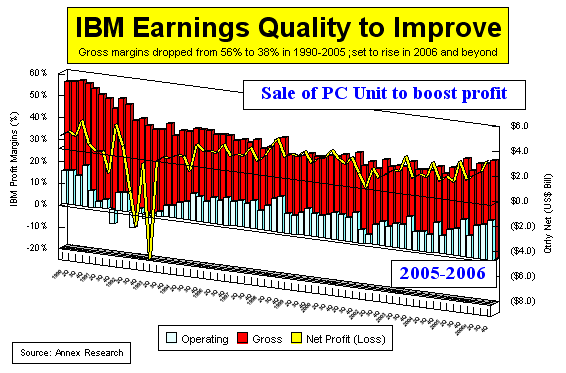
gross margins, for example, that had dropped from 56% in John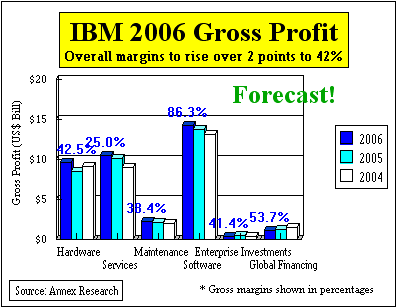 Akers' era (early 1990s) to 35% under Lou Gerstner (1999), have now moved
back up into the low 40s on Sam Palmisano's watch. And they will
continue to rise in the next several years as the benefits of IBM's
emphasis on quality spread throughout its businesses.
Akers' era (early 1990s) to 35% under Lou Gerstner (1999), have now moved
back up into the low 40s on Sam Palmisano's watch. And they will
continue to rise in the next several years as the benefits of IBM's
emphasis on quality spread throughout its businesses.
Net earnings will follow a similar pattern. In 2006, for example, we expect IBM to earn $9.9 billion, or $6.32 per share, on revenues of $91 billion, essentially flat with 2005 (see 2006-2007 P&L forecast table). This translates into a 10% net margin, the first time IBM profit margins will have returned to double digits in 21 years (they were 13.1% in 1985).
Unlike in 1985, however, when IBM earned $6.6 billion on revenues of $50 billion, the 2006 earnings will not be padded by a one-time sale of assets that boosted the company’s 1985 profits (see "Akers: The Last Emperor…Great IBM Lease Base Sale," Annex Bulletin 91-31, 6/12/91).
(An excerpt from Annex Research 2005 IBM forecast, Mar 2005)
In short, IBM is proving that "smaller is better" (also see "Break Up, IBM!," Mar 1996, on that subject).
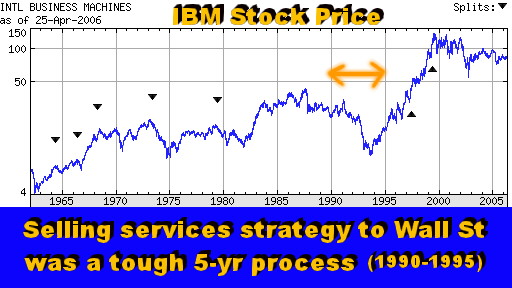
But such a concept is evidently still foreign to Wall Street's "industrial strength" minds. Which means that companies like IBM need to run a lot of marketing education for the stock market traders and investors, just as the company had to explain in the early 1990s why services was going to be such a hot future market. That selling process took almost five years before Wall Street finally "got it" (see above chart).
IBM's
yesterday's 50% boost to dividend payout is a step in the same
direction. Having had great cash flow performances in the last
several quarters, the company is letting the money doing the
talking. But the market's tepid reaction to such a big dividend hike
is proof that it will take a lot more real talking before the Wall Street
"gets it" this time. When it does, the "smaller is
better"- and "quality over quantity"-concepts will pay out
even bigger dividends in the future.
"I am convinced that the headwinds we faced as we entered this decade are now largely behind us," Palmisano told the shareholders who attended yesterday's annual meeting in Tulsa, Oklahoma. He added that the company had improved its competitive position in its core areas of hardware, software and services. "We have transformed this company from top to bottom," he said, according to a story in today's Wall Street Journal.
Contrast that with the conclusion the TheStreet.com columnist reached:
IBM is stuck at $82, and I don't expect shares to move higher anytime soon, regardless of products cycles or gross-domestic-product growth. Its announcement Tuesday that it will complete another $4 billion buyback of its shares shows that the company will continue to lower its share count to improve its EPS. That's just low-quality earnings growth any way you slice it.
While a great balance sheet and plentiful cash generation are important factors to consider when picking stocks, it doesn't necessarily qualify a stock as a good selection. On that note, the lack of investment opportunities facing IBM is a real weight on the company's stock, and I would avoid the shares until it finds a better way to spend its capital on growth initiatives.
(An excerpt from "Steer clear of incredible shrinking IBM" by William Gabrielski)

Well, wasting its money on stock buybacks is one aspect of IBM's business on which we do agree with the Street.com columnist. Since the company began doing it in 1995, it has spent $70 billion on share repurchases. Yet as you can see from the earlier stock price chart, the more money IBM spent on it, the less beneficial the practice has been to the company and its shareholders...
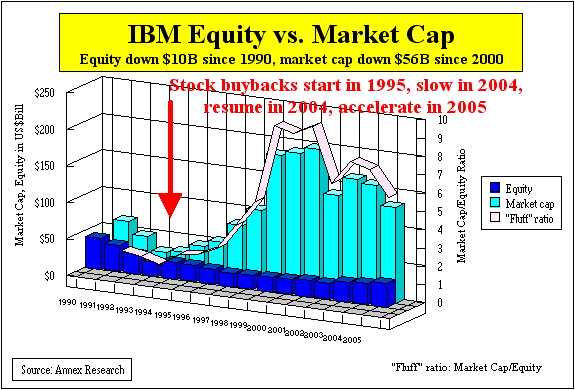
...and the more detrimental to its balance sheet (see above chart).
Meanwhile, back to the IBM P&L, after a flat 2006 performance, we expect the IBM revenues to rise 4% in 2007 to about $95 billion.
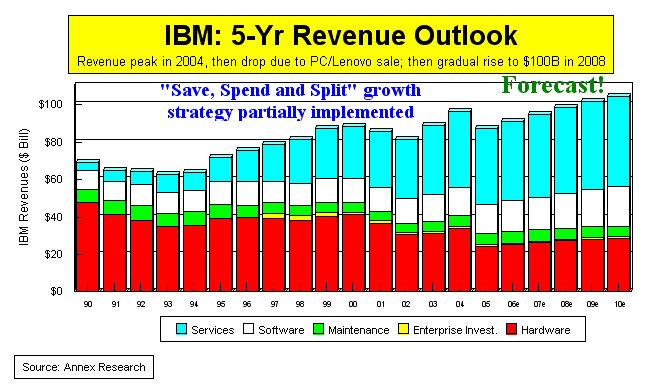
Barring any major acquisitions, w IBM revenues should rise organically at about a 3% compound annual growth rate over the next five years. We expect Big Blue to cross the $100 billion threshold at some point in late 2008 or early 2009. From there, they will continue a gradual climb to about $105 billion in 2010.
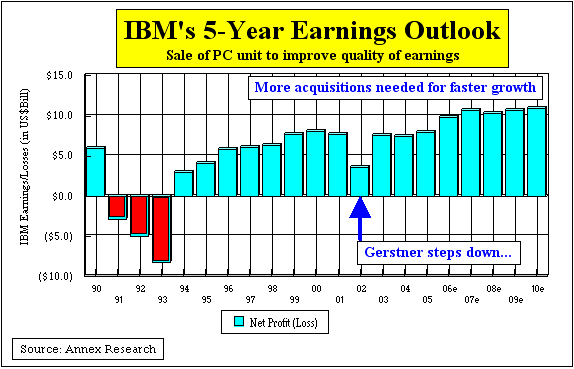
The IBM earnings can be expected to follow a similar pattern, though they will rise a little faster. We expect them to reach nearly $11 billion by 2010, for a 5.4% compound annual growth rate over the next five years. So the old seafaring captain's "steady as she goes"-adage seems an appropriate description of our outlook for IBM in the next several years.
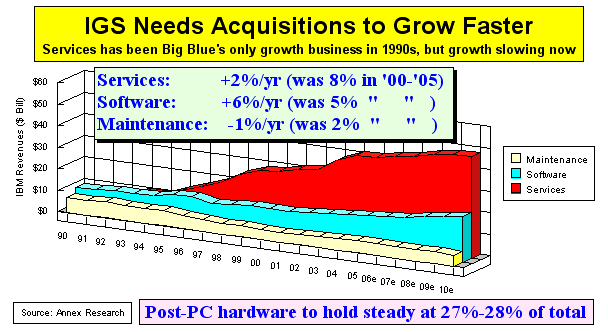
After spearheading the company's growth for the better part of the last 15 years, IBM Global Services (IGS) has become a net drag on IBM's revenues and earnings (for more details, see "Jewel Develops Patina," Apr 2006). Looking forward, we expect IGS to grow at a compound annual rate of 2% over the next five years. Looking back five years, we see that this IBM unit has grown at a compound annual rate of 8%. And even that is only a fraction of its torrid growth in the 1990s.
Furthermore,
maintenance, the most profitable part of IGS, will likely shrink at a 1% annual rate looking ahead.
IBM software, the company's most profitable operation, is expected to grow at 6% per year between 2006 and 2010. That's roughly the same growth pace as software has demonstrated in the last five years.
So by the
time all is said and done, we do not expect any dramatic changes in the
composition of IBM's business circa 2010. Hardware and software will
account for slightly less than half of the business, while services will
comprise the rest (see above pie chart). Of course, this may change
if IBM decides to spend some of its money on acquisitions instead of stock
buybacks or dividends.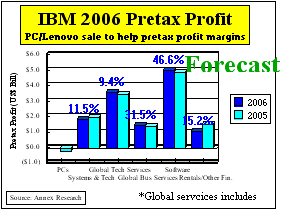
At the bottom line, however, Big Blue will be a more profitable company. In 2010, we expect its net margins to be about 11%. With exception of software companies whose business metrics are closer to the media financial statements, there are not any other computer conglomerates that can boast those kinds of prospects - now or in the future.
Just to put things in perspective, IBM's 2006 net of $9.9 billion is 90% bigger than the earnings of Fujitsu, EDS, HP, Accenture, CSC and Capgemini - combined! And even the IBM 2005 actual net was more than 50% larger.
We don't see anything "low" or shabby about the quality or size of such earnings, as the Street.com columnist suggested. We see the new Big Blue as one giant cash generating machine. Maybe Wall Street will also notice that if it keeps looking at IBM long and hard.
|
For detailed tables, click on IBM 2006-2007 P&L, IBM historical data, and IBM historical data by decades/CEOs |
Happy
bargain hunting
Bob Djurdjevic
Click here
or on the symbol
for a PDF (print) version...
Supplementary Historical Charts

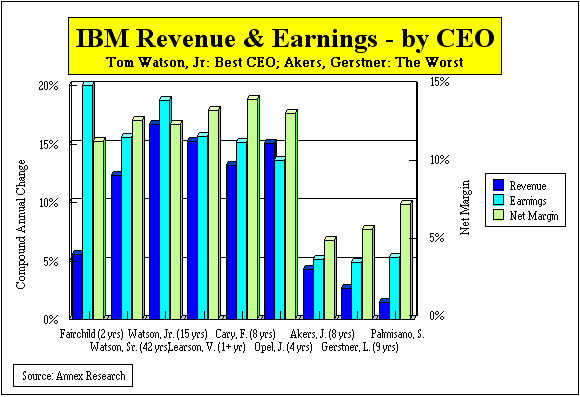

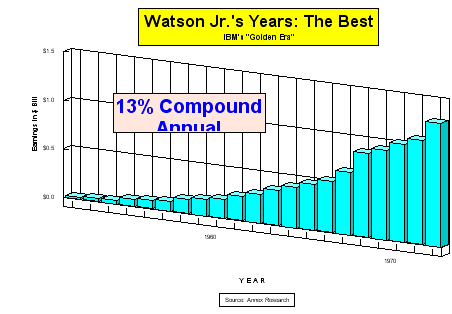
For additional Annex Research reports, check out... Annex
Bulletin Index 2006 (including all prior years' indexes) Or just click on Volume XXII, Annex Bulletin 2006-17 Bob Djurdjevic, Editor 8183 E Mountain Spring Rd, Scottsdale, Arizona 85255 The copyright-protected information contained in the ANNEX BULLETINS
and ANNEX NEWSFLASHES is part of the Comprehensive Market Service (CMS).
It is intended for the exclusive use
by those who have contracted for the entire CMS service. 
 and use "company or topic name"
keywords.
and use "company or topic name"
keywords.
April 26, 2006
(c) Copyright 2006 by Annex Research, Inc. All rights reserved.
e-mail: annex@djurdjevic.com
Tel/Fax: +1-602-824-8111

Home | Headlines | Annex Bulletins | Index 2006 | About Founder | Search | Feedback | Clips | Activism | Client quotes | Workshop | Columns | Subscribe