
IBM Partnerworld 2007 Photo Gallery & Notes
(click on thumbnails to enlarge)
St. Louis, Missouri, Day 1, Apr 30, 2007

Lowering Center of Gravity
IBM Stresses Globalization, SMB to Receptive Partner Audience
ST. LOUIS, Apr 30, 2007 - Some 4,000 IBM business partners from all over the world gathered here, at America's Gateway to the West-city, for the opening of Partnerworld 2007 on Apr 30. A three-day event was held at the Edward Jones Dome, the football stadium that is home to NFL's St. Louis Rams (see below). It was this writer's first time at a Partnerworld event. So we bring you here, also for the first time, a pictorial as well as a narrative report about it.


The Opening Act...
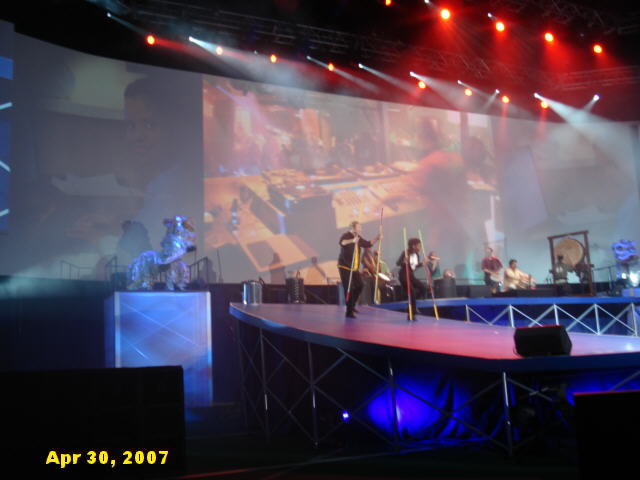
The show began with a spectacular, high-voltage dance performance by a local group. The theme was globalization and internationalism... in music and dance as in the IT industry.



The Opening Speeches...
 The
Indian-born Ravi Marvaha, IBM's top business partner management executive
(right), was a perfect choice to kick off an event whose theme was
globalization. He said that in 2006, IBM grew its revenues earned
through business partners by 11%. That's nearly three times the IBM
overall growth rate (up 4% organically, without the divested PC business,
or virtually flat as reported). He also said that 80% of the
business partners come from Asia and Europe.
The
Indian-born Ravi Marvaha, IBM's top business partner management executive
(right), was a perfect choice to kick off an event whose theme was
globalization. He said that in 2006, IBM grew its revenues earned
through business partners by 11%. That's nearly three times the IBM
overall growth rate (up 4% organically, without the divested PC business,
or virtually flat as reported). He also said that 80% of the
business partners come from Asia and Europe.
IBM now sells 55% of its hardware through the partner channel which it funds to the tune of $2.5 billion per year, Marvaha added. To put this figure in perspective, that's about 3% of IBM's revenues, or about half of the company's spending on R&D, one of Big Blue's fortes.

 Steve
Mills (left), the head of IBM software who followed Marvaha on the stage,
later said that $1 billion of that $2.5 billion total is invested in
support of ISV (Independent Software Vendors) activities. Business
partners account for about 30% share of IBM software's global revenues,
Mills said. He expects them to represent more the majority of the
business in the future.
Steve
Mills (left), the head of IBM software who followed Marvaha on the stage,
later said that $1 billion of that $2.5 billion total is invested in
support of ISV (Independent Software Vendors) activities. Business
partners account for about 30% share of IBM software's global revenues,
Mills said. He expects them to represent more the majority of the
business in the future.
Furthermore, IBM grew the services it sells through business partners by 8% in 2006, according to Marvaha.
Val Rahmani, a British-born Global Technology Services
(GTS) executive (right), said that services is
 a $350 billion global market growing at 6% per year.
As if to underscore the importance of business partners to services, she
added that GTS has 225 people in attendance at the Partnerworld.
a $350 billion global market growing at 6% per year.
As if to underscore the importance of business partners to services, she
added that GTS has 225 people in attendance at the Partnerworld.
Geographies.
Yet despite being the largest IT services company in the world, IBM's
share of the services market is only  about
10%, according to Marc Lautenbach (left), the head of IBM North America,
who formerly managed IBM's SMB business in its embryonic stage.
"That's because services accounts for the largest share of IT
spending due to it being so labor-intensive," he added.
about
10%, according to Marc Lautenbach (left), the head of IBM North America,
who formerly managed IBM's SMB business in its embryonic stage.
"That's because services accounts for the largest share of IT
spending due to it being so labor-intensive," he added.
Lautenbach also said IBM had a single digit share of SMB. Yet about 70% of IBM North America's $7 billion revenue comes from business partners.


The preceding are some of the interesting charts that backed up the presentation by IBM North America executives about their business and the SMB opportunity there. The BP (business partner) share of services here, for example, is only 4%. By contrast, the BP's share of System i revenues is over 70%.


It is interesting to contrast that with the same in Asia/Pacific, for example, especially the pie charts that show the SMB shares of the business (second charts from left above). In A/P, the SMB accounts for 87% of the total IBM hardware (STG) revenues, and the business partners contribute 72% of the total.
But there is one caveat. One has to be careful here not to mix apples and oranges, as the SMB market definitions outside the U.S. vary from country to country. Some include large enterprises, much bigger than the under 1,000-employee companies that Americans consider as SMB.
The lady in the rightmost thumbnail (above), featured in a Digital China video in the main tent, is Cordelia Chung, an IBM China executive who was an architect of the "Bluesky project" - an expansion to 85 interior cities in China.
Overall, IBM executives saw the emerging markets (Brazil, China, India, Russia...) as a $25 billion opportunity growing at 11% per year, double the worldwide IT industry growth rate, which Mills pegged at 4% to 6% per year.
High Labor Costs. The world's total IT market was $1.2 trillion, according to Mills. The top IBM software executive said that labor accounts for more than 50% of the vendor spending, and the same is true of the customers' in-house IT costs. The replacement value of the world's software is about $20 trillion, which is why "nobody can afford to do that," from a labor standpoint. So companies are modernizing their code in stages, and trying to save money through offshoring and centralization of resources.
"There is an incredible shift to high-end servers as a result of consolidations," Mills said. He then proceeded to give several examples of what he called the "pain points" customers are trying to address. Alas, some of them were large enterprise issues that are only marginally relevant, if at all, to the SMB-dominated audience assembled at the St. Louis Dome.
Which shows that, as hard as it may be trying, it is very difficult for the Big Blue leopard to change its spots. Which is why we recommended IBM create a new "Baby Blue" brand last fall (see "From Little Acorns Mighty Oaks Grow," Nov 2006), and which is what Bill Zeitler, the head of IBM hardware, did back in January (see "IBM Lowers Its Center of Gravity," Jan 2007). It remains to be seen if other lines of business join in.
A "No Name" Decade? Try "GooglePod" Era
Mills closed by noting that nobody has as yet named the
current decade the way IT people used to refer to the "PC era"
or the "client/server era" in the past. He concluded that
that was because the future will be business-driven,
not technology-driven. "The customers are in control," he
said. "I am incredibly optimistic about the future."
Actually, while nobody in corporate boardrooms may be referring to the current period with a new buzzword, this is hardly a "no name" decade. The decade is being defined by upstart companies and ideas, such as Google or Apple's iPod, for example, that are thriving in mass markets IBM has chosen not to be in. They are empowering individuals and small companies to compete with giant corporations (Google), or just enriching their lives (iPod). Back in 1994, we likened them to the invention of the handgun. In an implicit recognition of their popularity, even the IBM web site is offering "podcasts" to its visitors (click on the right icon to see it.
So how about the "GooglePod" era? It is breathing a new life into MySpace and You(r)Tube in SecondLife?
Is History Repeating Itself? All of this is kind of reminiscent of another era, 30 years ago, when IBM was missing the boat on the significance of new industry trends. As "micros" proliferated (the name the industry used back then to describe the pre-PC products), and companies like Apple thrived, IBM shunned these opportunities dismissing them as "hobbyist" market. This writer quit IBM in 1978, for example, because he got tired of fighting the corporate brass when he advocated that IBM ought to be in such developing markets. Three years later, IBM reversed itself and entered the business, creating the buzzword "PC" in the process (though we've heard some Apple executives claim that they were the first to use that term).
Here we are, 30 years later, and the same companies - Apple and IBM - are at it again. "The more things change, the more they are the same" (Alphonse Karr, 1809-1890).
Creating a Culture of Innovation
The next speaker, Sir Ken Robinson
(right), was introduced as "one of the world's greatest thinkers
 on
creativity and innovation." Liverpool-born, a former professor
of philosophy at Warwick University in Britain, lives in Los Angeles now.
on
creativity and innovation." Liverpool-born, a former professor
of philosophy at Warwick University in Britain, lives in Los Angeles now.
"We don't grow into creativity; we grow out of it," he asserted. "Somewhere on our way from childhood to adulthood, we lose it." He added that, "the creativity is the highest form of intelligence."
An eloquent and entertaining speaker, Sir Robinson offered some examples in support of his theory that our social attitudes can stifle creativity as well as encourage it.
A seven-year old girl, for example, was deemed to be a slow learner in school. The only thing she seemed to enjoy was drawing. One day, she spent a long time on a sketch, well beyond the point the rest of her classmates in an art class were finished. Seeing how focused she was on her drawing, the teacher asked her: "What are you working on?"
"I am drawing an image of God," the girl replied.
"An image of God? But nobody knows what God looks like," the teacher said.
"Well, if you wait a minute, you will found out," the girl retorted without raising her eyes from the sketch. :-)
Another example involved a famous fellow-Liverpudlian, another Briton who was bestowed a knighthood for his achievement in the field of music, Sir Paul McCartney. The two knights had a lunch before some ceremony at a local Liverpool school in their old neighborhood that they were both supporting. Sir Robinson said that the former Beatle star confided in him that when he was in school nobody ever suspected that he had any musical talents.
"Cultivating creativity is a process of encouragement, socially and culturally," Sir Robinson concluded. For, "creativity is applied imagination." And it is essential for innovation in the field of arts as well as business.
He added that IT technology development are progressing at such a rapid pace that "computers will attain our (human) intelligence in our lifetime."
If that is so, and if we take Sir Robinson's earlier assertion that creativity is the highest form of intelligence, Logic 101 would suggest that therefore, we can expect computers to become world class painters, writers, composers, business executives... and not just chess champions (as the Deep Blue supercomputer achieved 10 years ago, almost to the day).
Having a computer as a boss? A pretty scare thought, isn't it?
Exhibits & Afternoon Sessions


 The
preceding scenes from the exhibition hall and the luncheon area should
give you a good feel about the enormity of the St. Louis Convention Center
that's attached to the Edward Jones Dome. Considering that they are
both located in downtown St. Louis, which is obviously thirsting for
business judging by the number of closed stores and other rundown
buildings, IBM and its 4,000 partners were most welcome guests.
The
preceding scenes from the exhibition hall and the luncheon area should
give you a good feel about the enormity of the St. Louis Convention Center
that's attached to the Edward Jones Dome. Considering that they are
both located in downtown St. Louis, which is obviously thirsting for
business judging by the number of closed stores and other rundown
buildings, IBM and its 4,000 partners were most welcome guests.
The St. Louis Soldan High School marching band, that kicked off the proceedings after the morning session in the "main tent," was very cute. The kids took their jobs so seriously, especially that guy holding the banner.
Off to the Races with IBM Software Team
The theme of IBM Software team's Executive Forum was car racing...


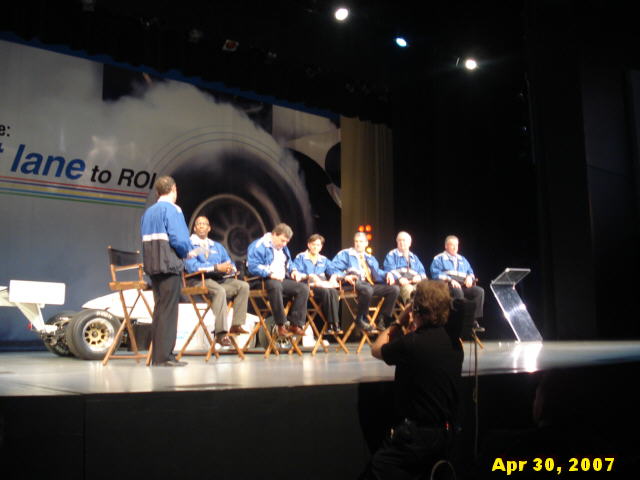
By the time all the dust and smoke had settled, the team
software executive members, led by Mike Borman, the head of global sales
and marketing, assembled on stage for short presentations and a mock-up Q&A (a mock up, because Borman was asking prescripted
questions). They even included a lady "driver" (Ilse
Cilliers, the head of IBM Northeastern Europe software business - right
thumbnail).
mock-up Q&A (a mock up, because Borman was asking prescripted
questions). They even included a lady "driver" (Ilse
Cilliers, the head of IBM Northeastern Europe software business - right
thumbnail).
Here are some interesting points that emerged from that discussion...
-
Middleware is a $90 billion market growing at 6% per year (Steve Mills)
-
IBM has acquired 66 companies since 1993, mostly to fill out its middleware portfolio
-
500,000 enterprises are potential buyers for IBM software (Mills)
-
25,000 programmers work in IBM Software division, along with 10,000 field support engineers. Together, they comprise the majority of the nearly 50,000 employees in IBM Software.
-
"Software as a Service" (SAS) is a coming new trend (Jim Corgell, vice president of software marketing channels (thumbnail below left)


The IBM Software would-be racers were followed on stage by a real racing legend - Mario Andretti (right thumbnail above). It suffice it to say that he was more of a legend before than after his long and boring speech, which he read verbatim from prepared remarks.
CLICK HERE to go to DAY 2 (May 1)...
 Click
here for PDF (print) version of Day 1
Click
here for PDF (print) version of Day 1

Home | Headlines | Annex Bulletins | Index 1993-2007 | Special Reports | About Founder | Search | Feedback | Clips | Activism | Client quotes | Speeches | Columns | Subscribe