
Annex Bulletin 2011-12 June 14, 2011
A partially OPEN edition
Recent...

Happy Birthday, IBM! (IBM to turn 100 on June 16; what's the secret of its success?)
Apple Falls from Tree to Cloud, Then to Earth... with a Thud (Last major holdout joins race to cloud, but falls flat on first attempt)
INDUSTRY TRENDS
Updated 6/14/11, 00:30AM HST
Toward a Centenary Milestone
Happy Birthday, IBM!
Big Blue to Turn 100 on June 16: What's the Secret of Its Success?
A merger of
three 19th-century companies—the Tabulating
 Machine
Company, the International Time Recording Company and the
Computing Scale Company of America—created the
Computing-Tabulating-Recording Company (CTR) on June 16, 1911.
CTR is a precursor to IBM, the name Big Blue adopted globally in
1924. IBM Canada, however, was calling itself that ever
since 1917. Machine
Company, the International Time Recording Company and the
Computing Scale Company of America—created the
Computing-Tabulating-Recording Company (CTR) on June 16, 1911.
CTR is a precursor to IBM, the name Big Blue adopted globally in
1924. IBM Canada, however, was calling itself that ever
since 1917. |
HAIKU, Maui, June
9, 2011 - One week from today, Big Blue will turn 100. One week ago ,
June Gregg turned 100. Both are Ohioans "born and bread." Both
are Gemini's. But that's where similarities end1.
While the former grew to be one of the world's largest corporations, June
led a quiet and modest life, retiring from a Post Office job 36 years ago.
She never married and has no children. IBM had 426,751 employees at
the end of 2010.
,
June Gregg turned 100. Both are Ohioans "born and bread." Both
are Gemini's. But that's where similarities end1.
While the former grew to be one of the world's largest corporations, June
led a quiet and modest life, retiring from a Post Office job 36 years ago.
She never married and has no children. IBM had 426,751 employees at
the end of 2010.

As Big Blue is getting ready to celebrate its birthday bash next week, this writer has been fielding questions from the media about the soon-to-be centenarian. The most typical of those has been "what's the secret of IBM's success?" The short answer is - IBM's ability to change, to reinvent itself. And to keep doing it over and over. The chart on the right is "a picture that's worth a thousand words." It depicts the growth in IBM revenues during the last 100 years.
Through recessions and depressions; through two world wars and dozens of other wars
and conflicts; through communism’s and fascism's rise and fall; through
capitalism’s
triumph and decline; through 17 U.S. presidents - Democratic and Republican,
through nine IBM CEOs and dozens of technological wars and revolutions - this survivor of three major government antitrust
lawsuits against it. which left Big Blue intact, came
through all those changes and challenges still thriving and prospering.
recessions and depressions; through two world wars and dozens of other wars
and conflicts; through communism’s and fascism's rise and fall; through
capitalism’s
triumph and decline; through 17 U.S. presidents - Democratic and Republican,
through nine IBM CEOs and dozens of technological wars and revolutions - this survivor of three major government antitrust
lawsuits against it. which left Big Blue intact, came
through all those changes and challenges still thriving and prospering.
Being a centenarian in business is not quite as rare as you might think. There are quite a few companies that are 100 years or older. In fact, 21,666 of them as of 2009, according to Tokyo Shoko Research2. In the U.S., household names like Crane (1801), Colgate (1806), Hartford Insurance (1810)... to mention some, are, in fact, over 200 years old. But there are none we know of that have been as successful at managing change as IBM has been.
In the last 100 years, IBM kept consistently outpacing the growth of the U.S. GDP by almost two-to-one (11% vs. 6% compound annual growth in the last 100 years). And that's a unique and remarkable record... a testimony of Big Blue's ability to change and persevere.
Some of the changes that IBM went through are well documented in business case studies about the ebbs and flows of technology and industry. Others have remained obscure. Among them are stories of hundreds of thousands of ordinary people who worked and fought for IBM in the trenches. I have unearthed some of them for this report, including this writer's personal account, never before made public.
My First Day at IBM
In the 1960s
and 1970s, IBM was a dream empl oyer.
The company's business was thriving. It
was Big Blue's Golden Era (see the chart -
right). The company treated its employees like an extended family.
Country Clubs and other employee perks and
benefits were the norm, not an exception. As a result, most of
them were "lifers," wedded to the Big Blue "from cradle to grave."
A line to join IBM in most cities was "a mile long." The
company could have a pick of the litter from almost any university or
community.
oyer.
The company's business was thriving. It
was Big Blue's Golden Era (see the chart -
right). The company treated its employees like an extended family.
Country Clubs and other employee perks and
benefits were the norm, not an exception. As a result, most of
them were "lifers," wedded to the Big Blue "from cradle to grave."
A line to join IBM in most cities was "a mile long." The
company could have a pick of the litter from almost any university or
community.
It is that kind of an IBM that this writer
joined in March 1970. Except that I had no idea about any of the
above at the time. To me, it was just a badly needed job, the first that
was offered to me. I was a new immigrant with $200 in my pocket and did
not not know another soul in North America.
So I gladly took it, even if the pay was lousy ($450 per month), I had to work three shifts, and was bored to tears as a
computer operator in an IBM data center, sorting
endless punched cards and feeding the S/370 mainframe beast (right).
per month), I had to work three shifts, and was bored to tears as a
computer operator in an IBM data center, sorting
endless punched cards and feeding the S/370 mainframe beast (right).

But I could survive on $450 per month. Barely. I did not eat much, as you can see from the 1970 photo (left) taken at the IBM Country Club. But surviving was all that mattered at the time. I knew I could make my own breaks when I got a chance. All I needed was a springboard. IBM was my springboard. And I was determined to use it to get a jump on life in the "land of the free."
So on my first day on the job, I dressed up as spiffily as I knew how. In Europe, young men would wear suits and ties for dates on weekends, and dress casually for work on weekdays. But because I wanted to leave a good first impression, I wore my best clothes. I put on a navy blue double breasted suit, a white turtle neck shirt and black shoes. I also had yellow socks, hoping nobody would notice or care.
Boy, was I ever wrong. It did not take
long for my immediate IBM manager to summon me into his office, close
the door behind us, and then proceed to tell me about the company dress
code. I had evidently violated it on at least two counts: turtle
neck shirt
and socks.

Needless to say, I never wore either to work again. But I had kept that 1970 pair of yellow socks as a souvenir for several decades. They were quite faded by the time I lost them during my move to Hawaii. And the next time I wore a white turtle neck shirt to work, I made sure I owned the company. :-) (the right photo was taken in 1978, a few months after I had left IBM to found Annex).
Oh, by the way, I also failed the so-called DPAT
test (Data Processing Aptitude Test) when I applied for an IBM job in
1970. I suppose it was mostly because my command of computer lingo in English was not good
enough yet. I did not understand half the questions.
So why did IBM give me the job? Apparently, the division manager liked me. He saw that I graduated as the top of my university engineering class, and decided to overrule the test. Not a common behavior for company men back then. But he was an uncommon man. Born and raised in South Africa, he could probably relate to someone "fresh off the boat," hungry for a job, and maybe also hungry literally. He was not wrong, as the next four decades of my work in the IT industry have shown.
In Jan 1974, not quite yet three years with the
company, I was made a manager of the unit I worked in.
Promotions that quick were pretty much unheard of, I was told. What made
it doubly challenging was that my yesterday's peers became subordinates
overnight.
 But that's how we grow... through challenges that take us out of our
comfort zones.
But that's how we grow... through challenges that take us out of our
comfort zones.

And then just as I got comfortable as a manager,
I asked for a transfer. I wanted to be a new account salesman,
pounding the pavement and knocking on doors making cold calls selling IB M's
first "PC."
M's
first "PC."
The 5100 (above left) was a back-breaking 50-pound precursor to the PC that IBM launched six years later. The 5100 came with a 60-pound printer, which I also lugged in the trunk of my car. The product lacked all sorts of bells and whistles the competition had. Yet it was the best move I ever made at IBM. Cold-calling and selling a "dud" shaved more rough edges off my ego than anything else I had done at IBM, including that first management job.
Incidentally, that IBM interview in 1970 was
my first and only job interview - EVER. I invented my next job
when I left IBM in 1978. And my every assignment since then.
But I
don't think I could have done that without the grou nding
and rounding in business and
discipline I got at IBM.
nding
and rounding in business and
discipline I got at IBM.
At one point in the 1980s, I summed up my own "Secrets to Success" in a training class I ran for my Annex employees (handwritten white board - right). They all had to do with providing top quality SERVICE to others. Which is what IBM has been doing for almost 100 years now. And that's another "secret of success" for Big Blue. Not the DPAT test grades.
The Way We Were... Antitrust Challenges
You saw from the preceding what kind of a company IBM used to be in the early 1970s. On the inside... caring, almost paternalistic toward its employees. On the outside, overbearing, even arrogant at times. What I did not realize when I joined IBM as a mere computer operator was that Big Blue was also ruthless vis-à-vis its competitors. Which is why in 1969, IBM became the target of a massive government antitrust lawsuit, the third of Washington's effort to break up the company or curtail its power (two earlier lawsuits were filed in 1932 and 1952 respectively).
The 1969 case inched forward at a snail's pace for 13 years in Judge David Edelstein's court in New York, before being dismissed by the government in Jan 1982. It happened on the same day the Washington trustbusters broke up AT&T into "Baby Bells." The IBM case, one of the most expensive antitrust lawsuits ever, was a big failure for the government. So the Justice Department try to cover it up using as a fig leaf its success in breaking up AT&T.
How did IBM manage to escape the wrath of government relatively unscathed? Simple. You know the old adage, "if you can't beat them, join them?" That's what IBM did. It stacked its Board with former government officials and prominent lawyers. When the pro-business Regan administration took over, they brought in a Stanford University law professor to head up the antitrust division of the Justice Dept. who happened to conclude that the IBM case was without merit. So he promptly dismissed it much to Judge Edelstein's chagrin.
Here's an excerpt from "Is Antitrust Dead?" (Mar 1989):
| By the time the
U.S. v. IBM trial ended, no less than eight lawyers, and ten
former government officials sat on IBM's board -- more than the
equivalent number on the boards of Bank of America, GM, Ford,
Exxon, Aetna Insurance, United Airlines, United Technologies --
COMBINED -- even though all these companies, like IBM,
are also leading American corporate giants in their respective
industries! Asked to explain the reason for this at the company's 1984 Annual Meeting in Los Angeles, IBM's then chairman, John Opel, replied "we select our directors on their ability to contribute to the business, and if it sorts out at some point subsequent to that that they're all dentists, or that they're all lawyers, it's of no consequence to me" (see ACR Jun/84 issue). Well, as the industry still awaits the first dentist to join the IBM Board ... the way things got sorted out was that, after reaching a peak of eight lawyers at the height of IBM's antitrust battles, only three lawyers still remain (Katzenbach -- now retired from IBM as general counsel, Scranton and Coleman). (from Annex Bulletin 89-17, Mar 1989) |
But some good did accrue from the antitrust case even if it failed in courts. IBM changed its behavior in the marketplace. Voluntarily.
During the 1970s, for example, and for years after the case was dismissed, the company sold its products only at the published list prices. No negotiation.
And the IBM sales reps were not allowed to disparage against competitors, either. This writer knows of several instances in which valuable salesmen were fired because they were caught disparaging a competitor in order to win a deal.
You could say that such policies made life more difficult for the IBM sales people. True enough. But it also made them more proud of the company they worked for.
The Way We Were... Morality Issues
Nowadays, we see people in leadership positions, such as
this character Anthony Weiner (Rep, NY), or Dominique Kahn (former IMF boss)
involved in moral and sexual transgressions, and still trying to carry on as
if nothing had happened. What about leadership by example? Once
upon a time, if something like that occurred
 at
IBM, it would spell the end of someone's career. And did.
at
IBM, it would spell the end of someone's career. And did.
Check out this story by Fran Donovan, a former IBM employee during the World War II years:
"...We were all properly impressed with the brilliant engineers on the staff of the IBM Engineering Department and they were so important that all of them worked under deferments. One Monday morning one of the most highly regarded engineers was seen getting off the sleeper train from New York in the company of someone who was not his wife. As valuable as he was he was gone before noon that day. And just as I had learned when Mr. Kirk died, IBM continued to function without a hitch.
Working with IBM customers brought me in contact with many fine people and I still treasure the happy memories of those years. In 1947 as I was planning to be married, I was informed that IBM did not employ married women so my job would stop on that date. During the war that rule had not been enforced but as soon as the war ended it was again part of the IBM program.
Today that surprises many people but way back then it was just understood that a company could operate that way with no threat of being taken to court. Within two months of being married they contacted me to see if I would consider taking on some work but since I had moved away I really was not interested and soon that restriction was removed from their hiring practices."
(from
It's IBM's 100th: Share your memories and pictures of IBM Corp).
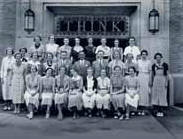
Different strokes
for different folks? Backward at times, from today's perspective.
Maybe. But in many ways, IBM was also a progressive company in its
time. 
In 1935, for example, during the post-Depression era, IBM started to train and hire women into its work force.
[Left photo: first class of women service professionals, 1935]
By 1943, IBM had its first female vice president.
And in 1946, 18 years before the "Civil Rights Act of 1964," IBM hired its first black sales rep. T.J. Laster (right) became the forerunner of the "dream" Martin Luther King talked about in the 1960s.
The Era of Greed: Also, Worst Business Performance
But IBM started to lose its moral compass during the Akers'
and Gerstner's reigns,  especially
the latter, the "Era of Greed," as this writer called it contemporaneously.
It was also the time of IBM's worst business performances. The company
almost went into the tank in the early 1990s.
especially
the latter, the "Era of Greed," as this writer called it contemporaneously.
It was also the time of IBM's worst business performances. The company
almost went into the tank in the early 1990s.
I've never heard of anyone teaching a course in esteemed MBA
schools on the inverse correlation between morality and greed, but the left
chart makes that case in spades and colors. When IBM failed during the
100 years of its existence, it did so for two reasons:

The first was Complacency. That nearly destroyed IBM's highly profitable mainframe business in the 1990s (the left part of the chart on the right).
The second was Greed. That's the seed that Lou Gerstner implanted into the heretofore pristine IBM culture. It was that seed from which the weed, like Bob Moffat, sprouted out, for example. Here's an excerpt from the Triple Trouble Hits Armonk (Oct 2009):
"Being lily white and pure as mountain spring water was ingrained as part of the Big Blue culture. No longer. Not after what Bob Moffat, senior IBM vice president in charge of all of company's hardware, has been accused (and subsequently convicted, 6/10/11) of doing - passing proprietary company information to his Wall Street co-conspirators for personal gains.
[...]
All that changed when Lou Gerstner took over in 1993. Massive layoffs ensued, showing his "disrespect for the individual." Nothing of the kind had ever happened before. Gerstner also allowed senior IBM executives to profit from their stock options. "Greed is good," became IBM's new philosophy.
[...]
They say you reap what you sow. Gerstner planted the seed of greed at Armonk. And it grew out of control in Moffat's case. What this IBM executive has alleged done is simply an unlawful extension of the "anything goes" greed-driven era the former IBM chairman had brought to Armonk.

As IBM has done throughout its 100 years history, after suffering a black eye in the Moffat scandal - Big Blue changed. It went back to the past and to its roots to define its future. And the result was once again the emphasis on quality and service.
IBM Outlook
Here's what we said about IBM's outlook in our five-year forecast update back in April (also click here for detailed tables and charts):
"... we expect Big Blue to grow its revenues at about 4% compounded annually between 2010 and 2015, while its earnings should rise 5% compounded
annually. But IBM could accelerate these growth by cranking up acquisitions. So far, the company has fingered about $20 billion for it between now and 2015, while "reserving" about $50 billion for stock buybacks. If these figures were reversed, or at least brought closer into balance, IBM would have a much better chance of making its 2015 forecast of "at least $20 (operating) EPS."
Either way, the company is poised for a ride up the market cap slope."
(From "Wall Street's New "Rock of Gibraltar" ," Apr 2011).

Which is exactly what the IBM stock had done, before being
taking down
 along
with everybody else in the last few weeks in an ebbing overall market.
Yet even in retreat, Big Blue has beaten the market which it has led upward
most of this year. It is more than a bit profound that in its
centenary year, IBM, and not Google or Apple, should become once again a
bellwether IT stock (right chart).
along
with everybody else in the last few weeks in an ebbing overall market.
Yet even in retreat, Big Blue has beaten the market which it has led upward
most of this year. It is more than a bit profound that in its
centenary year, IBM, and not Google or Apple, should become once again a
bellwether IT stock (right chart).
Here's another excerpt from our five-year IBM forecast:
[...] The pattern we are seeing here is that of a company that's not seeking growth for the sake of growth. It is that of a company whose goal is quality earnings growth. It is the growth that only happens when earnings and margins rates of increase exceed that of the bulk of the business - revenues.
That's what we were trying to get the former IBM chairman, Lou Gerstner, to understand back in 1996 (see Break Up IBM!, Mar 1996 and Louis XIX of Armonk, Aug 1996). We were not successful. But his successor "got it." Sam Palmisano showed the first spark of it in public during an analyst meeting in Bangalore, India, in June 2006 (see IBM vs. HP: A Tale of Two Blues). Here's the chart that "said it all" back then about the new Big Blue.
Ever since, we have been seeing confirmations of this strategy, and the financial benefits that accrued to IBM shareholders from it. Just as important, especially from Wall Street's point of view, the new strategy has brought stability back to IBM results. "Steady, as she goes" was not chosen randomly as the theme of this analysis and forecast.

|
Click here for detailed IBM forecast tables and charts (Annex clients only) |
Bob Djurdjevic
NOTE 1:
There is actually another remarkable curiosity about June Gregg ,
the Ohio centenarian, and IBM. Take a look at the photo on the
right, taken on her birthday a week ago. The former IBM chairman Frank
Cary looks like it could be June's younger brother. Cary was born in
1920 and died in 2006 (see
Frank Cary
Dies). His photo was taken in the early1980s when he was
in his early 60s. But he was born in Idaho and raised in California. So
their look-alike appearance is probably just an interesting coincidence.
,
the Ohio centenarian, and IBM. Take a look at the photo on the
right, taken on her birthday a week ago. The former IBM chairman Frank
Cary looks like it could be June's younger brother. Cary was born in
1920 and died in 2006 (see
Frank Cary
Dies). His photo was taken in the early1980s when he was
in his early 60s. But he was born in Idaho and raised in California. So
their look-alike appearance is probably just an interesting coincidence.
NOTE 2: According to the Bank of Korea, there are 3,146 firms founded over 200 years ago in Japan, 837 in Germany, 222 in the Netherlands and 196 in France. There are seven companies in Japan over 1,000 years old. About 89% of the companies with over 100 years of history are businesses employing fewer than 300 people.

Or just click on SEARCH and use "company or topic name" keywords.
Volume XXVI, Annex Bulletin 2011-12 Bob Djurdjevic, Editor
(c) Copyright 2011 by Annex Research,
Inc. All rights reserved. |
Home | Headlines | Annex Bulletins | Index 1993-2011 | Special Reports | About Founder | Search | Feedback | Clips | Activism | Client quotes | Speeches | Columns | Subscribe
Annex's 33rd Birthday (May 15, 2011)
Big Blue "Rock of Gibraltar" Stands (Analysis of IBM's first quarter business results)
Wall Street's New "Rock of Gibraltar" (Annual update to our 5-yr IBM forecast)
HP: Ghost of EDS Haunts HP (Analysis of HP's first quarter 2011 business results)
Case Makes a Case for Innovation (Analysis of new "Startup America" program)
HP: New Broom Sweeps Clean (Apotheker fills our first prescription in board shake-up)
IBM: Another Phoenix of the IT Industry , Analysis of IBM's 4Q10 result
One Man's Pain, Another Man's Gain? (Analysis of possible impact of Steve Jobs' health on IBM, Intel, other IT companies)
Consumer Rules (Analysis of top 15 global IT leaders' stock and business performances)
IBM Hardware to Rise and Shine Again (Analysis of IBM STG business results and outlook)
BARRON's: IBM Shareholders Will Like New Year (Analysis of Barron's article on IBM stock)
HP's "Stealth CEO" Sounds Bullish in First Public Appearance (Analysis of HP's fourth quarter business results)
Silicon Valley Rodeo (Editorial on shenanigans and costly trivial pursuits)
IBM Business Up, Stock Down (Analysis of Big Blue's third quarter business results)