

Home |
Headlines | Annex Bulletins
| Index 2004 | About
Founder | Search | Feedback
| Clips | Activism
| Client quotes | Workshop | Columns
| Subscribe 
The copyright-protected information contained in the ANNEX BULLETINS and ANNEX NEWSFLASHES is part of the Comprehensive Market Service (CMS). It is intended for the exclusive use by those who have contracted for the entire CMS service.
An OPEN Client Edition
IBM FINANCIAL
Analysis of IBM Second Quarter Business
Results
“Old World”
Renaissance?
zSeries Growth Lifts Hope, But Mainframe “Recovery” May Be Short-lived
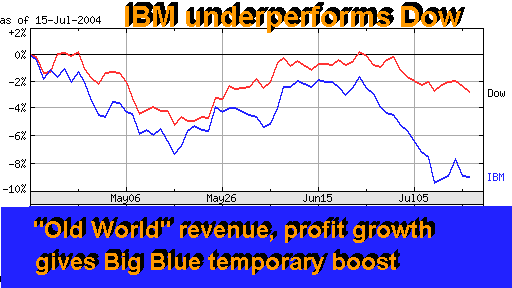
PHOENIX, July 16 – If someone told you that railroads and ocean liners are back in vogue on Wall Street, would you jump up and down for joy and invest in them? If not, then you may be one of the few investors who are not susceptible to IBM’s hype. The Big Blue stock got a boost this morning from its second quarter report – read, from its “old world” revenues and profit growth.
It was the zSeries, the modern-day name for
the 40-year old mainframes, that again provided the biggest boost to IBM
in the latest period. Its 44%
growth helped push IBM’s second quarter revenues above Wall Street’s
expectations - to $23.2 billion, up 7% as reported, up 4% in constant
currency.
IBM hardware was certainly the biggest upside
surprise in the quarter. Their
revenues surged by 12% to $7.4 billion, the second quarter of double-digit
growth in a row. By contrast, IBM’s “new world” growth engine - IBM
Global Services (IGS) - had a lackluster quarter. It produced only a 2%
growth in constant currency, while its new contract sales and backlog
declined.
Meanwhile, IBM software results, a downside
surprise, were “disappointing” even in the words of the company’s
smooth new CFO, Mark Loughridge. Revenues
declined 4% in constant currency. Yet
software still managed to drop a 28% pretax margin to the IBM bottom line.
IBM’s net profit from continuing operations
was up 15% to $2 billion - a strong performance by any measure, especially
in light of the disappointing recent results of some of Big Blue’s
rivals (e.g., Unisys). So all seems well at Armonk.
But the question is… how long will the
“old world” bonanza last?
The answer… until the customers overhaul
their creaky tracks and rusty engine rooms (continuing our opening
railroad and ocean liners metaphor).
Mainframes have been the engine of the IBM
growth in the last two quarters. Their
resurgence is largely due to replacements of older technology with new
models. So being bullish
about IBM’s long-term prospects at this point in time is like cheering a
replacement parts manufacturer in the rust belt.
Eventually, the job will be done, and the customers will return to
the “same old, same old”… What IBM will do for growth then - is the
$64 million-question. Alas, no one asked it last night during IBM’s
teleconference with analysts.
Will
Big Blue go back to its “new world” growth engine – IBM Global
Services? If so, get ready for a sputtering ride… For, a question that
no analyst asked was, “what’s wrong with IGS?”
There seems to be much to worry about, and plenty that IBM’s new
CFO so skillfully swept under the rug…
Services’ Growth Woes
Take the backlog, for example. Answering an analyst question, Loughridge said that IGS backlog was up $6 billion since a year ago. True enough. What he didn’t say, however, is far more relevant… It was down $2 billion since three months ago! Why?
Again, no one asked that question, letting the
IBM CFO off the hook. But we
suspect that something is seriously broken in this erstwhile IBM growth
engine. We think that the
main cog in its wheels is “rescoping,” a term the former IBM CFO, John
Joyce, now the head of IGS, coined two years ago (see “Ban
IBM Hoarse Whisperers,” July 2002).
IGS is losing more business than it is winning. That’s why its backlog has shrunk. That’s what’s worrisome about IGS’ future.

In
the latest period, IBM signed $10.6 billion in new contracts, down 1% from
a year ago. Which means that
it lost $13 billion from its backlog in the quarter. That’s
higher than the $12 billion per quarter average losses in 2004 and 2003,
and much higher than $11 billion average in 2002, the $9 billion
average in 2001, or the $7 billion average in 2000 (see the chart on page
2).
And that suggests that the spread of the
“rescoping” malaise is accelerating, not subsiding, as Loughridge
hinted at one stage during the teleconference, echoing the IBM CEO, Sam
Palmisano (from May 2003).
A 7% decline in new contract sales in the
first six months of 2004 exacerbates the “rescoping” problem.
As long as a company sells more than it loses, its backlog rises,
and everybody is happy. But that’s not the case at IGS.
Not anymore.
Since 1999, IGS has sold $235 billion-worth of new contracts. Yet, it’s backlog increased by only $58 billion. Which means that $177 billion went into a “black hole” comprised of “rescoping,” cancellations and expirations.
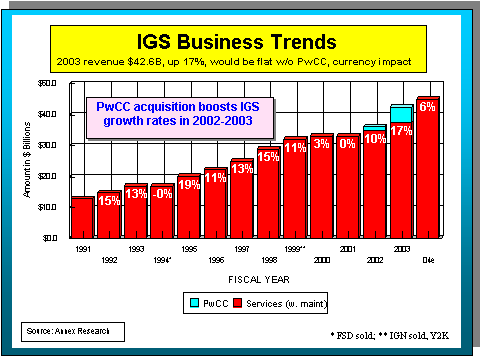
No wonder the IGS revenues grew by only 2% in
the quarter, and would have been pretty well flat-lining in the last three
years, had it not been for the PwCC acquisition (in 2002), and the foreign
exchange boost.
Software Growth Stalls
IBM software is the company’s most
profitable business segment, with gross margins in excess of 86%, and
pretax margins around 22%. In
the last 3-4 years, it has also been a growing business.
That ended in the second quarter.
Software revenues were down 4% in constant currency.
Now, that’s not the end of the world,
especially as the latest software gross margins actually slightly improved
to (86.3%), while its pretax margins shot up to 28%.
Yet uncharacteristically, IBM termed the results
“disappointing,” and blamed “numerous transaction deferrals” for
it.
That sounds like a strange explanation,
especially considering the strong mainframe sales (over two-thirds of IBM
software is mainframe-based), and the fact that software license fees are
like an annuity (revenues are earned over time).
The only way IBM mainframes revenues and MIPS
could be up 44% and 75% respectively, while the related software revenues
decline 4%, is if
there is no increase in the number of mainframe footprints! In fact, the software decline hints at a probable decrease
in the number of mainframes installed - a result of customer data center
consolidation projects that IGS and other IT services vendors have been
spearheading.
In short, the IBM software decline at a time
of booming mainframe sales only serves to confirm the temporary nature
of such a “recovery.”
Other Business Segments
“And then there were six Indians,” a
nursery rhyme counts down the number of Indians.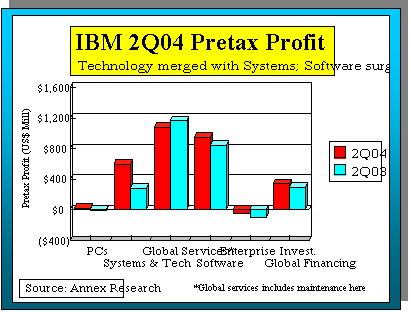
How do you deal with a money losing business?
You sweep it under the rug. In
IBM’s case, the money-losing Technology unit has disappeared from the
charts, having been merged with the now increasingly profitable Systems
group in the latest IBM release.
As a result, the new Systems & Technology
segment grew its revenues by 10%, while increasing its pretax profit by
111%. Bingo! The problem unit disappears from the public view.
Now, that’s investor relations marketing/management…
perceptions over facts.
As for IBM’s PC unit, another perennial
money loser, it managed to eke out a meager profit ($27 million) on
revenues of $3.2 billion in the latest quarter.
Nothing to write home about, especially compared to the profits
Dell, for example, makes on PCs. But
it beats bleeding “red ink.”
Summary
IBM’s new CFO, Mark Loughridge, delivered a
flawless performance in his first “on stage” appearance on behalf of
Big Blue. He was as smooth as
silk. Whenever he addressed a
problem area, it was something that other competitors were also
experiencing. Whenever he
talked about an IBM strength, Big Blue was the only vendor doing so well.
The Wall Street analysts lapped it up, judging by their tepid
questions.
Loughridge’s pep talk about IBM’s growth
initiatives was a case in point. He
highlighted Business Process Transformation Services and the Emerging
Countries as two areas that would supposedly help IBM grow in the future.
He said the first one has grown 40% per year, while the second one
amounted to a 35% annual surge.
Sounds impressive… but only for the
uninitiated. For, the some
total of the first initiative is represents only 3.1% of IBM revenues,
while the second one amounts to only 4.2% of the total.
So Loughridge would
have us believe
that a fast growth in a 7.4% segment of its business would countervail the
flat or declining trends in the remaining 92.6% of the total?
Hm… Maybe on Wall Street such math would work, but not where common sense prevails.
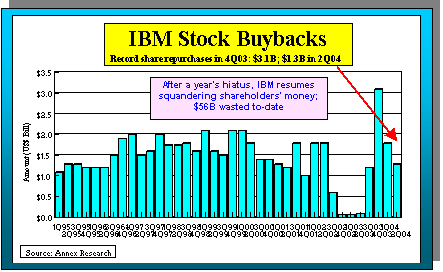
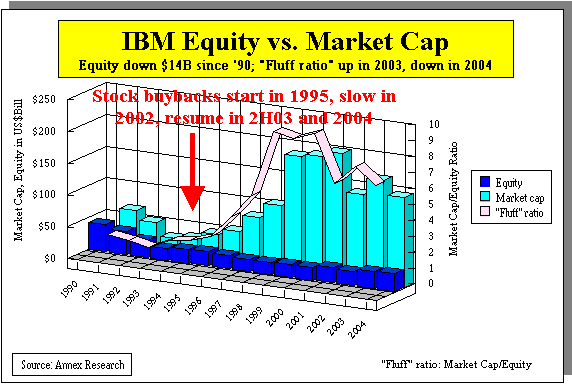
In summary, IBM’s second quarter was a very good period for Big Blue. Unfortunately, it was largely driven by a temporary resurgence in an “old world” business. When that trend blows itself out, which may well happen before the end of the year, IBM will probably return to its old anemic growth, coupled with occasional declines. Unless the company quits wasting money on stock buybacks, and adopts our “save, spend and split” recommendation, 2005 may be the first of such declining years.
Happy bargain hunting!
Bob Djurdjevic

For additional Annex Research reports, check out...
2004:
Moody's Lowers the Boon on EDS (July 2004); HP: Delivering Value Horizontally (Jun 2004); Accenture: Revving Up a Notch (Jun 2004); Beware Your CFO! (May 2004); IBM: Changing of the Guard (May 2004); Capgemini: Texas-size Home Run (May 2004); Following the Money (May 2004); EDS: On a Wink and a Prayer (Apr 2004); HPS Wins by a Nose! (Octathlon 2004); Going Retro with Mainframes (Apr 8); IBM: Five-year Forecast (Apr 8); Mainframe at 40! (Apr 2); Accenture: Burning the Track (Mar 2004); "Crown Jewel" Restored? (Mar 2004); "Cap Gemini: Another, Smaller Loss" (Feb 2004); "CSC: Good Quarter Gets Boos" (Feb 2004); "Hot Air Jordan" Flaunts Flop as Feat (Feb 2004); "Cronyism Is Alive and Well at EDS" (Jan 2004); "Five Most and Least Likely Forecasts for 2004" (Jan 2004)2003 IGS: "IBM OnDemand: Different Strokes for Different Folks" (Dec 2003); "Investing in Growth" (Apr 2003)
2003 IBM: "IBM vs. HP: Spinning Global Server Market Shares" (Nov 2003); "Finally Heard, Part II," (Nov 2003), “Small Is Now Big at Big Blue” (Oct 16), “On the Nose But No Cigar” (July 16), “A Paler Shade of Blue” (June 2), “Save, Spend and Split” (May 8), “Shrunk by the Marketplace” (Apr 17), “Turnaround Continues...” (Apr 15), "Finally Heard!" (Jan 29), “Start of a Real Turnaround?” (Jan 17).
2002 IGS: "Half or Double Trouble?" (Aug. 12, 2002), "IBM to Take $500M Charge" (Sep 3, 2002), IBM-PwCC Update (Oct 2, 2002), Analysis of IBM Second Quarter Results (July 17, 2002), IBM Layoffs Confirmed! (Aug 14, 2002), Analysis of IBM Third Quarter Results (Oct 16, 2002), Boom Amid Gloom and Doom (Oct 10, 2002)
2002 IBM: “Gerstner: The Untold Story” (Dec 27), "Gerstner Spills the Beans" (Dec 13), "On a Wing and a Prayer" (Oct 21), "IBM-PwC Tie the Knot" (Oct 2), Big Blue Salami (June 19), "Looming IBM Layoffs" (May 14), "IBM 5-Yr Forecast: From Here to Eternity?" (Apr 2002), “Tough Times, Soft Deals,” (Apr 25, 2002), “Gerstner’s Legacy: Good Manager, Poor Entrepreneur” (Jan 2002), IBM Pension Plan Vapors: Where Did $17 Billion Go? (Mar 2002), "Sir Lou OutLayed Lay!" (Apr 1, 2002).
A selection from prior years: Is IBM Cheating on Taxes, Annex Bulletin 99-17 (May 1999), IBM 5-year Forecast 2001: An Unenviable Legacy (June 2001), "Break Up IBM!" (Mar. 1996), Fortune on IBM (June 15, 2000), “Smoke and Mirrors Galore,” July 2000), "Slam Dunk of Bunk" (Jan 2000), Annex Bulletin 98-14 ("Wag the Big Blue Dog"), Armonk's Fudge Factory (Apr. 9, 1999), Where Armonk Meets Wall Street, Greed Breeds Incest (November 1998), Stock Buybacks Questioned: Is IBM Mortgaging Its Future Again?, 97-18 (4/29/97), "Some Insiders Cashed In On IBM Stock's Rise, Buybacks" 97-22, 7/27/97, Djurdjevic’s Forbes column, "Is Big Blue Back?," 6/10/97; “Executive Suite: How Sweet!,” (July 1997), "Gerstner: Best Years Are Behind", Aug. 10, 1999), "IBM's Best Years Are 3-4 Decades Behind Us" (July 1999), "Lou's Lair vs. Bill's Loft" (June 1999), "Corporate Cabbage Patch Dolls," 98-39, 10/31/98; Djurdjevic’s Chronicles magazine October 1998 column, "Wall Street Boom; Main Street Doom", “Louis XIX of Armonk,” (Aug. 1996), "Mountain Shook, Mouse Was Born" (Mar. 25, 1994), “A Nice Guy Who Lost His Compass” (Jan 26, 1993), “Akers: The Last Emperor?” June 1991), Industry Stratification Trend (Mar. 30, 1990), etc.]
Or just click on  and use appropriate
keywords.
and use appropriate
keywords.
Volume XX, Annex Bulletin 2004-15 Bob Djurdjevic, Editor 4440 E Camelback Rd #29, Phoenix, Arizona 85018 |
Home | Headlines | Annex Bulletins | Index 2004 | About Founder | Search | Feedback | Clips | Activism | Client quotes | Workshop | Columns | Subscribe