
Annex Bulletin 2005-18 August 18, 2005
Confidential
Client Edition
SOFTWARE TRENDS
Analysis
of Oracle’s FY05 Business Results
Bigger Is Better?
“Size Matters” Says Oracle “Prez;” But Will IBM Try to Break the Gridlock?
PHOENIX, Aug 18 – “Bigger is better” seems to be
the message emanating from Oracle’s acquisitive strategy.
“Size matters,” underlined Charles Phillips, Oracle’s
president, in his August 11 address to a CIBC (bank) conference in New York.
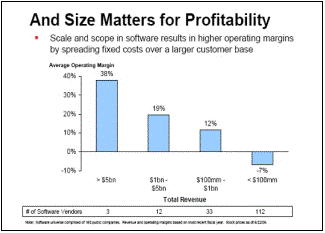
Phillips even put it on a chart that compared Oracle with 25 top
software vendors (see the chart). And
he reiterated the same point on profitability: “four largest software
vendors have grown faster and account for larger share of total revenue.”
August 11 address to a CIBC (bank) conference in New York.
Phillips even put it on a chart that compared Oracle with 25 top
software vendors (see the chart). And
he reiterated the same point on profitability: “four largest software
vendors have grown faster and account for larger share of total revenue.”
Yet everything about Oracle’s product and corporate strategy points the other way. In an October 2003 speech, for example, the company’s flamboyant CEO Larry Ellison spoofed both Microsoft and IBM for embracing bigness in computing and reviving the mainframe. The industry had gone through “40 years of building bigger and bigger mainframes,” he said, recalling his start in the Silicon Valley business at Amdahl in the early 1970s.
“Forty years after that race began, Microsoft gets into the race” (by inventing the ‘Windows Mainframe’ – the 64 processor MS SQL server), Ellison chastised his big competitor. Then he went on to mock it.
“It seems peculiar that 40 years into a race someone would join (it) in the middle. I have an explanation for this… I think what happened was, Bill (Gates) sent a team of people out to IBM to try to figure out what was new; where was IBM going… what was the newest, latest, hottest technology coming out of that great company IBM.”
“And what happened was, somehow the Microsoft intelligence gathering team held their Yahoo map upside down, and instead of making a left turn into the IBM research, they made a right turn into the IBM museum…”
Laughter in the audience.
“… and gathered all this information about IBM mainframes.”
Then they dashed back to Seattle and explained to Bill that this was the latest thing from IBM, Ellison surmised.
“I don’t know how else to explain it,” he summed it up to more laughter from the crowd.
End of set up. Then came the kill.
Ellison went on to plug his latest oracle. Which is that grid would supersede mainframes.
Why? As an The Oracle TV ad puts it, “the Oracle grid: runs faster, costs less and never breaks.” (Any similarity with classic Miller Lite commercial “Tastes Great – Less Filling” is, of course, coincidental). J
Ellison then marshaled in the proof of his oracle.
FASTER… Grid computing offers a 30-to-1 price/performance advantage over the mainframe solution, Ellison alleged. But the mainframe is slower, he said, citing “a neighbor down the street” from Oracle as a case in point.
“Don’t try this on a
mainframe,” he said of the Electronic Arts’ gaming application that has
100,000 to 150,000 concurrent users and generates 30,000 SQL (inquiry) calls
per second. “It won’t run” (on a mainframe - see the chart).

“With the grid, you just plug in another low-cost two processor, or four processor-Intel machine into the grid,” and off you go.
“After 40 years, we can stop building bigger and faster machines,” he summed it up.
COSTS LESS… The grid system is made up of inexpensive PC components. It costs $2,400 per Intel processor vs. $46,000 per processor on an IBM mainframe.
NEVER BREAKS… “The system is absolutely tolerant if some of its components fail,” he added. “It just keeps running.” And it will run all customer applications – SAP, Siebel, Oracle, PeopleSoft, etc.
CLOSE… In short, the grid computing offers “ten times more capacity and one-tenth of the price.”
Over to IBM…
IBM
Silent on Gridlock
Well, Big Blue wasn’t
there to defend itself. But
that was two years ago. Marketing
silence has continued. No
Oracle gridlock rebuttal pitch was evident at IBM’s recent z9
mainframe announcement, either (see “IBM:
Polaris Eclipses T-Rex,” July 2005).
Maybe Big Blue felt it didn’t have to.
Its virtualization approach does the same thing with more flexibility
and at lower cost (also see “Poughkeepsie
Spring”, May 2005).
But IBM didn’t say it.
We did. And customers
need to hear these things. Over
and over again. Or else the
gridlock of clashing computing concepts will continue.
Simplicity and repetition are cornerstones of good marketing messages. Oracle’s achieved that very well: “the Oracle grid: runs faster, costs less and never breaks.”
Over to IBM… Again. Its three main z9 marketing tenets - “virtualize everything, commit to openness, collaborate to innovate” – are nice. But maybe using “breaking the gridlock” as a theme may not be a bad starting point toward a simpler, punchier message.
Meanwhile, Michael Dell, Dell’s CEO and founder, seconded Ellison’s view at the Oracle OpenWorld 2004 by saying, “the enterprise data center is in transition from big iron to scalable enterprise.”
So there you have it. Sounds like a slam-dunk of Intel-based PCs vs. IBM mainframes. But it isn’t. For, great scalability is one of the strengths the new IBM z9 servers offer.
No wonder the marketplace showed its ambivalence. Both Oracle and IBM have been doing well, as has Dell. Oracle at what it does best – developing and selling enterprise-type software; IBM - building and selling the world’s best servers; and Dell – growing its PC business like clockwork at double-digit rates, quarter after quarter.
So each to his own. At least for now there is no shortage of choices or of competing solutions for enterprise-class customers.
Will a preferred solution eventually emerge? Time will tell. Aggressiveness and quality of marketing will determine that. For now, the “clash of the titans” in corporate data centers – PC vs. Mainframe – seems to be a tied score.
Great
Year
The
clash of computing concepts notwithstanding, and despite a protracted
(18-month) vicious takeover battle with PeopleSoft, Oracle gobbled up its
biggest prey in its 2005 fiscal year without much of a scratch on its
financials. To be sure,
operating margins took about a five-point hit due to the acquisition-related
expenses and charges. But at
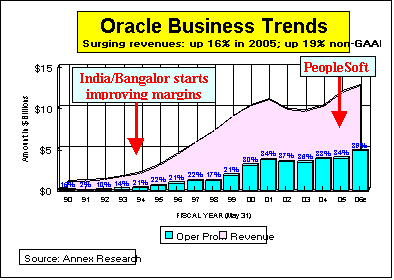
34%, they are still the envy of the IT world, as are its net earnings
margins at 24.5% (30% non-GAAP).

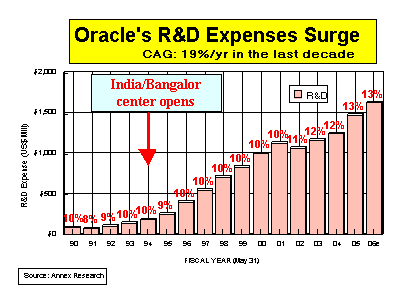
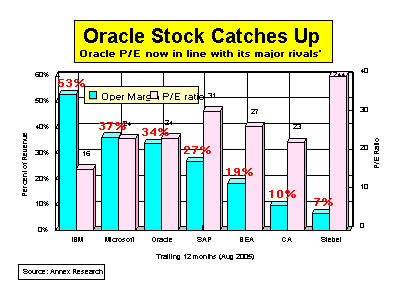
Nevertheless, the 34% operating margin did drop Oracle from second to third place among the world’s top software companies (see the chart). We expect it to bounce back to about 39% in the current fiscal year, and to the second place in the industry, barring any more PeopleSoft-type adventures. And that’s despite a continued aggressive investments in R&D. They have grown at 19% compounded annually during the last decade, and now represent about 13% of revenues.
As
for Oracle’s revenues, they got a shot in the arm from the PeopleSoft
acquisition, jumping 16% to $11.8 billion in the latest fiscal year (ended
May 31). On a “non-GAAP”
basis (read apples-to-apples), the revenues growth was even higher (up 19%
to $12.1 billion).
“The rapid integration of PeopleSoft into our business contributed to the strong growth in both application sales and profits,” said Oracle’s president Safra Catz in a release that accompanied the FY05 earnings report (Oracle has two presidents).
Indeed,
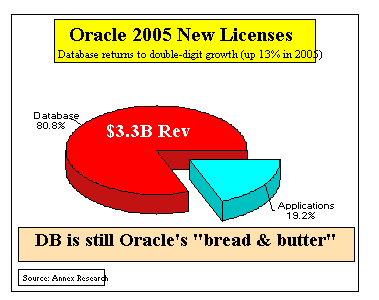
the application sales of new licenses soared by 28% for the year, while
database product revenues increased by 13%.
But the database is still the bread and butter of Oracles’
business, accounting for 81% of total new license revenues (see the chart).
The
“i” Surprise
There
was one part of PeopleSoft’s business that seemed to surprise Oracle.
It was its IBM iSeries application software unit that PeopleSoft
acquired when it bought J.D. Edwards in May 2004.
With over 6,000 accounts, PeopleSoft is IBM’s largest ISV
(Independent Software Vendor). Which
gives Oracle a foot in the SMB market (see “An
iSeries Revival,
Mar 2005).
“Oracle
had no idea what they got with it when they bought PeopleSoft,” said one
industry executive close to the situation.
“So at first they tried to market the iSeries business under their
own label, then changed their minds and re-branded it back to J.D.
Edwards.”
Now
the executive who came to PeopleSoft from J.D. Edwards to run this division
is again in charge of marketing the iSeries applications for Oracle.
His name is John Schiff. We
interviewed him last winter during our research for the above iSeries
whitepaper.
“If
you look at just the hardware prices, that (IBM/iSeries advantage) is not
necessarily apparent,” he told us. “You must look deeper to see the
beauty of the iSeries.”
Schiff
added that, “new customers do not fully understand the cost of (a lack of)
reliability on long term projects. I have (iSeries) customers who tell me
they haven’t had a failure in years.
And that’s something that’s not exactly commonplace
in the IT world.”
So
Oracle’s “costs less” and “never breaks” grid claims also seem to
apply to IBM servers like the iSeries or the mainframe.
As for “runs faster”…Schiff also unwittingly rebutted Dell’s
and Ellison’s claims regarding scalability and server speed/throughput.
“…If
you look at the very high volumes of transactions, these (mainframes and iSeries) are the only platforms that have the scalability and the
reliability to do that,” he opined.
And
Schiff should know what he is talking about.
Not just because he now works for Oracle.
But because PeopleSoft, like Oracle, also offered software solutions
that ran on AIX (Unix), Linux, NT,
Oracle, IBM DB2, Sequel… and other systems.
In other words, it covered the gamut of the software landscape.
Bottom
line, however, has been the iSeries acceptance in the market place.
After a dismal 2004 while IBM retooled its marketing, the iSeries has
returned to double-digit growth in the second quarter.
And that, more than any rhetoric, seems to be the proof that it also
“runs faster, costs less and never breaks.”
It
is the ultimate irony that all these positive iSeries attributes are now
working in Oracle/Ellison’s favor.
Outlook
In our year-ago review of Oracle’s 2004 results, we noted that its stock seemed undervalued relative to its rivals (see “Unbreakable Spirit,” Aug 2004). After about a 40% rise of its share prices, Oracle has outperformed not the broader market (S&P) but also its main industry rivals (SAP, Microsoft). And it did it by several-fold (see the chart).
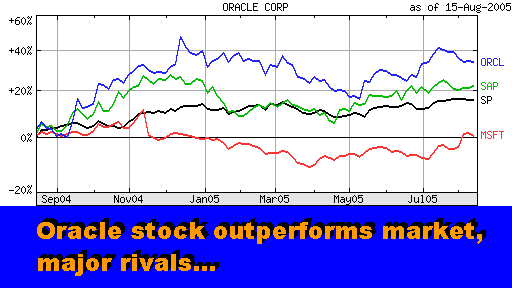
As a result, Oracle’s stock has now pretty much caught up with the valuations the market gives its main competitors (see the chart).
So
is there much upside left?
Oracle’s
president, Charles Phillips, thinks so.
Why?
In
his Aug
11 assessment of the company’s performance and vision of the future,
he said that, “not many companies our size are growing at these kinds of
rates.” He added that,
“size is going to matter even more as we are going forward.”
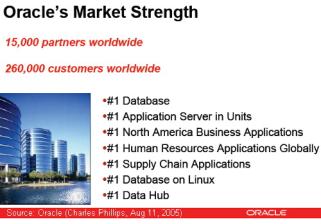
Phillips
first rattled off the seven areas in which Oracle claims the No. 1 position
in the marketplace (see the above chart).
For example, Oracle holds a huge lead over its rivals in the (rival)
SAP database marketplace (with 67% market share - see the chart below).

He
also stressed Oracle’s work in and support of the Linux market, one area
that both IBM and Oracle are aggressively promoting.
Phillips
then went on to assert that grid acceptance has been taking off, which
Oracle believes is its big competitive advantage.
“For
every 100 database enterprise deals, 18 are RAC deals,” he said, referring
to Real Application Clusters (RAC), the clustering product that represents
grid. “That’s double what
it was a year ago.”
As
a result, Oracle now has about 9,500 total RAC installations (out of some
260,000 customers), and has grown the RAC revenue by 27% over the last year.
About half of those customers are coming back for repeat business,
Phillips said, which bodes well for grid computing acceptance in the future.
“Grid is taking off and competitors don’t have any answer for it right now,” Phillips summed it up.
Happy
bargain hunting!
Bob Djurdjevic


For additional Annex Research reports, check out...
2005 IT: Oracle: Bigger Is Better? (Aug 2005); HP: Sweet Turnaround (Aug 2005); Dell Spooks Street (Aug 2005); EDS Ups Its Forecast (Aug 2005); Capgemini Beats Forecast (July 2005); Fujitsu: Losses Reversed; Forecast Upgraded (July 2005); IBM: Polaris Eclipses T-Rex (July 2005); IBM Bounces Back (July 2005); Accenture: Smashing Records (July 2005); Merrill's New Bull (EDS) (May 2005); IBM Trumps Trump (May 2005); Tweaking Big Blue (May 2005); Hurd's First RBI (May 2005); Dell Rings the Bell (May 2005); Stock Buybacks: The Phantom Is Back (May 2005); EDS Misfiring on All Cylinders (May 2005); HP Surges, Dell Slumps; Lenovo Completes IBM Deal (May 2005); Fujitsu Revenues Flat, Lower Net (Apr 2005); Capgemini Jettisons Healthcare in N.A. (Apr 2005); HP: From India to Poland (Apr 2005); IBM: Slammed and Dunked (Apr 2005); Hurd Advice: Up Mount Market Cap (Apr 2005); Accenture: Roaring Ahead (Apr 2005); Fujitsu Unveils New Servers (Mar 2005); EDS Executive Suite; HP's New CEO (Mar 2005); An iSeries Revival (Mar 2005); EDS Booster Club Fees Rise (Mar 2005); An Upside-Down View (Mar 2005); The Worst of Both Worlds (Mar 2005); Octathlon 2005: Accenture Wins (Mar 2005); IBM Global Services: Smaller, Shorter - Better? (Mar 2005); IBM 5-yr Forecast: Quality over Quantity (Mar 2005); Rumor Lifts EDS', Fujitsu's Shares (Mar 2005); Capgemini: Turning the Corner (Feb 2005); IBM Servers to Grow Again (Feb 2005); Carly's Fickle Fans (Feb 2005); CSC: Gearing Down on Purpose (Feb 2005); EDS: Grossly Overpriced Stock (Feb 2005); IBM Historical Update: 2004 Shot in the Arm (Feb 2005); New HeadTurners Series #1 (Feb 2005); IBM: A Crescendo Finale! (Jan 2005); Accenture: Strong Finish, Better Start (Jan 2005); Annex Coverage 2004: IT Services Dominate (Jan 2005)
2004 IT: EDS: The Titanium Stock (and other Wall Street tales) (Dec 2004); IBM PC: Good Riddance (Dec 2004); Fujitsu: Recovery Continues (Nov 2004); IBM Server Renaissance (Nov 2004); HP Hits Home Run (Nov 2004); Capgemini: Revenue, Stock Soars (Nov 2004); EDS: Jordan's Swan Song? (Nov 2004); To Russia with Love and $ (Oct 2004); IBM: Slow Quarter No Longer (Oct 2004); Accenture: Revenues, Profits Up, Stock Down (Oct 2004); Capgemini: A Takeover Target? (Oct 2004); Sellout of America (Oct 2004); Spy Wars (Sep 2004); Outsourcing Boomerang (Sep 2004); EDS to Cut Up to 20,000 More Jobs (Sep 2004); Capgemini Stock Plummets on Unexpected Loss (Sep 2004); HP Savaged by Wall Street (Aug 2004); Moody's Lowers the Boon on EDS (July 2004); HP: Delivering Value Horizontally (June 2004); Accenture: Revving Up a Notch (June 2004); Beware Your CFO! (May 2004); IBM: Changing of the Guard (May 2004); Capgemini: Texas-size Home Run (May 2004); Following the Money (May 2004); EDS: On a Wink and a Prayer (Apr 2004); HPS Wins by a Nose! (Octathlon 2004); Accenture: Burning the Track (Mar 2004); IGS: "Crown Jewel" Restored? (Mar 2004); HP: Still No Cigar (Feb 2004); Cap Gemini: Another, Smaller Loss (Feb 2004); CSC: Good Quarter Gets Boos (Feb 2004); EDS: "Hot Air Jordan" Flaunts Flop as Feat (Feb 2004); IT Industry: Whither Goeth It? (Jan 2004); Cronyism Is Alive and Well at EDS" (Jan 2004)
Or just click on  and use appropriate
keywords.
and use appropriate
keywords.
Volume XXI, Annex Bulletin 2005-18 Bob Djurdjevic, Editor 4440 E Camelback Rd #29, Phoenix, Arizona 85018 The copyright-protected information contained in the ANNEX BULLETINS and ANNEX NEWSFLASHES is part of the Comprehensive Market Service (CMS). It is intended for the exclusive use by those who have contracted for the entire CMS service. |
Home | Headlines | Annex Bulletins | Index 2005 | About Founder | Search | Feedback | Clips | Activism | Client quotes | Workshop | Columns | Subscribe