
An
OPEN
Client Edition
IT SERVICES
Updated 2/18/05, 8:45AM MST (updates "Reverse Bias, PR Offensive")
Analysis of EDS’s Fourth Quarter Business Results
A $6- to $9-Stock?
EDS Shares Grossly Overpriced Compared to Major Rivals’, Latest Disappointing Results
PHOENIX, Feb 7 – They say that numbers don’t lie; that they always tell the real tale. Well, we consulted the numbers after having seen Electronic Data Systems’ (EDS) fourth quarter results, released today after the markets closed. And they told us that EDS, whose shares rose to $21.35 today in advance of the earnings release, is actually only about $6 to $9-stock.

How can that be? Well, check out the chart that compares EDS’s trailing
price/earnings (P/E) ratio with those of its major rivals – Accenture,
CSC and IBM. If you apply the
average P/E ratios of these actually more successful major EDS rivals to
the just-released EDS 2004 earnings of $0.32 per share, you get a stock
whose price should be about $6! Yet,
EDS is trading at almost four times that.
And even if priced at the forward average P/E ratios of its major competitors, and taking its own topside 2005 forecast of $0.60 per share at face value, EDS’ shares should be just over $9, the numbers tell us. Which is less than half EDS’ current price.
Clearly, there is only one way that such a stock should head from its current dizzying heights: South! Make that “deep south!” The drop in after-hours trading of over 6%, that followed the company’s earnings release, is only the first step in that direction (also see “EDS: The Titanium Stock,” Dec 2004).
Business Segment Analysis
 EDS’
fourth quarter results were so full of special charges, adjustments and
“pro forma” statements, that its executive tap dancing around the
explanations would have made Fred Astaire or Gene Kelley proud. Which
is what one has to do when letting the numbers speak for themselves would
destroy one’s optimistic case.
EDS’
fourth quarter results were so full of special charges, adjustments and
“pro forma” statements, that its executive tap dancing around the
explanations would have made Fred Astaire or Gene Kelley proud. Which
is what one has to do when letting the numbers speak for themselves would
destroy one’s optimistic case.
Earnings. EDS’ fourth quarter earnings, for example, were $0.10 per
share as reported. But the
EDS release headline touted the $0.25 per share “pro forma” profits
(the “pro forma” figures excluded the restructuring charges, a
reversal of the portion of the second quarter charge and some divestitures
and discontinued operations gains and losses).
And as if that weren’t enough, the company also restated its 2003
fourth quarter results, reducing its loss to $337 million.
For the full
year, EDS posted a net profit of $158 million versus a loss of $1.7
billion last year. But at the
operating and pretax profit levels, the company continued to lose money in
2004 ($108 million and $388 million respectively, versus $277 million and
$543 million losses in 4Q03 and 2003 respectively).
Revenue. What
reversed the actual losses into apparent profits was the $453 million
income from discontinued operations.
In other words, it was a non-recurring boost.
The fourth quarter revenues were down 5% as
reported, and down 8% on an organic basis (excluding currency
translations, acquisitions and divestitures).
For the full year, however, EDS revenues were essentially flat at
$20.6 billion with its restated 2003 totals (the 2003 revenues were
originally reported as $21.5 billion; then restated to $20.6 billion).
New Contract Sales. Perhaps the most disappointing number, though not surprising, was EDS’ new contract sales drop. At $3.8 billion, it’s the company’s lowest fourth quarter sales record since 1998. And that was the last year of the Les Alberthal era, and the last nail in the coffin of his administration, that brought on a change and Dick Brown as CEO.

The $3.8 billion new contract sales number is
not only down from last year’s disappointing fourth quarter total of
$4.3 billion (restated to $4.0 billion), but it also falls woefully short
of the company’s $5.5 billion target for the latest period.
Michael Jordan, the CEO, and Bob Swan, the CFO, did not hide their disappointment, but tried to put on a brave face, optimistically suggesting some of the missed targeted sales may pop up in the first quarter of this year.

One reason for the declining sales is the
shrinkage of the average contract period from seven years in 2002, to
about five years last year, according to Swan.
But that can certainly not explain the gaping $1.7 billion gap
between the fourth quarter expectations and reality.
Cash Flow. Free cash flow was another area of mumbo-jumbo adjustments to
adjustments that made it difficult to make heads or tails in the bottom
line results. But even taking
it at EDS’ face value, the free cash flow results are disappointing.
Early
in 2004, the EDS guidance was for a full-year cash flow
of "$500-$600 million, including NMCI," according to the
company's Feb 5, 2004 release. This
was later revised to “$300-$500 million. “Is
EDS trying to rewrite history to fit the present?”, we asked in the
"Moody's
Lowers the Boon on EDS," July 2004-piece.
As it turned out, the actual 2004 free cash
flow was $305 million. But
that excluded the $522 million “pay-down on the NMCI securitization
facility,” for reasons that remained unclear even after the EDS
executive tap dance.
Geographies. The Americas, the largest EDS geographic segment, had fourth
quarter revenues of $2.2 billion, down 4% from the same period a year ago.
The good news was that the operating profit in this region was up
21% to $344 million.
The European fourth quarter revenues were down
by 7% to $1.4 billion, mainly due to the loss of the Inland Revenue
mega-contract (see “Biggest
Feather in Cap’s Cap,” Dec 2003).
But the operating profits on the Old Continent also improved by 20%
to $231 million.
The Asia/Pacific region was the problem area in the fourth quarter. Revenues were down 16% to $251 million, while the area posted an operating loss of $12 million for the quarter.
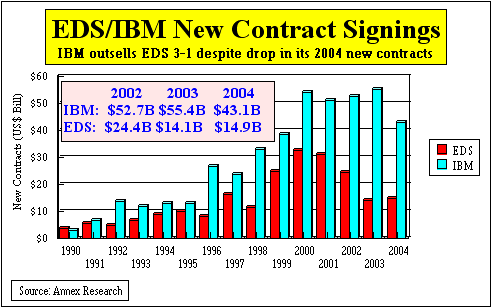

EDS’ own outlook for 2005 is considerably
more downcast than were its executives’ earlier pontifications.
And not just in numbers… in tone, too, during the post-earnings
teleconference with analysts.
The company expects full-year 2005 revenues of
$20 billion to $21 billion. In
other
words, it will be a flat or down year again.
Which, frankly, would be quite an achievement, given how much
future revenue the declining new contract sales have already drained away.
"Our focus is revenue, revenue, revenue," Jordan said, nearly two years too late (see “Pain Without Gain,” Oct 2003).
EDS also projects new contract sales this year would rise 11% to meet the flat revenue target. And Jordan also told the media after the earnings release that the company would get more price-competitive, and would transfer 450 consultants to sales and sales-support roles this year.
So goodbye meager (7% to 8% gross) margins…
worse ones are ahead?
Indeed, the strategy changes will lower
expected 2005 profit by 34 cents a share, Jordan said. Wall
Street had expected the company to deliver 74 cents per share.
So Jordan's estimate would put the 2005 earnings at 40 cents a
share.
The company also predicts full-year cash flow
of between $500 million and $700 million, about the same as it did a year
ago. What EDS did not say was
how many special adjustments, like the ones in 2004, it would take to make
this figure "come true."
So a reasonable question by an impartial and
uncommitted investor would be – why is the market overpaying for this
particular stock so much, relative to the much more prosperous companies,
such as Accenture, IBM or CSC?
Good question. We cannot think of any reasonable answers. So back to the “deep south” discussion…
PHOENIX, Feb 8 - To say that EDS is in a tough spot would be a gross understatement. If its new mantra for 2005 suddenly becomes "revenues, revenues, revenues," as its CEO suggested yesterday, and the company starts buying the business with heavy discounting, its already low margins will be shot to hell. We can't see how the company could make any money in 2005, let alone earn 40 cents a share that Jordan's 34 cent per share "competitiveness penalty" implies. In fact, by trying to keep its revenue at about $20 billion, we think EDS would lose about $376 million pretax, or about 55 cents a share in 2005 (click here to view our forecast Table 1).
If, on the other hand, the company focuses on improving its margins and profitability, which had been its stated course up until now, the lack of results notwithstanding, then EDS revenues will take a steep dive. The company will need to shake off its remaining bad apples, and "rescope" in a positive sense its existing low margin contracts (click here to view our forecast Table 2). And it would have to accept continued declines in new contract sales. But its bottom line would turn to black again. Really. Without the tap-dancing adjustments.
So EDS is stuck between a rock and a hard place. Perhaps the latter Scenario #2 would be a more prudent one for EDS shareholders. But we do not think the market place would accept it, especially now that Jordan's new battle cry has become "revenues, revenues, revenues." So off to Scenario #1 we go...
Except that there is no reasonable way we can see EDS how could make any money with such a strategy in 2005. Projecting 40, 50 or 60 cents a share earnings, while realistically facing more losses due to price discounting, would be misleading the market place. And that's exactly what EDS executives have been doing.
We're not suggesting here any deliberate wrongdoing. Perhaps they have duped themselves into believing their own fairy tales? But it would take some really gullible independent souls to accept them as non-fiction.

This morning's 6% drop in EDS' share prices in heavy trading suggests that even the company's most ardent institutional loyalists may be having second thoughts.
Being "color blind" when it comes to technology has always been an important factor in customer selections of an outsourcing vendor. Up until now, we have thought that technological independence was a marketing advantage that "pure" IT services competitors, such as EDS, Accenture, CSC, Capgemini and others enjoyed over vertically integrated computer companies, like IBM, HP or Fujitsu. That's one reason we argued back in 1996 that IBM should spin off its IBM Global Services operation (see "Break Up IBM!", Mar. 1996).
Well, EDS has now turned this argument on its head, and its natural advantage to its detriment. In a February 9 interview with Business Week, EDS' CEO Mike Jordan was quoted as saying that EDS is encouraging customers to switch from IBM or HP to its alliance partners, such as Sun Microsystems and EMC (see EDS Turbocharges Its Partnerships, Business Week, Feb 28, 2005).
So from now on, when EDS competes with IBM or HP or Fujitsu, prospective customers can use this reverse bias against an EDS representative's claims of independence. Way to shoot yourself in the foot, EDS! (as if it's not full of holes already).
PR Offensive to Defend Sagging Stock
"What goes up must come down," we wrote in our year-end report on institutional investors (see "EDS: The Titanium Stock," Dec 2004). Eventually. "So it will the 'titanium stock' – EDS. Probably starting in the New Year, just as was the case last year" (see update Jan 7, 2005).

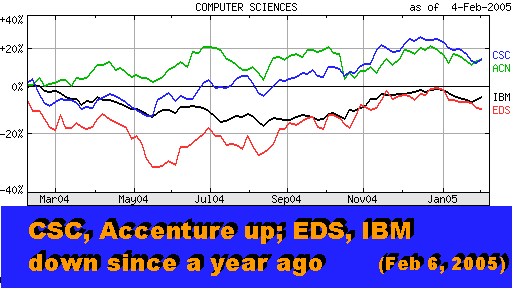
Well, EDS stock price has certainly been on a downward path since the start of the year (see the chart). So what's the company doing about it? It is unleashing a PR offensive, especially on Wall Street. Check out the calendar of planned public appearances by EDS executives just next week, according to the company's releases:
-
EDS (NYSE: EDS - News) executive vice president and CFO Bob Swan will discuss the company's strategy during a question and answer session on February 24 at 2:30 p.m. (Central time) at the Goldman Sachs 2005 Technology Investment Symposium at The Arizona Biltmore Resort and Spa, Phoenix, Ariz.
-
Dan Allison, vice president of EDS' US region for Global Sales & Client Solutions, is presenting on February 23 at 2:20 p.m. (Central time) to the Robert W. Baird Business Solutions Conference at The Pierre Hotel, New York, N.Y.
-
Jim Duffey, vice president of EDS' Global Sales and Client Solutions - US Government, will be participating in a panel discussion on February 25 at 8:05 a.m. (Central time) for Tier 1 Federal IT Services companies at the UBS Q-Series: Government and Defense IT Conference held at the Ritz-Carlton, Tysons Corner, McLean, Va.
-
Finally, EDS (NYSE: EDS - News) will broadcast its securities analysts meeting live on the Internet, Tuesday, Feb. 22, beginning at 8:30 a.m. Eastern time until approximately 11:45 a.m., from The Pierre Hotel in New York. At this meeting, EDS will provide an update on 2005 financial and operational goals and initiatives, as well as the company's longer-term strategic, operational and financial goals and initiatives. The information will be presented by key members of EDS' executive leadership team.
Furthermore, EDS has picked a new
ad agency to handle its corporate PR. The
company has tapped British consumer-products agency Bartle
Bogle Hegarty to replace Fallon Worldwide, which held the account
since 1999, according to a Feb
3 Wall Street Journal report.
"We
felt we could benefit from a consumer ad agency to stimulate new thought
and creativity in our message and in how we position ourselves," Bob
Segert, EDS's recently named chief marketing officer, told the
Journal.
Bartle Bogle Hegarty's current clients are large, non-technology brands including Levi Strauss & Co.'s Levis, Unilever PLC's Axe deodorant and Diageo PLC's Johnnie Walker whiskey, the Journal story said.
Can you just picture a new hybrid corporate image for EDS? A Texas cowboy with slick freshly Axed Levi's jeans, sipping Johnnie Walker on the porch of his ranch before teeing off in the Byron Nelson golf tournament. :-) Or not...
Jokes aside, having a consumer ad agency will probably be good for EDS. It may help shake up EDS' stodgy corporate image. And at a time when most lines are pointing south, almost any shake up is goodness. So boom, boogie and bugle away - Bartle Bogle and Hegarty. Just no bogies, please. Hear?
Happy
bargain hunting
Bob Djurdjevic
For additional Annex Research reports, check out... 2005
IT: EDS:
Grossly Overpriced Stock (Feb 2005); IBM
Historical Update: 2004 Shot in the Arm (Feb 2005);
New
HeadTurners Series #1 (Feb 2005);
IBM:
A Crescendo Finale! (Jan 2005); Accenture:
Strong Finish, Better Start (Jan 2005); Annex
Coverage 2004: IT Services Dominate (Jan 2005); 2004
IT: EDS:
The Titanium Stock (and other Wall Street tales)
(Dec 2004); IBM
PC: Good Riddance (Dec 2004); Fujitsu:
Recovery Continues (Nov 2004); IBM
Server Renaissance (Nov 2004); HP
Hits Home Run (Nov 2004); Capgemini:
Revenue, Stock Soars (Nov 2004);
EDS:
Jordan's Swan Song? (Nov 2004);
To Russia with Love
and $ (Oct 2004);
IBM: Slow
Quarter No Longer (Oct 2004); Accenture:
Revenues, Profits Up, Stock Down (Oct 2004);
Capgemini:
A Takeover Target? (Oct 2004); Sellout
of America (Oct 2004); Spy
Wars (Sep 2004);
Outsourcing
Boomerang (Sep 2004);
EDS
to Cut Up to 20,000 More Jobs (Sep 2004); Capgemini
Stock Plummets on Unexpected Loss (Sep
2004); HP
Savaged by Wall Street (Aug 2004); Moody's
Lowers the Boon on EDS (July 2004); HP:
Delivering Value Horizontally (June 2004); Accenture:
Revving Up a Notch (June 2004); Beware
Your CFO! (May 2004); IBM:
Changing of the Guard (May 2004); Capgemini:
Texas-size Home Run (May 2004); Following
the Money (May 2004); EDS:
On a Wink and a Prayer (Apr 2004); HPS
Wins by a Nose! (Octathlon 2004); Accenture:
Burning the Track (Mar 2004); IGS:
"Crown Jewel" Restored? (Mar 2004); HP:
Still No Cigar (Feb 2004);
Cap Gemini: Another, Smaller Loss
(Feb 2004); CSC: Good Quarter Gets Boos (Feb
2004); EDS:
"Hot Air Jordan" Flaunts Flop as Feat (Feb 2004); IT
Industry: Whither Goeth It? (Jan 2004); Cronyism
Is Alive and Well at EDS" (Jan 2004) Or just click on Volume XXI, Annex Bulletin 2005-03 Bob Djurdjevic, Editor 4440 E Camelback Rd #29, Phoenix, Arizona 85018 The copyright-protected information contained in the ANNEX BULLETINS
and ANNEX NEWSFLASHES is part of the Comprehensive Market Service (CMS). It is intended for the exclusive use
by those who have contracted for the entire CMS service. Home |
Headlines | Annex Bulletins
| Index 2005 | About
Founder | Search | Feedback
| Clips | Activism
| Client quotes | Workshop | Columns
| Subscribe 
 and use appropriate
keywords.
and use appropriate
keywords.
February 7, 2005
(c) Copyright 2005 by Annex Research, Inc. All rights reserved.
e-mail: annex@djurdjevic.com
TEL/FAX: (602) 824-8111