
Annex Bulletin 2005-17 July 26, 2005
Confidential
Client Edition
IBM CORPORATE
Updated 7/26/05, 4:45 PM EDT (adds "Executive Quotes, Photos")
Analysis
of IBM’s New “Z9” High End Servers: A $1.2 Billion-Mainframe Bet
Polaris Eclipses T-Rex
New Mainframe, New Strategy – Quantum Leaps from Just Two Years Ago
NEW YORK, July 26 – Just over two years ago, Big Blue took a swipe at its large systems strategy critics who compared mainframes to dinosaurs. IBM chose an in-your-face code name “T-Rex” for its then new $1 billion-z990 server (after the fearsome 20-foot tall, 15-ton Tyrannosaurus Rex, the “king of dinosaurs”).
 Less than a
year later, on mainframe’s
40th birthday (Apr 7, 2004), the T-Rex was followed by the
“son of T-Rex” - the “z890.”
What ensued was the most successful IBM mainframe sales year in
decades (see “IBM
Servers to Grow Again,” Feb 2005 and “IBM
Server Renaissance”, Nov 2004).
Less than a
year later, on mainframe’s
40th birthday (Apr 7, 2004), the T-Rex was followed by the
“son of T-Rex” - the “z890.”
What ensued was the most successful IBM mainframe sales year in
decades (see “IBM
Servers to Grow Again,” Feb 2005 and “IBM
Server Renaissance”, Nov 2004).
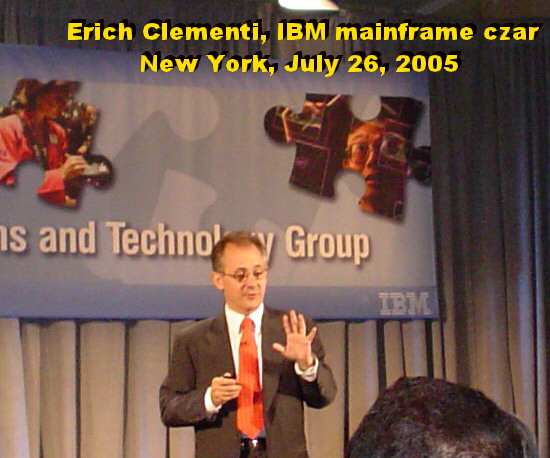
"We've shipped more capacity in the last four years than in 36 years before that," said Erich Clementi, IBM's "mainframe czar," speaking this morning at the IBM announcement press conference in New York attended by some 130 reporters.
But success can be a pain… next year, when you have to do it all over again, and scale new heights. As you saw from IBM’s latest report, after rising 45% the year before, mainframe revenues declined 24% in the second quarter as the customers awaited Big Blue’s next “big bang.”
And what a bang it was…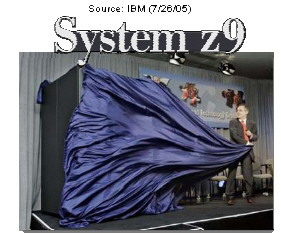
"We make announcements all the time, (but) we only do events like this once every five years," said Bill Zeitler, IBM senior vice president, speaking at the IBM announcement press conference in New York this morning (see the photo below). Zeitler heads up the company's systems and storage hardware business.

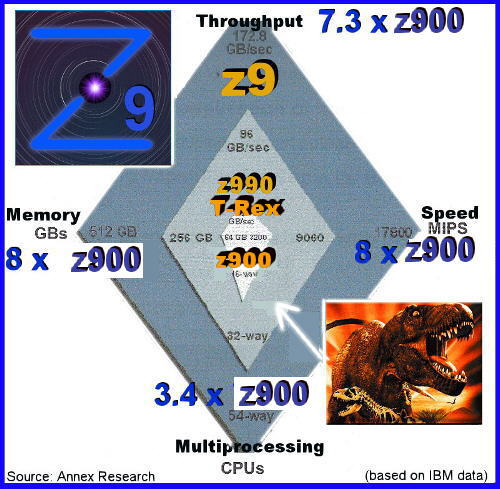
The new Polaris mainframe, IBM’s code name for the $1.2 billion-“z9” server being unveiled today, leaves the T-Rex in the dust, just as dinosaurs eventually ended up in the dustbin of history. It’s a quantum leap not only from the two-year old T-Rex (up to eight times more powerful), but it represents a doubling of performance even relative to its successor – “son of T-Rex,” announced only 15 months ago (see the chart).
Why the Polaris code name?
Just like Polaris, the Northern Star that has been used for navigational
purposes for centuries because all other stars appear to rotate around it,
the new z9 intends to be the guiding light to safe harbors for
wayward IT travelers in the 21st century.
As such, it may become the new center of each customer’s IT
universe.
That’s because the z9 is a lot more than just a bigger, faster mainframe. It plays right into the sweet spot of four important industry trends that we identified earlier this year – recentralization, reintegration and virtualization, and corporate customers’ increased anxiety over security, both physical and intellectual (see “Poughkeepsie Spring” and “An iSeries Revival”).
It is clear that the z9 will be IBM's high-end systems platform for ages... Which in IT terms means at least for the next five years or so.
"This system is going to be the base for the next phase of mainframes," said Clementi.
Strategy
Triad
“There are three systems imperatives,” explained Irving Wladawsky-Berger, a veteran IBM vice president who is in charge of
innovation at Big Blue, speaking in a pre-announcement briefing.
“Virtualize everything, commit to open and collaborate to
innovate.”
Wladawsky-Berger, a veteran IBM vice president who is in charge of
innovation at Big Blue, speaking in a pre-announcement briefing.
“Virtualize everything, commit to open and collaborate to
innovate.”
He said that the demand for high-end systems has become global in nature. And that requires that traditional transaction processing be augmented by a collaborative approach that more tightly and securely integrates technology, processes and personnel.
 Virtualize
Everything. A project leader in a large federal government agency’s
data center, who asked to remain anonymous, also raved about the importance
and value of virtualization in his world.
Virtualize
Everything. A project leader in a large federal government agency’s
data center, who asked to remain anonymous, also raved about the importance
and value of virtualization in his world.
“We’re finding we can get it on more hardware now with less pain,” our source said. “Virtualizing is really saving us (money) because we can just stamp out images.”
“We run the agency’s web portal based on IBM WebSphere software,” he added. “That’s become a new standard for enterprise web content management system and enterprise collaboration. And all these agencies are starting to roll in and use that technology because the government has taken money away from them” (making it more difficult to use a “go it alone” approach).
“And virtualization is saving us people dollars because of being able to just stamp out virtual servers on the mainframe,” for these new customers, he added. “And they are all very reliable. Nobody has a problem going there anymore.”
No wonder Websphere revenues have been consistently growing in the double-digit range during the last two years, including in the last (second) quarter (up 18%), when the mainframe hardware revenues slumped.
IBM
today also enhanced its virtualization technology.
Called Virtualization Engine 2.0, the technology is a giant leap
forward in enabling virtualization for the first time across an entire
enterprise and beyond. It uses open interfaces and Web services to connect IBM and
select non-IBM server and storage systems.
 Commit
to Openness. If you still hear some IBM mainframe critics these days
complain about Big Blue’s “proprietary sysems” approach, you should
know that such critics are marooned in the past.
There was indeed a time… make it a long time – several decades
long – when IBM only designed and sold proprietary systems.
Commit
to Openness. If you still hear some IBM mainframe critics these days
complain about Big Blue’s “proprietary sysems” approach, you should
know that such critics are marooned in the past.
There was indeed a time… make it a long time – several decades
long – when IBM only designed and sold proprietary systems.
But that began to change five years ago, when the zSeries was announced, along with a new strategy embracing openness. As a result, some 75% of the mainframe MIPS IBM ships now are for workloads built on open standards.
"Ever since we opened the mainframe, we've seen amazing things happen," said IBM's Clementi. "Mainframe has become mainstream, and is ready to collaborate."
Words like that are music to IBM mainframe customers' ears.
“We’re going to expand our use of (zAAP) Java,” one big IBM customer in the health care field told us this spring. “I think it’s been a good thing for IBM to do (to open up). The irony now is that Microsoft is now the big bad proprietary vendor (the attributes that used to be ascribed to IBM in the past). What goes around comes around. It’s Microsoft’s turn now.”
By contrast, IBM is continuing to champion openness and sharing. The company’s mainframe designers are now touting an enterprise-wide Services Oriented Architecture whose purpose is to interconnect and leverage the various IT assets that customers have accumulated over the years.
 Collaborate
to Innovate. It does
not seem intuitively obvious that collaboration is a key to innovation.
Leonardo da Vinci, for example, the great Renaissance inventor and
artist, would certainly have had a good laugh if anyone presented him with a
“design by committee” concept.
Collaborate
to Innovate. It does
not seem intuitively obvious that collaboration is a key to innovation.
Leonardo da Vinci, for example, the great Renaissance inventor and
artist, would certainly have had a good laugh if anyone presented him with a
“design by committee” concept.
Yet
the famous German poet and
writer Johann Wolfgang Goethe understood the importance of collaboration
before creation.
“The greatest genius will never be much if he pretends to draw exclusively from his own resources,” Goethe said. “Every one of my writings has been furnished by a thousand different persons, a thousand different things.”
At this day and age when thousands of workers are scattered in dozens of countries around the world in global enterprises, impediments to collaboration are also obstacles to innovation. And that’s what the new IBM products are intended to remove, fostering the sharing of ideas (applications) and not just data.
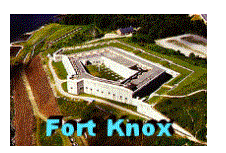 Top-Notch
Security.
Ever since 9/11, increased demand for top-notch security has elevated
the importance of the zSeries, especially in a 24/7 operating world where
the mainframe shines. It is, after all, the system some of the world’s largest
banks bank on. Now, other
industries, including governments, are coming to realize that the zSeries is
the “Fort Knox of the IT world” when it comes to security.
Top-Notch
Security.
Ever since 9/11, increased demand for top-notch security has elevated
the importance of the zSeries, especially in a 24/7 operating world where
the mainframe shines. It is, after all, the system some of the world’s largest
banks bank on. Now, other
industries, including governments, are coming to realize that the zSeries is
the “Fort Knox of the IT world” when it comes to security.
Besides
the cost savings, “the other reasons (for switching to mainframe) were the
mainframe’s superior reliability and security,” explained Dr. Claudio
Podesta, Iside SpA’s Assistant General Manager of Operations, one of
Italy’s biggest banks. “So
I backed a sure winner.”
That
was “yesterday.” Today, the
IBM mainframe security just got even better.
The z9 is the most sophisticated, secure computing system
ever, IBM claims. The z9
mainframe will act as a centralized hub to help businesses collaborate more
efficiently with each other able to fend off all know threats.
For
the first time, the identities of consumers and their personal information
can be encrypted not only on the mainframe, but wherever the information is
stored, including tapes.
The
loss and theft of tapes with 676,000 customer records has recently grabbed
headlines and caused consumer concern around the world.
The number of computer viruses is also exploding.
They were up 25% in 2004 to over 112,000. The growth rate of viruses embedded in e-mails has doubled
from prior years.
The
new z9 security features seek to thwart such threats to corporate
data through a holistic approach, including physical and virtual protection
of customer assets.
Per
Ardua Ad Astra
One of the challenges that IBM and large enterprises face is a relative dearth of mainframe skills.
“The people who know those disciplines and understand the mainframe structures are in their 50s,” said Kevin Sharkie, Aviva Australia’s CIO (Aviva is the largest insurance and finance company in Britain). “And that is a problem; that is a global problem.”
Given
the scope of the problem, “per ardua at astra” (“through hardships we reach the stars”), the Royal Air Force motto,
aptly applies to this predicament.
(“through hardships we reach the stars”), the Royal Air Force motto,
aptly applies to this predicament.
IBM understands that. In Australia, for example, the central government and IBM are working on setting up courses at various universities that would reintroduce the mainframe skills lost in the last several decades.
In
China, IBM just announced (March 2005) the “IBM zSeries University
Program” that will be offered at seven universities in that country (see
the photo from the March 18, 2005 press conference).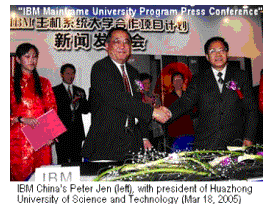
IBM
expects that opening the courses on mainframe technology will uplift the
academic levels of selected universities.
It also hopes teaching and using the mainframe technology skills will
provide the universities with capabilities to implement large scale IT
programs.
IBM’s
goal is to have 20,000 skilled mainframe professionals in the global
marketplace by 2010.
So
if anyone is thinking that the mainframe is dead, or even hibernating, think
again. Big Blue and its large
customers are clearly thinking and investing for the long term.
New
Sources of Demand
And
no wonder. Besides the
traditional legacy customers and applications, there is a whole new world of
wealth out there waiting to be poured into the mainframe.
Peter Horowitz, for example, a
Managing Director with BearingPoint, noted in a June 8 release that
China’s banks are poised to potentially become some of the most
influential financial institutions in the world over the next 10 years. But they first need to know their customers and conduct
better segmentation of the market.
“The growth of China's mass affluent and high net worth segments will require improved financial planning processes, asset allocation and ‘open product’ architectures, such as the ability to distribute financial products manufactured by other institutions,” said Horowitz.
“In
many countries, servicing a client's assets and liabilities, simultaneously,
is difficult given the integration needed for legacy systems and platforms.
China is positioned to leapfrog these platforms with an approach
taking a complete view of a client's needs from the outset.”
And when China banks do leapfrog over their competition, IBM and its z9 will be there to catch it. And you can take that to the bank.

Summary
IBM’s new mainframe, the z9, as impressive as it is on a “speeds and feeds” basis, is merely a part of a much bigger picture. Big Blue is on a quest to redefine the axioms of corporate computing. Not for the first time. Not for the last time. But again for the long haul.
"We've been in the forefront of many industry trends that are generating new demand," IBM's Zeitler told the media and analysts assembled in New York today. The z9 mainframe and the associated software and hardware are just the latest example.
And
when Big Blue means business, it usually means big business. The
company is putting big money where its mouth is.
Some $1.2 billion went into the latest turn of the wheel of progress
- the Polaris eclipsing the T-Rex. Clearly,
IBM believes its 41-year old has a bright future.
Smart money should not bet against Big Blue’s strategy. Most of us did it once before when we buried the mainframe in the early 1990s. And smart people are supposed to learn from history, not repeat it.
Happy
bargain hunting!
Bob Djurdjevic


For additional Annex Research reports, check out...
2005 IT: IBM: Polaris Eclipses T-Rex (July 2005); IBM Bounces Back (July 2005); Accenture: Smashing Records (July 2005); Merrill's New Bull (EDS) (May 2005); IBM Trumps Trump (May 2005); Tweaking Big Blue (May 2005); Hurd's First RBI (May 2005); Dell Rings the Bell (May 2005); Stock Buybacks: The Phantom Is Back (May 2005); EDS Misfiring on All Cylinders (May 2005); HP Surges, Dell Slumps; Lenovo Completes IBM Deal (May 2005); Capgemini Jettisons Healthcare in N.A. (Apr 2005); HP: From India to Poland (Apr 2005); IBM: Slammed and Dunked (Apr 2005); Accenture: Roaring Ahead (Apr 2005); Fujitsu Unveils New Servers (Mar 2005); EDS Executive Suite; HP's New CEO (Mar 2005); An iSeries Revival (Mar 2005); EDS Booster Club Fees Rise (Mar 2005); An Upside-Down View (Mar 2005); The Worst of Both Worlds (Mar 2005); Octathlon 2005: Accenture Wins (Mar 2005); IBM Global Services: Smaller, Shorter - Better? (Mar 2005); IBM 5-yr Forecast: Quality over Quantity (Mar 2005); Rumor Lifts EDS', Fujitsu's Shares (Mar 2005); Capgemini: Turning the Corner (Feb 2005); IBM Servers to Grow Again (Feb 2005); Carly's Fickle Fans (Feb 2005); CSC: Gearing Down on Purpose (Feb 2005); EDS: Grossly Overpriced Stock (Feb 2005); IBM Historical Update: 2004 Shot in the Arm (Feb 2005); New HeadTurners Series #1 (Feb 2005); IBM: A Crescendo Finale! (Jan 2005); Accenture: Strong Finish, Better Start (Jan 2005); Annex Coverage 2004: IT Services Dominate (Jan 2005)
2004 IT: EDS: The Titanium Stock (and other Wall Street tales) (Dec 2004); IBM PC: Good Riddance (Dec 2004); Fujitsu: Recovery Continues (Nov 2004); IBM Server Renaissance (Nov 2004); HP Hits Home Run (Nov 2004); Capgemini: Revenue, Stock Soars (Nov 2004); EDS: Jordan's Swan Song? (Nov 2004); To Russia with Love and $ (Oct 2004); IBM: Slow Quarter No Longer (Oct 2004); Accenture: Revenues, Profits Up, Stock Down (Oct 2004); Capgemini: A Takeover Target? (Oct 2004); Sellout of America (Oct 2004); Spy Wars (Sep 2004); Outsourcing Boomerang (Sep 2004); EDS to Cut Up to 20,000 More Jobs (Sep 2004); Capgemini Stock Plummets on Unexpected Loss (Sep 2004); HP Savaged by Wall Street (Aug 2004); Moody's Lowers the Boon on EDS (July 2004); HP: Delivering Value Horizontally (June 2004); Accenture: Revving Up a Notch (June 2004); Beware Your CFO! (May 2004); IBM: Changing of the Guard (May 2004); Capgemini: Texas-size Home Run (May 2004); Following the Money (May 2004); EDS: On a Wink and a Prayer (Apr 2004); HPS Wins by a Nose! (Octathlon 2004); Accenture: Burning the Track (Mar 2004); IGS: "Crown Jewel" Restored? (Mar 2004); HP: Still No Cigar (Feb 2004); Cap Gemini: Another, Smaller Loss (Feb 2004); CSC: Good Quarter Gets Boos (Feb 2004); EDS: "Hot Air Jordan" Flaunts Flop as Feat (Feb 2004); IT Industry: Whither Goeth It? (Jan 2004); Cronyism Is Alive and Well at EDS" (Jan 2004)
Or just click on  and use appropriate
keywords.
and use appropriate
keywords.
Volume XXI, Annex Bulletin 2005-17 Bob Djurdjevic, Editor 4440 E Camelback Rd #29, Phoenix, Arizona 85018 The copyright-protected information contained in the ANNEX BULLETINS and ANNEX NEWSFLASHES is part of the Comprehensive Market Service (CMS). It is intended for the exclusive use by those who have contracted for the entire CMS service. |
Home | Headlines | Annex Bulletins | Index 2005 | About Founder | Search | Feedback | Clips | Activism | Client quotes | Workshop | Columns | Subscribe