
Annex Bulletin 2005-08 March 7, 2005
Confidential
Client Edition
IT SERVICES
Analysis of IBM Global Services’ 2004
Business Results
Smaller, Shorter - Better?
Strong Organic Growth (w/o Major Acquisitions) Will Be Hard to Come By
PHOENIX, Mar 7
– IBM Global Services (IGS), Big Blue’s erstwhile “crown jewel”
and the growth engine of the 1990s, is sputtering again.
Not that its 8% growth rate in 2004 was bad, mind you, especially
when compared to major competitors’, like EDS or Fujitsu.
And it matches the overall growth rate IBM reported last year.
But IGS is no longer driving IBM’s growth.
That’s the “new news.” Its
8% revenue increase is a far cry from the double-digit annual surges to
which we were accustomed in the early- to mid-1990s.
Besides, even the 8% rise is more than meets
the eye. Take away the
favorable currency impact, and IGS’s real 2004 growth was about half of
that amount.
No surprise there. We said three years ago that IGS would need (major) acquisitions to grow. It acquired PwCC in 2002, which did give it a temporary boost (see the chart). But in 2004 and beyond, IGS is back to the old grind.
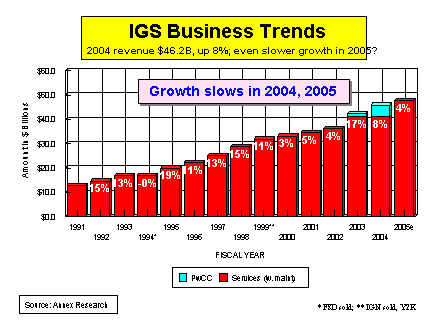
Again, as predicted. Losing $13 billion per quarter through “rescoping” and various other contract terminations doesn’t help its growth case, either (see the chart).

What’s
IGS to do?
So what's IGS to do?
“For
years IBM has stressed its ability, thanks to
its large scale, to take on huge, long-term contracts that promise it
steady streams of revenue for years to come,” the Wall Street Journal
noted in a Feb 24 article on IGS. “But Mr. (John) Joyce (IGS’s head)
said that IBM has discovered that smaller contracts are more profitable
and are preferred by customers.”
Really? That’s like discovering that the Earth is round.
Here’s, for example, what we recommended back in June 1996 to the
late Dennie Welsh, the founder of IBM’s services business, on the
subject of European market (the same principles, of course, apply
elsewhere):
“…(IBM) would have an additional competitive benefit by driving the market toward the more complex deals, in which IBM has a “built-in” advantage in Europe due to its range and reach. At the same time, IBM would not totally extricate itself from the (smaller) national deals, which can often be more profitable than the hotly-contested ‘megadeals.’
In other words, we think that IBM
should change its current style of thinking – ‘think global-deliver
local,’ to ‘pay global-deliver as the customer needs’.”
Since that time, we have also repeatedly urged
both IBM and its competitors to consider the small and medium (SMB)
business market as the source of future growth – for precisely the
reasons IBM’s Joyce “has just discovered.”
Well,
guess better late than never… Of course, smaller deals tend to be more
profitable – at the gross profit level.
But they are also more expensive to win (from the SG&A
standpoint). Which is why IT services competitors haven’t been exactly
stumbling over each other to get into the SMB market in the last nine
years, the gross margins allure notwithstanding.

Well, that’s about to change now. Not only because the megadeals are fewer and harder to come by. But because there are now ways to reduce the selling and delivery costs (through web-based applications) that weren’t available nine years ago.
So stand by not just for IGS, but also other competitors to discover that the Earth is round. Capgemini, for example, is already blazing the trail, as you saw in our review of its 2004 results. Its SMB business segment is the fastest growing and the most profitable (see “Capgemini: Turn ing the Corner,” Feb 2005).

Meanwhile, the death of the traditional
outsourcing is “greatly exaggerated,” if we may borrow from Mark
Twain. In IGS’s case, it is
still its biggest segment ($19 billion or 42% of the total), and also the
fastest growing (up 13% in 2004). It’s
just that it’s not as profitable as consulting or smaller service deals. So over time, one can expect the growth of outsourcing to
slow down as the SMB activities pick up.
Profit Boost from Maintenance
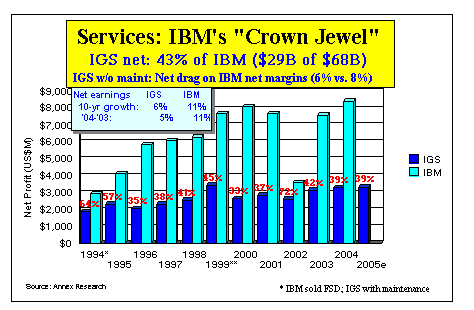
Furthermore, IGS, whose net margins are around
7%, is getting a profit boost from IBM maintenance.
We figure that the latter has net margins of about 19% - more than
three times higher. Which is why IBM chose several years ago to report maintenance
as a part of IGS, thus making its erstwhile “crown jewel” looking
better and shinier.

Over the last 10 years, for example, we estimate that IGS earned about $17 billion on revenues of $276 billion. Maintenance operations, on the other hand, earned about $12 billion on revenues of only $63 billion.
Outlook
Since we’ve already done the revenue and
P&L forecast for IBM, which included a segment on IGS, we incorporate
it here by reference:
IBM Global Services.
After years of being the fastest growing segment of Big Blue’s
business, IGS is likely to become a drag on IBM’s growth this year and
next. Unless, of course, John
Joyce, IGS’s head, does something rather dramatic to turn things around.
The reason for our relative
pessimism were the disappointing IGS new contract sales and
“rescoping” results in 2004. One
curtailed the fresh new blood supply; the other drained it in enormous
amounts. And in an
annuity-type business, such shortfall leaves deep and long-lasting scars
on its financial results and prospects for growth.
What sort of dramatic steps can
Joyce take? Well, he must
either sharply curb its “rescoping” losses, or significantly increase
its new contract sales. Or
both. Or IGS must seek to
acquire companies that can bolster its growth (see “Save,
Split and Spend,” Apr 2005).
Since there is no evidence that
either of the three IGS boosters are in progress, we are expecting its
revenues to grow at 4% both this year and next.
This would put it at just shy of the $50 billion mark by the end of
2006.
Of course, should IGS take our
advice and implement one or all three steps we recommended, its growth
rates will be higher than those outlined in this forecast.
And so will IBM’s.
(An
excerpt from IBM
Revenue Forecast, Feb 2005)

IGS’s
recent acquisition of Ireland's Equitant, which
caters to companies looking to outsource their financial administration,
is a step in the right direction. The
Dublin-based Equitant -- whose 200 staff manage about 44 billion euros
($57 billion) in revenues for clients -- provides order-to-cash services
that streamline the process from ordering a product through to final
payment for it. Equitant
has been working with IBM in a marketing partnership for the last year.
But IGS will need to do a lot more of those kinds of deals this year and next if it is to accelerate its meager rates of growth. For, one swallow does not make a spring.
Happy
bargain hunting!
Bob Djurdjevic

For additional Annex Research reports, check out...
2005 IT: IBM Global Services: Smaller, Shorter - Better? (Mar 2005); IBM 5-yr Forecast: Quality over Quantity (Mar 2005); Rumor Lifts EDS', Fujitsu's Shares (Mar 2005); Capgemini: Turning the Corner (Feb 2005); IBM Servers to Grow Again (Feb 2005); Carly's Fickle Fans (Feb 2005); CSC: Gearing Down on Purpose (Feb 2005); EDS: Grossly Overpriced Stock (Feb 2005); IBM Historical Update: 2004 Shot in the Arm (Feb 2005); New HeadTurners Series #1 (Feb 2005); IBM: A Crescendo Finale! (Jan 2005); Accenture: Strong Finish, Better Start (Jan 2005); Annex Coverage 2004: IT Services Dominate (Jan 2005)
2004 IT: EDS: The Titanium Stock (and other Wall Street tales) (Dec 2004); IBM PC: Good Riddance (Dec 2004); Fujitsu: Recovery Continues (Nov 2004); IBM Server Renaissance (Nov 2004); HP Hits Home Run (Nov 2004); Capgemini: Revenue, Stock Soars (Nov 2004); EDS: Jordan's Swan Song? (Nov 2004); To Russia with Love and $ (Oct 2004); IBM: Slow Quarter No Longer (Oct 2004); Accenture: Revenues, Profits Up, Stock Down (Oct 2004); Capgemini: A Takeover Target? (Oct 2004); Sellout of America (Oct 2004); Spy Wars (Sep 2004); Outsourcing Boomerang (Sep 2004); EDS to Cut Up to 20,000 More Jobs (Sep 2004); Capgemini Stock Plummets on Unexpected Loss (Sep 2004); HP Savaged by Wall Street (Aug 2004); Moody's Lowers the Boon on EDS (July 2004); HP: Delivering Value Horizontally (June 2004); Accenture: Revving Up a Notch (June 2004); Beware Your CFO! (May 2004); IBM: Changing of the Guard (May 2004); Capgemini: Texas-size Home Run (May 2004); Following the Money (May 2004); EDS: On a Wink and a Prayer (Apr 2004); HPS Wins by a Nose! (Octathlon 2004); Accenture: Burning the Track (Mar 2004); IGS: "Crown Jewel" Restored? (Mar 2004); HP: Still No Cigar (Feb 2004); Cap Gemini: Another, Smaller Loss (Feb 2004); CSC: Good Quarter Gets Boos (Feb 2004); EDS: "Hot Air Jordan" Flaunts Flop as Feat (Feb 2004); IT Industry: Whither Goeth It? (Jan 2004); Cronyism Is Alive and Well at EDS" (Jan 2004)
Or just click on  and use appropriate
keywords.
and use appropriate
keywords.
Volume XXI, Annex Bulletin 2005-08 Bob Djurdjevic, Editor 4440 E Camelback Rd #29, Phoenix, Arizona 85018 The copyright-protected information contained in the ANNEX BULLETINS and ANNEX NEWSFLASHES is part of the Comprehensive Market Service (CMS). It is intended for the exclusive use by those who have contracted for the entire CMS service. |
Home | Headlines | Annex Bulletins | Index 2005 | About Founder | Search | Feedback | Clips | Activism | Client quotes | Workshop | Columns | Subscribe