
Confidential
Client Edition
IT SERVICES
Analysis of Capgemini's 2004 Business Results
Turning the Corner
But Big Write-offs Bleed More Red Ink to Bottom Line
PHOENIX, Feb
24 – Capgemini’s
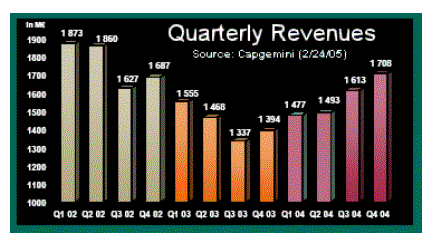
2004 revenues rose 9% in €uros
(up 15% in U.S. dollars) to €6.3
billion ($8.3 billion), but big write-offs resulting from continued
restructuring dropped €359 million ($474 million) of red ink to the
bottom line. Operating
profit, fell to €58
million from €155
million in 2003.
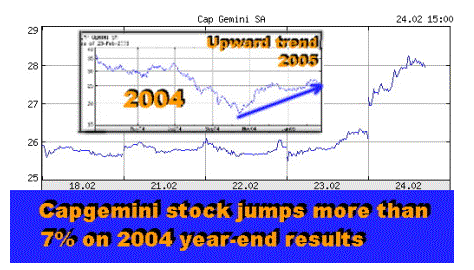
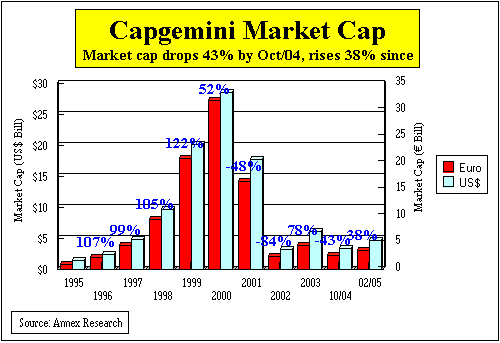
The stock market evidently liked what it saw. Undaunted by the company’s continuing losses, the Paris Bourse lifted the Capgemini shares by almost 8% to €28.30 following the release of its latest results (see the chart). That’s because the operating income fell less than analysts had feared, and revenues and new contract sales were higher than expected.
“We
are on a new profitability trend,” Nicolas Dufourcq, Capgemini’s
CFO, told the analysts during a teleconference that followed the
earnings release. “It is
not a hiccup (a one-time blip?). It's
something that will be continued in 2005.”
Capgemini’s
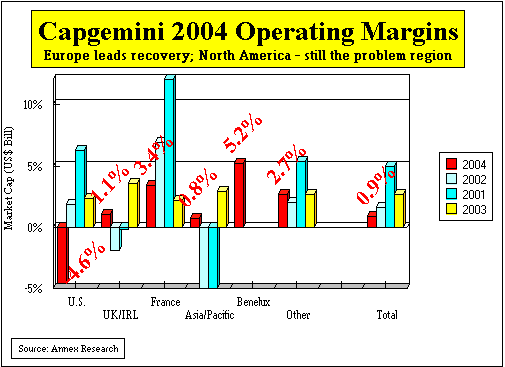
recovery in Europe is gathering momentum, while North America continues
to be its biggest enfant terrible (problem child).
The North American operations showed a loss of €32
million in the second half, the same amount as in the first, with the
ramp-up costs of large contracts like TXU contributing to it.
 Paul
Hermelin, the CEO, told the conference call participants that, “in the
second half (of 2004), we delivered on our commitments -- growth and a
return to profitability, with a strong recovery in Europe ...”
Paul
Hermelin, the CEO, told the conference call participants that, “in the
second half (of 2004), we delivered on our commitments -- growth and a
return to profitability, with a strong recovery in Europe ...”
Capgemini
has a new man at the point leading the U.S. recovery efforts.
It is its new COO, Pierre Danon, whom Capgemini has just
recruited from British Telecom where he ran very successfully its retail
operations. Danon will be the third top executive in less than 12 months
to take a crack at fixing the leaky North American ship.
The
CEO Hermelin is confident that his new man and the region’s recovery
plan, codenamed “Booster,” will bear fruit.
And quickly. “We started the U.S. (turnaround) plan, and I hope we can
give you some positive news within two months,” he told the analysts.
How
will the “Booster” reverse the consequences of the three
“Bruiser” years that have dropped the U.S. revenue share from 40% to
22%?
Capgemini
will refocus on a limited number of accounts in the U.S.; will be more
selective in its investments; and will reduce the number of its office
locations from 44 to 12, Hermelin said.
It will also offshore more services to Poland and India.
But Capgemini’s big challenge in the U.S. market has been and will be generating profitable new business, such as the TXU deal, and thus growing its revenue. Reducing the number of engagements, consolidating offices, and shifting work to lower-cost countries – the key “Booster” steps - will hardly boost its U.S. revenues.
Strong European, SMB Results
Meanwhile,
Capgemini’s European operations seem to be going gre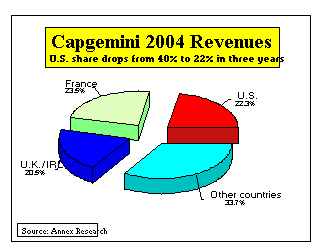 at
guns again. Their operating
income rose from €12
million in the first half of the year, to €110
million in the second half, and “is starting 2005 with renewed
operational confidence,” the company said.
at
guns again. Their operating
income rose from €12
million in the first half of the year, to €110
million in the second half, and “is starting 2005 with renewed
operational confidence,” the company said.
Furthermore,
European and Asia/Pacific revenues grew by 21% for the year, while North
American business declined by 18%, despite the influx of new revenues
from the TXU megadeal.
Within
Europe, the two largest Capgemini countries, the U.K. and
France, led the recovery with 53% and 48% respective revenues spurts (in
euros). The Benelux and
Nordic countries also reported a strong double-digit rise.
But the fastest growth occurred
in Capgemini’s small and medium business [SMB] market.
With the integration of the Transiciel business, acquired in late
2003, Capgemini has exploded in local professional services.
With a headcount of almost 14,000, this unit posted a revenue
jump from about $580 million to $1.3 billion (a 6.6% organic growth
rate). This has doubled its
share of Capgemini revenues from 8% to 16% in just one year.
More importantly, it has also increased its contribution to
profits.
Outsourcing
Growth Adds to Profit Woes, For Now…
Outsourcing
is also gaining share of Capgemini’s business.
It now accounts for one-third of the total (up 21% over 2003 as
reported in euros, and up 26% in U.S. dollars).
 At the end of
2004, the backlog stood in excess of €14
billion (an increase of 40% over the year).
This should contribute €3
billion to 2005 revenues, Capgemini said. Of that total, the outsourcing contracts represent €11
billion, or nearly 80% of the total backlog.
At the end of
2004, the backlog stood in excess of €14
billion (an increase of 40% over the year).
This should contribute €3
billion to 2005 revenues, Capgemini said. Of that total, the outsourcing contracts represent €11
billion, or nearly 80% of the total backlog.
Alas,
the increase in outsourcing share is actually one reason for
Capgemini’s profitability struggles.
The other is technology services.
The company’s two largest horizontal business segments have the
lowest profit margins (technology services actually lost €46 million
in 2004 on revenues of about €2.2 billion, while outsourcing made a
€14 million operating profit on revenues of €2.1 billion).
By contrast, the SMB operation (“local professional
services”) has much higher (7.5%) profit margins, but its 2004 revenue
is only €1 billion.
The
company’s net cash position improved from €266
million to €402
million at the end of 2004 - topping the €350
million Capgemini executives had predicted.
This included €98
million from asset sales. But
equity declined to €3
b illion
from €3.35
billion in 2003, due to the restructuring-related losses.
illion
from €3.35
billion in 2003, due to the restructuring-related losses.
New contract sales were down
slightly in 2004 compared to 2003, the company’s banner year
highlighted by its Inland Revenue win in the U.K. (see “Biggest
Feather in Cap’s Cap,” Dec 2003).
But at €10.5
billion ($13.8 billion), they are still quite respectable.
Outlook
The
company is hoping that as outsourcing matures, and the big deals’
upfront costs begin to wane, they will correspondingly drop larger
amounts to the bottom line. The
rapid growth in its SMB business will also have a beneficial profit
effect.
“We are shooting for a
(operating) margin of 3% or better if the U.S. restructuring can be
accelerated,” Hermelin told the analysts.
That’s
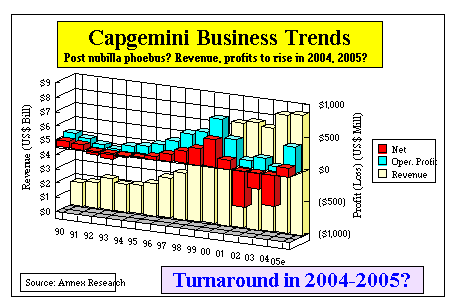
may not sound like much, but it beats €1 billion (over $1.3 billion) of red ink Capgemini
has bled to the bottom line in the last three years. And that qualifies the 3% profit a turnaround of major
proportion, at least in our books, especially when accompanied with a
double-digit (10%) growth at the top line.
Improving Capgemini’s sales and revenue record in the U.S. will
be the company’s “wild card” in achieving that.
Happy
bargain hunting!
Bob
Djurdjevic
For additional Annex Research reports, check out... 2005
IT:
Capgemini:
Turning the Corner (Feb 2005);
IBM
Servers to Grow Again (Feb 2005);
Carly's
Fickle Fans (Feb 2005); CSC:
Gearing Down on Purpose
(Feb 2005); EDS:
Grossly Overpriced Stock (Feb 2005); IBM
Historical Update: 2004 Shot in the Arm (Feb 2005);
New HeadTurners Series #1 (Feb
2005); IBM:
A Crescendo Finale! (Jan 2005); Accenture:
Strong Finish, Better Start (Jan 2005); Annex
Coverage 2004: IT Services Dominate (Jan 2005) 2004

2003 Cap: Biggest Feather in Cap's Cap (Dec 2003); The 10-year Glitch (Mar 2003)
A selection from prior years - Cap:
Analysis of CGE&Y 2001 Results (Feb 21, 2002), Analysis of Cap Gemini Ernst & Young 2000 ... (2001), CGG 1999 Preliminary (Mar 10, 2000), CGG Annual Report 1998 (June 18, 1999), CGG: The Most Improved (1998)
Or just click on  and use appropriate
keywords.
and use appropriate
keywords.
Volume XXI, Annex Bulletin 2005-06 Bob Djurdjevic, Editor 4440 E Camelback Rd #29, Phoenix, Arizona 85018 The copyright-protected information contained in the ANNEX BULLETINS and ANNEX NEWSFLASHES is part of the Comprehensive Market Service (CMS). It is intended for the exclusive use by those who have contracted for the entire CMS service. |
Home | Headlines | Annex Bulletins | Index 2005 | About Founder | Search | Feedback | Clips | Activism | Client quotes | Workshop | Columns | Subscribe