

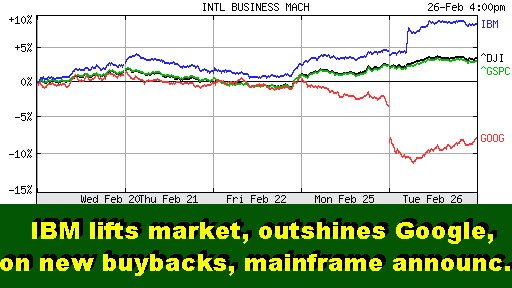
 But while the
stock market was buzzing with IBM and Google news, the greatest buzz at the
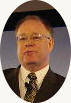
IBM mainframe announcement in New York was generated by Buzz Woeckener, a
customer (left).
But while the
stock market was buzzing with IBM and Google news, the greatest buzz at the
IBM mainframe announcement in New York was generated by Buzz Woeckener, a
customer (left).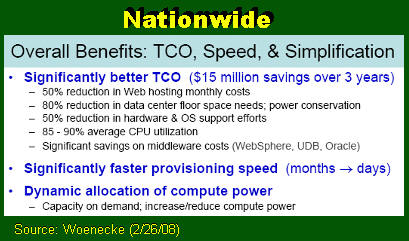 ation
project that has yielded $15 million in savings over three years.
"It's been a great ride," he added. "We've met all our expectations
and exceeded quite a few."
ation
project that has yielded $15 million in savings over three years.
"It's been a great ride," he added. "We've met all our expectations
and exceeded quite a few."
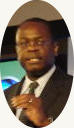 Rod
Adkins (left), senior IBM vice president of M&D, told the New York
audience that IBM itself "will double its computing capacity between
now and 2010 without increasing energy consumption or carbon
footprint." Adkins said that IBM currently
Rod
Adkins (left), senior IBM vice president of M&D, told the New York
audience that IBM itself "will double its computing capacity between
now and 2010 without increasing energy consumption or carbon
footprint." Adkins said that IBM currently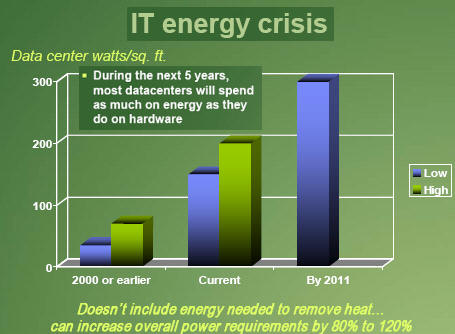 operates eight million square feet of data center space, and
influences and 40 million that its customers run.
operates eight million square feet of data center space, and
influences and 40 million that its customers run.
"We're about to hit the wall," Adkins said, when it comes to energy consumption. And the new z10 will help stave that off for a while.
Nationwide's Woenecke said his company was "going to hit the all" in 2005. But now, thanks to the new IBM mainframe technology, Nationwide will be able to put off a physical data center expansion till 2010.
Traditionally, mainframe computers run at utilization rates of
85% and more (up to 99%+ at Nationwide), while by contrast, the
PC-style servers have utilization rates of only about 15%. As
a result, the once costly mainframes, have become the low-cost data
center solutions, even if individual machines cost $1 million and
up.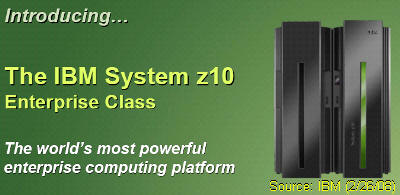
"The market economics are moving in our direction, and we’re seeing a return to the mainframe," Jim Stallings, general manager of IBM's Enterprise Systems, was quoted as saying in today New York Times story (Stallings was actually in Mumbai, India, leading the IBM announcement for this important Asian market, while Bill Zeitler, the head of all IBM hardware, did it in Tokyo and Beijing).
 Adding
executive weight to the importance of the New York launch was Steve Mills, the
head of IBM software. Mills said he reveled in the chance to
sell hardware for a change. His enthusiasm and almost
evangelical zeal in describing IBM's
virtualization strategy was as infectious as that of the Nationwide
customer.
Adding
executive weight to the importance of the New York launch was Steve Mills, the
head of IBM software. Mills said he reveled in the chance to
sell hardware for a change. His enthusiasm and almost
evangelical zeal in describing IBM's
virtualization strategy was as infectious as that of the Nationwide
customer.
"The z10 is an absolute screamer," Mills raved. "We have never taken a step this big" when introducing new mainframe technology. Indeed, the z10 offers between 50% and 100% performance improvement over the z9 which debuted in July 2005 (see "Polaris Eclipses T-Rex", July 2005).
Yet even with the previous generation z9, IBM enjoyed unparalleled success. Mills said that in 2006, "the fastest growing server in the industry from a revenue standpoint was the IBM System z, not some Intel-based server." And that's no small feat, considering that there are some 30 million servers in the world today.
Mills hailed the z10 as a "commercial supercomputer" and a "universal server" that can run a broad range of different workloads.
"We are at a fundamental inflection point in our industry," Mills said, likening the current situation to that in 1974, when the concept of virtual machines first emerged. There is an explosion of handheld devices around the world, as well as a huge increase in data storage. Both are straining the traditional data center concepts, and calling for new approaches.
Besides the z10, IBM also unveiled today what it calls the "new
enterprise data center" whose "underpinning is virtualization," said Adkins. He said
that between now and September, IBM will offer 300 free one-day data
center assessments to its enterprise customers that will help them
decide if the new IBM approach is the right one for them.
whose "underpinning is virtualization," said Adkins. He said
that between now and September, IBM will offer 300 free one-day data
center assessments to its enterprise customers that will help them
decide if the new IBM approach is the right one for them.
At Nationwide, that is no longer a question. "in two minutes I can now configure new servers for one of our users who wants to test some new idea," Woeckener raved. "And if the idea doesn't work out, I can remove them just as fast."
In January 2006, for example, they were able to stress-test the performance of their system at a 22-fold increase in computing capacity, anticipating additional demand due to their new Superbowl commercial.
You can't do t hat
with any physical "industry standard" (Intel-based) servers, he
added. The fact that all through 2007, their mainframes "had
zero downtime from a hardware standpoint," was simply a bonus.
hat
with any physical "industry standard" (Intel-based) servers, he
added. The fact that all through 2007, their mainframes "had
zero downtime from a hardware standpoint," was simply a bonus.
Add to it the IBM System z's legendary "Fort Knox"-type security, and you can begin to understand while the mainframe is experiencing a renaissance (we predicted three years ago - see "Poughkeepsie Spring," Feb 2005 or click on the right image). For the rest of the year, the only question is to what extend they will boost IBM's financial fortunes as they have already done to its image in the market place.
|
Annex Clients: CLICK HERE for additional charts and photos |
 Click
here for PDF (print) version
Click
here for PDF (print) version
