

Home |
Headlines | Annex Bulletins
| Index 2004 | About
Founder | Search | Feedback
| Clips | Activism
| Client quotes | Workshop | Columns
| Subscribe 
The copyright-protected information contained in the ANNEX BULLETINS and ANNEX NEWSFLASHES is part of the Comprehensive Market Service (CMS). It is intended for the exclusive use by those who have contracted for the entire CMS service.
An OPEN Client Edition
JAPANESE COMPANIES
Analysis of Fujitsu FY04 Business
Results
Back
in the Black Again, But…
Shrunk by the Marketplace and More Japan-centric Than 10, 20 Years Ago
PHOENIX, July 26
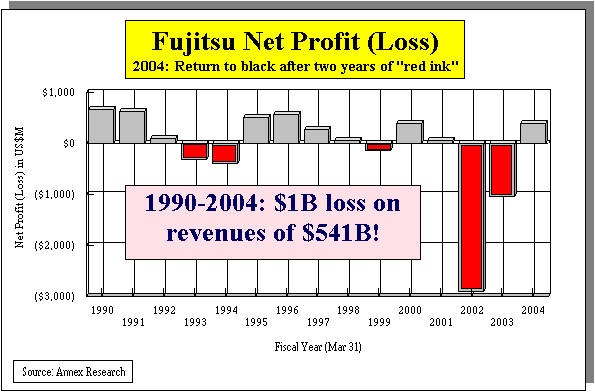
– After two years of horrendous losses that wiped out cumulative profits
from the last 15 years, and topped them off with $1 billion in “red
ink,” Fujitsu returned to black in its fiscal year 2004 (ended March
31). The leading Japanese
computer vendor earned $396 million on revenues of $43.3 billion, up 12%
(in U.S. dollars; up 3% in Yen).
Investors nodded in approval. Fujitsu shares are up about 40% since a year ago. They are up about 17% since the start of 2004 (see the chart).

But success is a relative thing.
After all was said and done in its first growth year since 2001,
the Japanese company’s latest turnaround attempt still leaves it smaller
than it was in 1998. If that
sounds familiar, it is. In
April 2003, we noted the same was the case with Fujitsu’s chief rival
– IBM.
Sam
Palmisano’s Big Blue of 2002 was about the same size as Gerstner’s IBM
was five years ago ($81.3 billion in revenues).
(see
“Shrunk
by the Marketplace,” Apr 2002).
Following IBM into its missteps as well as
successes, but always a few steps behind, has been one of several
consistent patterns in Fujitsu’s recent corporate history. Appearing to lead Japan’s charge on foreign markets,
especially the U.S., is another…
In the early 1980s, America fretted and feared an invasion from Japan. Not a military one. The U.S. computer industry was thought to be the next target of aggressive business leaders from the “Land of the Rising Sun.” Japanese companies had just executed successful campaigns against the American auto and electronics manufacturers.
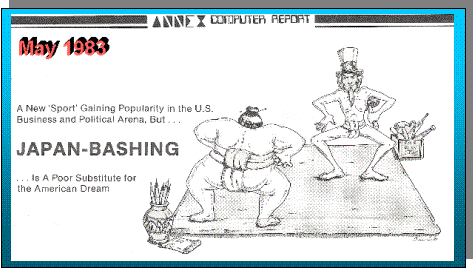
As a result, they were being both vilified and
admired in America. Most of all, however, they were feared (see “Japan
Bashing,” May 1983). They
needn’t have been. Here’s
what we said about it three years ago:
Anybody still remember quality
circles, consensus management, lifetime employment, fifth generation
computers…? They were the
hallmarks of the daunting “industrial miracle” that the Land of the
Rising Sun once represented.
The feared Japanese takeover of the American business became such an obsession in the early 1980s, that certain U.S. congressmen unabashedly bashed Japanese products on the Capitol steps with hammers, symbolizing the Japan-bashing climate that pervaded the American psyche at the time.
Today (2001), admiration and fear
of the former Japanese industry titans has been replaced in America with
pity and indifference. And
for good reason… Those who
ride the crest of one economic wave are the first to crash when the next
one comes along.
(“From Piety to Pity,” Aug 2001)
What is the
reason the Japanese companies’ failed to conquer America’s IT market?
With the advent of services and the Internet, the ground shifted
and the game changed away from hardware manufacturing – the Japanese
strength. Set in their ways
and slow to change, the Japanese weren’t able to keep up and adapt, just
as we predicted over 14 years ago (see “Trouble for Japanese?” -
“Industry
Stratification,” Mar 1990).
“Can the Ethiopian change his skin, or the
leopard his spots?” (Book of Jeremiah).
The answer, of course, is no.
That is true not only of biblical Ethiopians or leopards but also
of some modern-day IT enterprises.
The more Fujitsu tries to become a global
contender – and it has been trying that very hard in the last two
decades - the more it looks like a Japan-centric company…
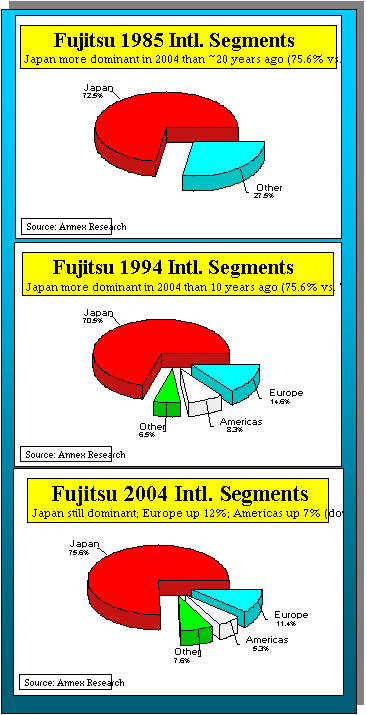
Two decades ago, Japan’s share of
Fujitsu’s worldwide revenues was 72.5%.
Ten years ago, it was 70.5%. Now,
Japan’s share is 75.6% (fiscal year 2004).
“It will not be enough to just (focus) on Japan; we will also
have to make our presence known abroad,” said Akira Yamanaka, corporate
vice president in charge of servers, speaking at a July 22 briefing in
Tokyo.
 Halleluiah!
How many times have we heard pontifications like that from the
various Fujitsu executives over the last two decades?
In fact, one can even go back one more decade (to 1974 when Fujitsu
invested in Amdahl Corp.), to trace this Japanese company’s global
ambitions. That’s when
Fujitsu acquired a minority position in Amdahl, an American
“plug-compatible manufacturer” (PCM) that became IBM mainframe’s
main bane in the next two decades.
Halleluiah!
How many times have we heard pontifications like that from the
various Fujitsu executives over the last two decades?
In fact, one can even go back one more decade (to 1974 when Fujitsu
invested in Amdahl Corp.), to trace this Japanese company’s global
ambitions. That’s when
Fujitsu acquired a minority position in Amdahl, an American
“plug-compatible manufacturer” (PCM) that became IBM mainframe’s
main bane in the next two decades.
Fujitsu also established a “beachhead” in
Australia in the 1970s, an English-speaking market from which the company
intended to launch its “invasion” of America.
It never happened. Technologies have come and gone; leaders have come and gone;
profits and losses have come and gone… Yet, Fujitsu has remained stuck
in the 70% to 76% range (Japan’s share of global business – see the
charts). Worse, overseas
markets continue to be the sore spots in Fujitsu’s financial results.
Business
Segments
Geographic Segments… Take
the Americas, for example. The
world’s biggest and richest IT market not only accounts for a miniscule
(5%) share of Fujitsu’s revenues; it has been losing money for the last
four years. In the latest fiscal year, for example, this geography lost
$120 million on revenues of $2.3 billion.
As for Amdahl, Fujitsu’s erstwhile pride and joy in America, it
has disappeared in the bowels of the Japanese giant (see “Amdahl
Boosts Fujitsu,” Feb 1998, and “Amdahl
Plans to Stop Making Mainframes,” Oct 2000).
Nor are Fujitsu’s European operations faring
much better. In 2004, they
earned only $61 million in operating income on revenues of about $5
billion (11% of worldwide total). The
year before, the operating profit was even smaller ($31 million). But that was still better than the two years of losses that
had preceded it.
Fujitsu’s
acquisition of ICL in 1990, a British IT company that had been a
formidable competitor to IBM in the 1970s and 1980s, was another example
of its global aggressiveness. Like
Amdahl, however, ICL disappeared in the bowels of the Japanese parent.
By late 2003, Fujitsu’s British operations
were hanging by their threads. Then
came a stroke of good luck… its partnership with Capgemini in the Inland
Revenue deal (see “Biggest
Feather in Cap’s Cap,” Dec 2003).
Although Fujitsu got only one-third of the $5.2 billion
“megadeal,” and the least profitable part at that (infrastructure
management), the company was more than happy.
“Beggars can’t be choosers,” as an old saw goes.
“(The Inland contract) saved the company,”
one insider told us afterward.
Software and Services… Managing
the change from hardware to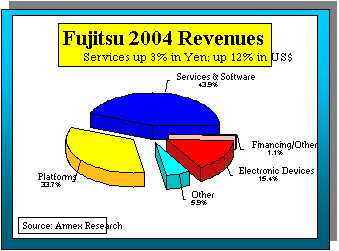 software and services has been one of the recent successes for Fujitsu.
In fiscal 2002, for example, this business segment’s revenues
exceeded those of the hardware for the first time in history.
And in 2004, software and services grew by 12% (up 3% in yen), the
same as the company’s overall growth.
software and services has been one of the recent successes for Fujitsu.
In fiscal 2002, for example, this business segment’s revenues
exceeded those of the hardware for the first time in history.
And in 2004, software and services grew by 12% (up 3% in yen), the
same as the company’s overall growth.
But once again, even in this relative success
story, Fujitsu was following in IBM footsteps.
It was IBM, a “gaijin” (foreigner) in Japan, that blazed the
trail to the new world of services in a culture that had staunchly
rejected paying for such “intangibles” in the past.
When this writer visited Japan in late 1993,
IBM’s march toward services was already under way, though still in its
early stages. So his
recommendation for the Japanese companies to follow suit, made during a
seminar in Tokyo, fell on deaf ears.
The excuse offered was that the Japanese customers would supposedly
never agree to pay for something they have been getting for free (services
were included in the price of hardware).
Well, 11 years later, IBM Global Services
(IGS) is thriving in Japan. Its
Asia/Pacific revenues, of which Japan is by far the biggest part, have
been growing in double-digits – faster than in any other part of the
world. And Fujitsu is once
again having to play catch up to IBM, this time in its domestic market.
Such is the fate of a follower… “The
scenery only changes for the lead dog,” as another old saying goes.
Furthermore, Fujitsu’s Japan-centric nature
is evident even in its services and software business, a $19 billion-unit.
Although now the third largest such operation in the world (after
IBM and EDS), Fujitsu’s non-Japanese revenues are only $4.7 billion or
less than one-quarter of the total (see the charts).
And its international portion actually declined 1% last year
(in Yen), while the Japanese services and software business grew by 5%
(also in Yen).
 Meanwhile,
Fujitsu’s solutions/systems integration versus infrastructure
services’ (outsourcing) revenue shares are pretty close (46% and 54%
respectively).
Meanwhile,
Fujitsu’s solutions/systems integration versus infrastructure
services’ (outsourcing) revenue shares are pretty close (46% and 54%
respectively).
Perhaps the most positive aspect of the
services and software unit is that its operating margin is by far the
highest among the Fujitsu business segments.
At 6.6% of revenue, it towers over that of hardware (1.8% - the
“platforms” in Fujitsu’s nomenclature), and of electronic devices
(3.8%). But it also serves to
underline how much less profitable even the “best of breed” Japanese
companies are in comparison to their U.S. counterparts.
Fujitsu’s 6.6%
operating margin includes software. IBM’s
does not. Software is IBM’s
most profitable unit. It
generates gross margins in the 86% range, and pretax margins around 24%.
Yet even without software, IBM Global Services’ operating margin,
estimated at 10.9% in 2003, by far exceeds Fujitsu’s 6.6% margin that
includes software. Such is
the difference between a leader and a follower…
Platforms…
Fujitsu’s platforms unit (hardware) ha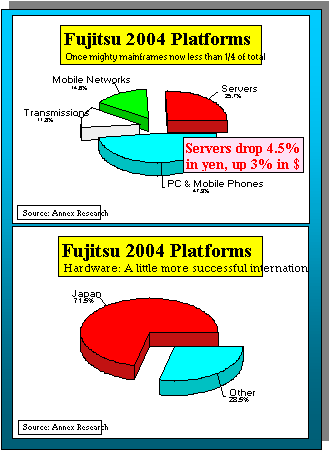 s
undergone the most radical changes in the last three years of the
company’s “restructuring” efforts.
They emerged smaller but profitable once again.
s
undergone the most radical changes in the last three years of the
company’s “restructuring” efforts.
They emerged smaller but profitable once again.
In 2002, the platforms lost $433 million at
the operating level on revenues of $15.2 billion. In 2004, they had a $266 million operating profit on revenues
of $14.6 billion. Clearly,
the revenue contraction was not as severe as was the profitability
improvement. So add one more
feather to the company’s management cap.
Within its hardware segment, however, the
servers’ revenues, which include the once mighty mainframes, continued
to shrink (down 4.5% in 2004 in Yen).
The executives who spoke at the company’s July 22 briefing in
Tokyo said they would reverse that trend.
Outlook
Chiaki Ito, executive vice president, said he
expected an 8% revenue growth for the servers in the current fiscal year,
and a 9.5% revenue growth for the platforms as a whole. More importantly for the Fujitsu shareholders, Ito said he
expected the operating margins to rise from 1.6% to 2.3%.
Still not much to write home about, of course, but better than the
read ink the Fujitsu hardware had been bleeding in prior years.
Ito also alleged that Fujitsu’s server
business is much more than meets the eye.
It provides a fourfold leverage to its other operations (for every
Yen spent on servers, the customers supposedly spend four Yen on other
Fujitsu products and/or services).
The services unit, for example, benefits to
the tune of 2.5 times from the server revenues. Even PCs, storage and middleware enjoy “drag-along”
effects from servers, though to a lesser degree (see the above chart).
It remains to be seen to what extent such
server praise may be self-serving. The
only thing certain from past evidence is that the Fujitsu servers have
shrunk drastically, while its services operations have expanded.
Akira Yamanaka, the vice president in charge
of servers, plans to reverse that. And
he is figuring on overseas business growth to do it. In the Unix market, for example, Yamanaka is hoping to grow
the business by 91% during the current fiscal year. This would put the overseas Unix servers’ share of
Fujitsu’s worldwide total at 58%, by far surpassing the 28.5%
international share for non-Japanese revenues at the corporate level (see
the chart on page 5).
As for Fujitsu services and software, the
planned revenue growth for the current fiscal year is quite modest (up
only 1%). But the company
will try to increase its operating margins to 7.9%.
So the emphasis seems to be on quality rather than quantity.
Summary
“The more things change, the more they are
the same,” Alphonse Karr noted in 1849.
Fujitsu is a case in point. The
harder the company tried to become a global contender, the more
Japan-centric it looked.
Is there a way to break out of that vicious
cycle? Yes, there is.
But it would take vision, courage and humility.
Vision – to lead, rather than follow.
Courage – to believe in and execute the vision.
Humility – to learn from others.
The next few years will show if Fujitsu’s
current leaders – Naoyuki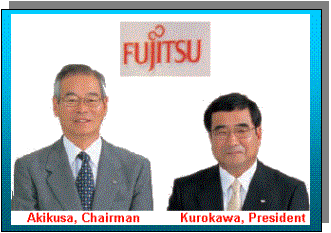 Akikusa, chairman, and Hiroaki Kurokawa,
president - have what it takes to do it.
Akikusa, chairman, and Hiroaki Kurokawa,
president - have what it takes to do it.
Let’s start with the vision…
What Fujitsu and other Japanese vendors
refused to believe back in 1993, has become quite obvious by now: Services
is the name of the game and the top of the food chain in the global IT
market.
What has also become quite evident by now is
that Fujitsu is incapable of becoming a major global IT services player on
its own. So it needs to buy
its way into it, and/or partner with others to do it.
Both choices take courage… courage to
change; to abandon the old tried and failed Fujitsu ways of doing things. Believing
that one can operate a successful global IT services company under a
Japanese brand name is one Fujitsu myth.
The company’s dismal North American results are screaming their
disapproval of such marketing theories.
Oddly enough, Fujitsu doesn’t have to look
far to see contrary examples of successful marketing. Enter humility…
Few buyers of
Infiniti luxury cares in America know that they are actually buying a
Nissan product. Ditto re. Lexus and Toyota brand names.
As for Japanese electronics manufacturers,
Panasonic, Pioneer etc. had pioneered this marketing branding trend long
ago.
Nor does it necessarily take a very long time
to establish a successful brand name.
Take Accenture, for example. Today,
this name is synonymous with IT services success world over.
Even competitors speak of it with awe and admiration.
Yet only four years ago, Accenture did not even exist.
The name was adopted by Andersen Consulting in late 2000 as part of
its arbitration settlement with Arthur Andersen.
Secondly, setting its sights on EDS as a
possible acquisition target could be a way for Fujitsu to kill two birds
with one stone. It could
become the second largest IT services provider in the world, practically
overnight. And it could
acquire a widely recognized global brand name. With
some spit and polish, and with new (American) leadership, EDS could easily
regain its former luster. And
Fujitsu would finally break out of its 25% to 30% overseas market share
barrier. It would be a
win-win deal.
Do Messrs. Akikusa and Kurokawa have what it
takes to carry out such a bold play?
Time will tell… And time seems to be one
commodity in ample supply in the Japanese culture.
Ironically in EDS’ case, time will work in
Fujitsu’s favor, at least in the short term. EDS
share prices are likely only to go one way – down.
Meanwhile, even if it did nothing drastic,
Fujitsu expects to double its operating income and net incomes in the next
three years. IF, of
course, things go according to plan… But, as Fujitsu knows all too well,
“the best laid plans of mice and men…” oft go astray.
Enter “Plan B.”
Ours.
Happy
bargain hunting! Bob
Djurdjevic

For additional Annex Research reports, check out...
2004:
Fujitsu: Back in the Black, But... (July 2004); Moody's Lowers the Boon on EDS (July 2004); HP: Delivering Value Horizontally (Jun 2004); Accenture: Revving Up a Notch (Jun 2004); Beware Your CFO! (May 2004); IBM: Changing of the Guard (May 2004); Capgemini: Texas-size Home Run (May 2004); Following the Money (May 2004); EDS: On a Wink and a Prayer (Apr 2004); HPS Wins by a Nose! (Octathlon 2004); Going Retro with Mainframes (Apr 8); IBM: Five-year Forecast (Apr 8); Mainframe at 40! (Apr 2); Accenture: Burning the Track (Mar 2004); "Crown Jewel" Restored? (Mar 2004); "Cap Gemini: Another, Smaller Loss" (Feb 2004); "CSC: Good Quarter Gets Boos" (Feb 2004); "Hot Air Jordan" Flaunts Flop as Feat (Feb 2004); "Cronyism Is Alive and Well at EDS" (Jan 2004); "Five Most and Least Likely Forecasts for 2004" (Jan 2004)2003 IGS: "IBM OnDemand: Different Strokes for Different Folks" (Dec 2003); "Investing in Growth" (Apr 2003)
2003 IBM: "IBM vs. HP: Spinning Global Server Market Shares" (Nov 2003); "Finally Heard, Part II," (Nov 2003), “Small Is Now Big at Big Blue” (Oct 16), “On the Nose But No Cigar” (July 16), “A Paler Shade of Blue” (June 2), “Save, Spend and Split” (May 8), “Shrunk by the Marketplace” (Apr 17), “Turnaround Continues...” (Apr 15), "Finally Heard!" (Jan 29), “Start of a Real Turnaround?” (Jan 17).
2002 IGS: "Half or Double Trouble?" (Aug. 12, 2002), "IBM to Take $500M Charge" (Sep 3, 2002), IBM-PwCC Update (Oct 2, 2002), Analysis of IBM Second Quarter Results (July 17, 2002), IBM Layoffs Confirmed! (Aug 14, 2002), Analysis of IBM Third Quarter Results (Oct 16, 2002), Boom Amid Gloom and Doom (Oct 10, 2002)
2002 IBM: “Gerstner: The Untold Story” (Dec 27), "Gerstner Spills the Beans" (Dec 13), "On a Wing and a Prayer" (Oct 21), "IBM-PwC Tie the Knot" (Oct 2), Big Blue Salami (June 19), "Looming IBM Layoffs" (May 14), "IBM 5-Yr Forecast: From Here to Eternity?" (Apr 2002), “Tough Times, Soft Deals,” (Apr 25, 2002), “Gerstner’s Legacy: Good Manager, Poor Entrepreneur” (Jan 2002), IBM Pension Plan Vapors: Where Did $17 Billion Go? (Mar 2002), "Sir Lou OutLayed Lay!" (Apr 1, 2002).
A selection from prior years: Is IBM Cheating on Taxes, Annex Bulletin 99-17 (May 1999), IBM 5-year Forecast 2001: An Unenviable Legacy (June 2001), "Break Up IBM!" (Mar. 1996), Fortune on IBM (June 15, 2000), “Smoke and Mirrors Galore,” July 2000), "Slam Dunk of Bunk" (Jan 2000), Annex Bulletin 98-14 ("Wag the Big Blue Dog"), Armonk's Fudge Factory (Apr. 9, 1999), Where Armonk Meets Wall Street, Greed Breeds Incest (November 1998), Stock Buybacks Questioned: Is IBM Mortgaging Its Future Again?, 97-18 (4/29/97), "Some Insiders Cashed In On IBM Stock's Rise, Buybacks" 97-22, 7/27/97, Djurdjevic’s Forbes column, "Is Big Blue Back?," 6/10/97; “Executive Suite: How Sweet!,” (July 1997), "Gerstner: Best Years Are Behind", Aug. 10, 1999), "IBM's Best Years Are 3-4 Decades Behind Us" (July 1999), "Lou's Lair vs. Bill's Loft" (June 1999), "Corporate Cabbage Patch Dolls," 98-39, 10/31/98; Djurdjevic’s Chronicles magazine October 1998 column, "Wall Street Boom; Main Street Doom", “Louis XIX of Armonk,” (Aug. 1996), "Mountain Shook, Mouse Was Born" (Mar. 25, 1994), “A Nice Guy Who Lost His Compass” (Jan 26, 1993), “Akers: The Last Emperor?” June 1991), Industry Stratification Trend (Mar. 30, 1990), etc.]
Or just click on  and use appropriate
keywords.
and use appropriate
keywords.
Volume XX, Annex Bulletin 2004-16 Bob Djurdjevic, Editor 4440 E Camelback Rd #29, Phoenix, Arizona 85018 |
Home | Headlines | Annex Bulletins | Index 2004 | About Founder | Search | Feedback | Clips | Activism | Client quotes | Workshop | Columns | Subscribe