

Home |
Headlines | Annex Bulletins
| Index 2004 | About
Founder | Search | Feedback
| Clips | Activism
| Client quotes | Workshop | Columns
| Subscribe 
The copyright-protected information contained in the ANNEX BULLETINS and ANNEX NEWSFLASHES is part of the Comprehensive Market Service (CMS). It is intended for the exclusive use by those who have contracted for the entire CMS service.
An OPEN Client Edition
IBM FINANCIAL
Analysis of IBM’s Third Quarter Business Results
Slow Quarter No Longer
Solid Growth Across the Board, But Some Challenges Remain
PHOENIX, Oct 19
– What is typically a slow quarter for both IBM and the IT industry
turned out to be Big Blue’s best three-month period in a very long time.
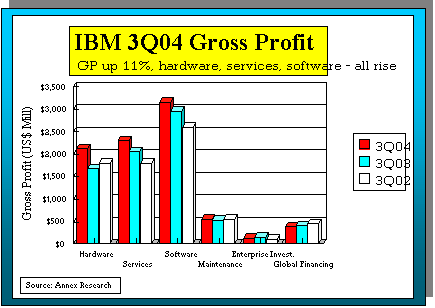
Third quarter revenues were up 9%, lead by hardware and services,
each of which grew in double digits (12% and 11% respectively).
Net earnings jumped by 15%, if adjusted for a $320 million one-time
charge IBM took on account of the pension plan lawsuit settlement.
Particularly encouraging was the surge in Americas, IBM’s most important geography ($10 billion revenues; 42% of total), within which the U.S. market is by far the largest. Revenues were up 8% (7% in constant currency), the highest quarterly jump this year. In recent years, the U.S. has been a slow or no growth area for IBM and other IT industry vendors. So the latest results herald a turnaround of sorts in customer spending.
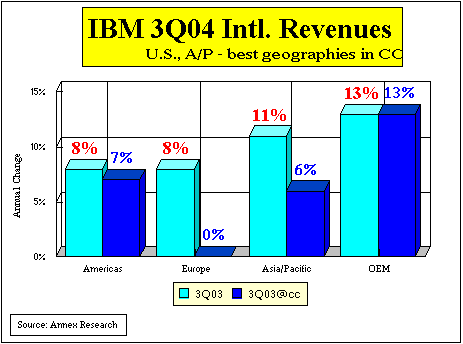
The Asia/Pacific revenue growth was also
strong (11% as reported; 6% in constant currency). It was the third quarter in a row that this region had a 6%
revenue increase in constant currency – the most consistent growth of
any IBM business segment.
Among various industries, communications,
government and distribution revenues grew in double digits (16% and 11%
respectively). Others
increased in single digits. None
declined.
As for IBM hardware product lines, the (Intel-based) xSeries and the zSeries (mainframes) servers turned in the best report cards. Their revenues jumped by 26% and 12% respectively. IBM PCs also showed strong revenue growth (up 17% to $3.3 billion). They were even marginally profitable (1.7% pretax margin), something that hasn’t happened very often with Big Blue PCs in the last decade or so.

The stock market reacted favorably to the IBM
third-quarter release, pushing up the stock by over four points today.
Some Disappointments
But it wasn’t all roses in the Big Blue
garden. There were some
weeds, too. But that’s
life… You have to take the bad with the good.
“No one has yet drunk a cup of honey without
mixing it with a cup of bile,” noted Njegos (1813-1851), a famed
Montenegrin ruler in his “Mountain Wreath” collection of poems. “A cup of gall needs a cup of bile; they are swallowed the
easiest when mixed.”
Services.
Back to real life
from poetry and metaphors, the biggest disappointment to us were the new
contract sales and backlog numbers that IBM Global Services (IGS)
reported. The “biggest” -
because IGS is now IBM’s largest and most important unit.
In the old days, people used to say, “as
goes the mainframe, so goes Big Blue.”
Nowadays, “as go the services, so goes Big Blue” is more
appropriate. IGS’ ups and
downs now pretty well shape the Big Blue future, as most of the
services contracts are multi-year deals.
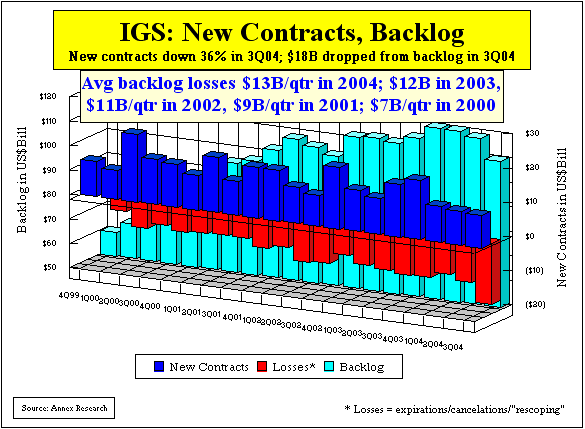
Anyway, IGS’ new contract sales were down
36% in the third quarter from the corresponding period a year ago.
At $9.8 billion, the latest new business signings were the lowest
since 3Q02, and only the third time in the last 20 quarters that new
business signings were in single digits (i.e., below $10 billion).
Nor is this just a one-time disappointment. For the first nine months of 2004, they new contract signings were also down - 40%. As a result, the IGS backlog is now $10 billion lower than at the start of the year, having dropped $8 billion in the latest period alone. Which means that $18 billion of the IBM backlog disappeared in various cancelations/expirations/ ”rescopings” during the third quarter – a record decline, compared to $13 billion per quarter average losses this year, and $7 billion only four years ago (see the chart).
So it wasn’t all JP Morgan, the
well-publicized $5 billion-IBM loss that some analysts quoted by the media
cited as the reason for the backlog decline (see “Outsourcing
Boomerang,” Sep 2004). IGS
has been struggling with new business sales and renewals of existing deals
even before the latest period (the backlog was down $2 billion in the
second quarter, too – see “Old
World Renaissance,” July 2004).
The latest results just happen to be the biggest disappointment
to-date.
IBM CFO, Mark Loughridge, tried to put a
positive spin on it during the conference with analysts that followed the
IBM earnings release.
“Over the last several quarters, in both
Strategic Outsourcing and Business Consulting Services, contracts are
smaller in size with shorter average duration,” he said. “This leads
to higher revenue yields.”
True enough.
But it also leads to increased sales costs and less profitable
deals. Besides, such
“spin” can hardly explain why $18 billion disappeared from IBM’s
backlog in a single quarter, at least not to analysts with open and alert
minds.
Loughridge seemed to agree, however
unwittingly. “Looking
forward, we expect the backlog erosion to return to more typical
levels,” he added.
That was an interesting comment. For, backlog
“erosion” has been anything but “typical” for IBM. Its backlog doubled between 4Q99 and 4Q03 from $60
billion to $120 billion. The
fact that the IBM CFO “looking forward” is still thinking
“erosion” instead of growth (that has been typical in
IGS’ past performance), is yet another reason to worry about the IGS future.
On the plus side, IGS has maintained its gross
profit margins at about 23% during the last 12 months, despite growing
share of outsourcing revenues - 12% vs. 7% for consulting and 10% for
systems integration. (Outsourcing
is typically less profitable than consulting or systems integration).
But the IGS pretax margin has eroded slightly (from 10.9% a year
ago, to 10.2% in the latest quarter).
See what we mean about the increased cost of sales?
iSeries. The iSeries servers,
formerly known as the AS/400s, were another disappointment in the latest
IBM quarterly report. Their
revenues were down 26%, after dropping 28% and 7% respectively in the
first two quarters of this year.
“The transition to Power5 (chip technology) is taking
longer than previous cycles, as existing customers must transition their
operating environment to the new level required,” was IBM CFO’s
explanation.

No
kidding (re. “taking longer”). Such
an excuse is already wearing thin. And
the iSeries’ revenue declines stand out like a sore thumb especially now
that all other IBM servers are reporting solid growth (also see “Old
World Renaissance,” July 2004).
The mainframes (zSeries), for example, grew by
12% in terms of revenues and by 17% in terms of MIPS.
The xSeries revenues soared by 26%.
Even the pSeries (Unix), the servers that share the Power5
technology with the iSeries, eked out a 1% growth, despite a weakness in
Europe.
So the new iSeries management had better start
delivering real growth real soon instead of the product transition
excuses.
SMB Market. The small and medium (SMB) market was another mild disappointment in the latest period. After growing by 15% and 7% respectively in the first two quarters of this year, the third quarter growth rate dropped off to only 5%. That shrank the SMB market share (of IBM total revenues) from 23% to 22%. And the SMB market is the IBM future! (see “Finally Heard, Part II,” Nov 2003).

Guess thinking small is hard for Big Blue,
just as it’s hard for a leopard to change its spots (re. “Can the
Ethiopian change his skin, or the leopard his spots?” - Book of Jeremiah).
IBM has always been the most comfortable with large enter
prises.
But the game is changing, and Big Blue must change with it.
About 70% of new jobs in America are created
by small and medium size businesses.
The economic growth is from the bottom of the corporate pyramid.
IBM knows it:
"IBM
market research indicates medium business spending on integration is
growing faster than the market as a whole (emphasis added)," IBM
said, adding that, "more than half of midsize companies are making
investments in connecting to their customers and suppliers in real
time."
(from
“Finally
Heard, Part II,” Nov 2003)
Since Big Blue seems to be now aware of where the greatest growth opportunities lie, all it needs to do is walk its SMB talk.
Some Other Upsides
Meanwhile, IBM did highlight two other upsides
that have developed recently in its business. Business Process Outsourcing (BPO), or Business Performance
Transformation Services in IBM Speak, recorded a 46% year-over-year
increase in the latest period. BPO
is now a $2.1 billion business at IBM.
It is a market that IBM and Accenture dominate, although other
major competitors, such as HP, EDS and Capgemini, are also trying to play
in it.
Emerging markets in four big developing
countries was another bright spot highlighted in IBM’s latest
financials. China, Russia,
India and Brazil now account for $3 billion of IBM revenues, up 33% from a
year ago. With exception of
Russia, those countries are also where much of the labor outsourcing is
taking place.
So it looks like “Finally Heard, Part
III,” may be in order. We
have been saying since at least 1996 that investing in developing
countries, especially in Eastern Europe, was another major growth
opportunity (see “Renaissance
II,” June 1996).
Summary
The latest IBM quarter was better than expected.
The company is firing almost on all cylinders.
The quarter wasn’t without some blemishes, but then there is no
such thing as a perfect game (except in baseball).
The most encouraging sign was a pick up in demand in the U.S.
market – a laggard until now. If
Big Blue keeps improving its pitching game – both high and low (IGS and
SMB) – it stands a good chance of making good quarterly results a habit.
Happy
bargain hunting! Bob
Djurdjevic

For additional Annex Research reports, check out...
2004 IT: IBM: Slow Quarter No Longer (Oct 2004); Accenture: Revenues, Profits Up, Stock Down (Oct 2004); Capgemini: A Takeover Target? (Oct 2004); Sellout of America (Oct 2004); Spy Wars (Sep 2004); Outsourcing Boomerang (Sep 2004); EDS to Cut Up to 20,000 More Jobs (Sep 2004); Capgemini Stock Plummets on Unexpected Loss (Sep 2004); HP Savaged by Wall Street (Aug 2004); Moody's Lowers the Boon on EDS (July 2004); HP: Delivering Value Horizontally (June 2004); Accenture: Revving Up a Notch (June 2004); Beware Your CFO! (May 2004); IBM: Changing of the Guard (May 2004); Capgemini: Texas-size Home Run (May 2004); Following the Money (May 2004); EDS: On a Wink and a Prayer (Apr 2004); HPS Wins by a Nose! (Octathlon 2004); Accenture: Burning the Track (Mar 2004); IGS: "Crown Jewel" Restored? (Mar 2004); HP: Still No Cigar (Feb 2004); Cap Gemini: Another, Smaller Loss (Feb 2004); CSC: Good Quarter Gets Boos (Feb 2004); EDS: "Hot Air Jordan" Flaunts Flop as Feat (Feb 2004); IT Industry: Whither Goeth It? (Jan 2004); Cronyism Is Alive and Well at EDS" (Jan 2004)
2003 IBM: "IBM vs. HP: Spinning Global Server Market Shares" (Nov 2003); "Finally Heard, Part II," (Nov 2003), “Small Is Now Big at Big Blue” (Oct 16), “On the Nose But No Cigar” (July 16), “A Paler Shade of Blue” (June 2), “Save, Spend and Split” (May 8), “Shrunk by the Marketplace” (Apr 17), “Turnaround Continues...” (Apr 15), "Finally Heard!" (Jan 29), “Start of a Real Turnaround?” (Jan 17).
2002 IBM: “Gerstner: The Untold Story” (Dec 27), "Gerstner Spills the Beans" (Dec 13), "On a Wing and a Prayer" (Oct 21), "IBM-PwC Tie the Knot" (Oct 2), Big Blue Salami (June 19), "Looming IBM Layoffs" (May 14), "IBM 5-Yr Forecast: From Here to Eternity?" (Apr 2002), “Tough Times, Soft Deals,” (Apr 25, 2002), “Gerstner’s Legacy: Good Manager, Poor Entrepreneur” (Jan 2002), IBM Pension Plan Vapors: Where Did $17 Billion Go? (Mar 2002), "Sir Lou OutLayed Lay!" (Apr 1, 2002).
A selection from prior years: Is IBM Cheating on Taxes, Annex Bulletin 99-17 (May 1999), IBM 5-year Forecast 2001: An Unenviable Legacy (June 2001), "Break Up IBM!" (Mar. 1996), Fortune on IBM (June 15, 2000), “Smoke and Mirrors Galore,” July 2000), "Slam Dunk of Bunk" (Jan 2000), Annex Bulletin 98-14 ("Wag the Big Blue Dog"), Armonk's Fudge Factory (Apr. 9, 1999), Where Armonk Meets Wall Street, Greed Breeds Incest (November 1998), Stock Buybacks Questioned: Is IBM Mortgaging Its Future Again?, 97-18 (4/29/97), "Some Insiders Cashed In On IBM Stock's Rise, Buybacks" 97-22, 7/27/97, Djurdjevic’s Forbes column, "Is Big Blue Back?," 6/10/97; “Executive Suite: How Sweet!,” (July 1997), "Gerstner: Best Years Are Behind", Aug. 10, 1999), "IBM's Best Years Are 3-4 Decades Behind Us" (July 1999), "Lou's Lair vs. Bill's Loft" (June 1999), "Corporate Cabbage Patch Dolls," 98-39, 10/31/98; Djurdjevic’s Chronicles magazine October 1998 column, "Wall Street Boom; Main Street Doom", “Louis XIX of Armonk,” (Aug. 1996), "Mountain Shook, Mouse Was Born" (Mar. 25, 1994), “A Nice Guy Who Lost His Compass” (Jan 26, 1993), “Akers: The Last Emperor?” June 1991), Industry Stratification Trend (Mar. 30, 1990), etc.]
Or just click on  and use appropriate
keywords.
and use appropriate
keywords.
Volume XX, Annex Bulletin 2004-22 Bob Djurdjevic, Editor 4440 E Camelback Rd #29, Phoenix, Arizona 85018 |
Home | Headlines | Annex Bulletins | Index 2004 | About Founder | Search | Feedback | Clips | Activism | Client quotes | Workshop | Columns | Subscribe