
Annex Bulletin 2005-19 October 24, 2005
An OPEN Client Edition
Updated 10/24/05, 7:20 PM PDT (adds U.S. dollar chart)

GLOBAL TRENDS
Annex Research Analysis of U.N. Annual Report on Global Investments
Yin-Yang Pacific Tsunamis
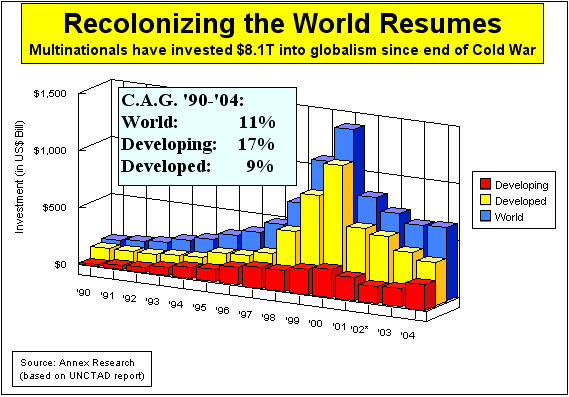
Australia Investments Soar in 2004; Money Also Pours into China, Russia, Brazil and Even Argentina Again; Global Investments Up 2%; Developing Up 17%, U.S. Rebounds by 69%, But he E.U. Slumps by 36%

NEW YORK, Oct 24 – As one natural tsunami wreaked havoc in the Asia/Pacific region at the close of 2004, another man-made tidal wave washed up on the shores of Australia and several other Pacific rim countries. The former brought death and destruction; the latter prosperity and merriment - the yin-yang effects of Pacific tsunamis.

And what countries were the biggest benefactors? Australia, first and foremost. It received $43 billion in direct investments in 2004, a six-fold increase over the year before. It was by far the strongest vote of business confidence that any country in the world got from the stingiest of judges – the capitalists who vote with their wallets. As a result, the Pacific Rim region investments also soared by 46% in the aggregate over the year before.

After
years of relative neglect, Russia’s oil and gas industry helped the
world’s largest country start to get some business recognition that it had
been sorely lacking since the end of the Cold War.
The Russia investments soared by 47% in 2004 to $11.7 billion, a
five-fold increase since 2001.
Nor is this just an energy boon driven by high oil and gas prices. Many IT companies have rushed into Russia (pun intended J) in pursuit of its excellently educated and still relatively low cost work force. No surprise there (see “To Russia with Love and $$$,” Oct 2004 and “New "Drang Nach Osten",” Sep 2005).

Other
Eastern European countries also continued to attract foreign investment in
large numbers. In fact, this
area is the only world region that did not suffer any declines at all in the
post-9/11 era. In 2004,
investments in Eastern Europe jumped by 45% over the prior year to $35
billion.
Latin America. The biggest
Latin American countries staged a comeback in 2004 in terms of foreign
investments. Brazil and Mexico,
for example, attracted $18.2 billion and $16.6 billion in multinationals’
capital, the 79% and 46% annual increases respectively.
And even the lowly Argentina, an erstwhile multinationals’ darling that turned into a pumpkin three years ago, soared back last year with a 125% jump in foreign investments to $4.25 billion. Bottom fishing by the Wall Street sharks? Probably. Just as was the case after the 1997 Southeast Asian financial crisis. Which goes to show us economic privation, and not just prosperity, can attract foreign capital. Another yin-yang story…
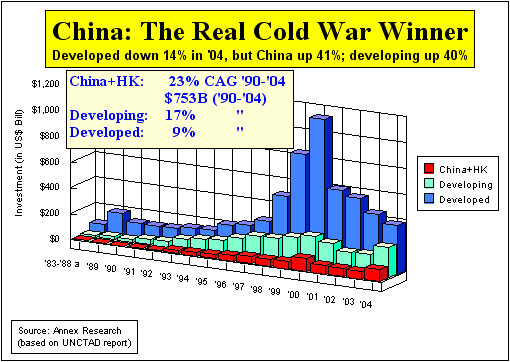
China. Despite increases in foreign investments elsewhere around the world, the Red China continues to be the biggest sustained attraction for western capitalists in the last 15 years. In 2004, China added another $95 billion to its foreign investment coffers, for a total of $753 billion since the end of the Cold War. This ranks China now as a virtual equal to the U.S., the country that has always dominated all others in terms of foreign investment appeal.

U.S. Speaking of the
U.S., the American economy rebounded in 2004 from a dismal 2003 investment
record in two prior years. The
U.S. ended the year with $96 billion in foreign investments, up 69% from
2003, but still considerably below the $159 billion-level in 2001, or the
$314 billion-record our country reached in 2000.
Still, a rise is better than three
India. In 2003 and
2004, and especially during the last U.S. presidential campaign, political
rhetoric made out India as the biggest nemesis of the American workers.
But talk is cheap. And the latest UN figures show that political noise can
overpower financial facts by a country mile.
In 2004, for example, even after a hefty 25% annual increase in foreign investments, India attracted “only” $5.3 billion of foreign capital. China, on the other hand, got $95 billion, as you saw earlier.

The
discrepancy between the two countries is even larger over a longer period of
time. Since 1990, for example,
China has attracted 22 times (!) more capital than India.
Yet our politicians, especially the Democrats, are screaming bloody
murder with
respect to “offshoring” of American jobs to India, while remaining
mostly mum about those that have gone to communist China.
Why
different strokes for different folks?
Maybe the Indians yet have a thing or two to learn from the Chinese
about buying of American politicians? (see “Sellout
of America - II,” Mar 2005, “The
Worst of Both Worlds,” Mar 2005 and “China
Follies Revisited,” Mar 2004).
Australia. Foreign investment flows into
Australia increased to a record $43 billion in 2004. Partly, this was due to a growth of equity investment from
$2.3 billion in 2003, to $35.5 billion in 2004, and a significant (56%) rise
in M&A deals. These were
driven by a strong demand for Australia’s natural resources.
For
example, two Japanese general trading companies, Ito Chu and Mitsui, plan to
invest jointly a total of $3 billion in iron ore in Australia with BHP
Billiton (Australia). The
privatization of State-owned assets, and liberalization of the media sector,
also played a part in foreign takeovers.
In
short, the apparent Australian prosperity is mostly built on selling out of
its resources to foreigners. With
economic policies like that, it’s just a matter of time before prosperity
turns into privation. If in
doubt, just ask the citizens of another country that starts with the letter
“A” (Argentina).
E.U. Which brings us to the biggest laggard among the countries the UN report on investments surveys – the European Union. Even though the latest UN report reclassifies the data to reflect the enlargement that added many fast-growing Eastern European countries to the EU, this continent’s foreign investments dropped by 36% in 2004 to $216 billion. Which means that the sluggishness of western industrial behemoths, such as France and Germany, for example, outweighed the benefits of more nimble economies to the east.

Global
investments in France, for example, dropped by 43% in 2004, from $43 billion
to $24 billion. But the French
had a relatively good record compared to Germany’s, the largest EU
economy. The latter actually
had a $39 billion foreign investment deficit, as many
multinationals called on their local subsidiaries to pay off the parent
company loans. It was the most
massive exodus of capital from a single country since we have been keeping
track of global investments (in the last 15 years).
Nor
was Germany alone in that respect. Nearly
$11 billion of foreign capital fled Denmark in 2004; almost $5 billion left
the Netherlands (for a total $24 billion decline since 2003), while Ireland
and Spain suffered $17 billion and $11 billion declines in 2004
respectively.
The
U.K. was the only major western European country to have attracted more
foreign capital in 2004 than the year before ($78 billion vs. $20 billion).
Since the U.K. is the least “European” of the EU countries, the
global capitalists, and not just the European voters, seem to be sending a
clear message to Brussels: “The EU ain’t working!”
Globalizing
R&D
As we’ve
noted earlier, the focus of this year’s UN report on global investments
has been the globalization of R&D.
This theme dovetails neatly on our recent report on the same subject
(see “New
"Drang Nach Osten",”
Sep 2005).
Last year, we talked about the globalization of services in the context of foreign investments (see “To Russia with Love and $$$,” Oct 2004). As the R&D is a form of service activities, like other service, it is “fragmenting”, the UN reports notes, with certain segments being located where they can be performed most efficiently. Indeed, according to a survey of Europe’s largest firms conducted in 2004 by UNCTAD and Roland Berger, all service functions – including R&D – are now candidates for offshoring.
Global
R&D expenditures have risen in the past decade to reach some $677
billion in 2002, the last year for which the UN has collected
data. The
R&D is highly concentrated. The
top 10 countries, led by the U.S., account for more than four-fifths of the
worldwide total. Only
two developing countries (China and Korea) feature among the top 10.
But
the share of developed countries fell from 97% in 1991 to 91% in 2002, while
that of developing Asia rose from 2% to 6%.
Similarly,
there has been a rise in innovation outputs (as measured by the number of
patents issued). The
share of foreign patent applications from developing countries, South-East
Europe and Russia to the United States Patent and Trademark Office, jumped
from 7% to 17% between 1993 and 2003.
The
globalization of R&D is also taking place beyond Eastern Europe and
Russia. Since
1993, for example, when Motorola established the first foreign-owned R&D
lab in China, the number of foreign R&D units in that country has
reached some 700.
The
Indian R&D activities of General Electric – the largest multinational
in the world – employ 2,400 people in areas as diverse as aircraft
engines, consumer durables and medical equipment.
Pharmaceutical
giants, such as Eli Lilly, GlaxoSmithKline, Novartis, Pfizer and
Sanofi-Aventis, all run clinical research activities in India. From
practically nothing in the mid- 1990s, the contribution by South-East and
East Asia to global semiconductor design reached almost 30% in 2002.
In
2003, foreign affiliates accounted for more than half of all business
R&D in Ireland, Hungary and Singapore and about 40% in Australia,
Brazil, the Czech Republic, Sweden and the United Kingdom. Conversely,
the R&D remained under 10% in Chile, Greece, India, Japan and the
Republic of Korea.
Summary
From China to India to Eastern Europe and Russia seems to be the direction of the big global financial tsunami, with sporadic waves of foreign dollars hitting the shores of Australia or Latin America. A polite way of describing the phenomenon would be to say that it is driven by lower labor costs and higher educational quotient. But the truth of the matter is that the fuel of global investments is greed, the same force that drives Wall Street investments.

If
in doubt, just check out the cross-border M&D (mergers and acquisition)
statistics in the latest UN report. In
2004, they surged by 28% to $380 billion, the highest level in the post-9/11
era. Since 1990, the
cross-border M&As have accounted for $5.3 trillion, or two-thirds of all
global foreign investments.
That
is why we wrote a year ago:
“When
we predict that the next global rage would be “To Russia with Love and
$,” we’re basically betting that greed would once again prevail.
Time will tell…”
(An
excerpt from “To
Russia with Love and $$$,” Oct 2004)
And time has already told, as you saw from the 46% surge of investments into Russia. As we look ahead, we see more of the same trend for the next several years… a “New Drang Nach Osten,” only with bigger numbers as the latest wave gathers momentum.
Happy bargain hunting!
Bob Djurdjevic
For additional Annex Research reports, check out... 2005
IT: Global
Investments: Yin-Yang Pacific Tsunamis (Oct 2005); IBM:
Springboard Quarter
(Oct 2005);
Top
Wall St Firms Bump Up Investments (Oct 2005); Accenture:
A Whopper Quarter
(Oct 2005); Global
Investments: New "Drang Nach Osten" (Sep 2005); HP:
Sweet Turnaround (Aug 2005); Dell
Spooks Street (Aug 2005);
EDS Ups Its Forecast
(Aug 2005); Capgemini
Beats Forecast (July 2005); Fujitsu:
Losses Reversed; Forecast Upgraded (July 2005);
IBM:
Polaris Eclipses T-Rex (July 2005);
IBM
Bounces Back
(July 2005); Accenture:
Smashing Records
(July 2005); Merrill's
New Bull (EDS)
(May 2005);
IBM
Trumps Trump
(May 2005);
Tweaking
Big Blue
(May 2005); Hurd's
First RBI (May
2005); Dell
Rings the Bell (May
2005); Stock
Buybacks: The Phantom Is Back (May
2005); EDS Misfiring
on All Cylinders (May
2005);
HP
Surges, Dell Slumps; Lenovo Completes IBM Deal
(May 2005);
Fujitsu
Revenues Flat, Lower Net
(Apr 2005);
Capgemini
Jettisons Healthcare in N.A.
(Apr 2005);
HP:
From India to Poland (Apr
2005);
IBM:
Slammed and Dunked (Apr
2005);
Hurd
Advice: Up Mount Market Cap (Apr 2005); Accenture:
Roaring Ahead (Apr
2005); Fujitsu
Unveils New Servers (Mar
2005); EDS
Executive Suite; HP's New CEO (Mar
2005); An
iSeries Revival (Mar
2005); EDS
Booster Club Fees Rise (Mar
2005);
An
Upside-Down View (Mar
2005);
The
Worst of Both Worlds
(Mar 2005); Octathlon
2005: Accenture Wins
(Mar 2005); IBM Global Services: Smaller,
Shorter - Better? (Mar 2005); IBM
5-yr Forecast: Quality over Quantity (Mar 2005); Rumor
Lifts EDS', Fujitsu's Shares (Mar 2005); Capgemini:
Turning the Corner (Feb 2005);
IBM
Servers to Grow Again (Feb 2005);
Carly's
Fickle Fans (Feb 2005); CSC:
Gearing Down on Purpose
(Feb 2005); EDS:
Grossly Overpriced Stock (Feb 2005); IBM
Historical Update: 2004 Shot in the Arm (Feb 2005); New
HeadTurners Series #1 (Feb 2005); IBM:
A Crescendo Finale! (Jan 2005); Accenture:
Strong Finish, Better Start (Jan 2005); Annex
Coverage 2004: IT Services Dominate (Jan 2005) 2004
IT: EDS:
The Titanium Stock (and other Wall Street tales)
(Dec 2004); IBM
PC: Good Riddance (Dec 2004); Fujitsu:
Recovery Continues (Nov 2004); IBM
Server Renaissance (Nov 2004); HP
Hits Home Run (Nov 2004); Capgemini:
Revenue, Stock Soars (Nov 2004);
EDS:
Jordan's Swan Song? (Nov 2004);
To Russia with
Love and $ (Oct 2004);
IBM: Slow
Quarter No Longer (Oct 2004); Accenture:
Revenues, Profits Up, Stock Down (Oct 2004);
Capgemini:
A Takeover Target? (Oct 2004); Sellout
of America (Oct 2004); Spy
Wars (Sep 2004);
Outsourcing
Boomerang (Sep 2004);
EDS
to Cut Up to 20,000 More Jobs (Sep 2004); Capgemini
Stock Plummets on Unexpected Loss (Sep
2004); HP
Savaged by Wall Street (Aug 2004); Moody's
Lowers the Boon on EDS (July 2004); HP:
Delivering Value Horizontally (June 2004);
Accenture: Revving Up a Notch (June
2004); Beware
Your CFO! (May 2004); IBM:
Changing of the Guard (May 2004); Capgemini:
Texas-size Home Run (May 2004); Following
the Money (May 2004); EDS:
On a Wink and a Prayer (Apr 2004); HPS
Wins by a Nose! (Octathlon 2004); Accenture:
Burning the Track (Mar 2004); IGS:
"Crown Jewel" Restored? (Mar 2004); HP:
Still No Cigar (Feb 2004);
Cap Gemini: Another, Smaller Loss
(Feb 2004); CSC: Good Quarter Gets Boos (Feb
2004); EDS:
"Hot Air Jordan" Flaunts Flop as Feat (Feb 2004); IT
Industry: Whither Goeth It? (Jan 2004); Cronyism
Is Alive and Well at EDS" (Jan 2004) Or just click on Volume XXI, Annex Bulletin 2005-19 Bob Djurdjevic, Editor 4440 E Camelback Rd #29, Phoenix, Arizona 85018 The copyright-protected information contained in the ANNEX BULLETINS
and ANNEX NEWSFLASHES is part of the Comprehensive Market Service (CMS). It is intended for the exclusive use
by those who have contracted for the entire CMS service. Home |
Headlines | Annex Bulletins
| Index 2005 | About
Founder | Search | Feedback
| Clips | Activism
| Client quotes | Workshop | Columns
| Subscribe 
 and use appropriate
keywords.
and use appropriate
keywords.
October 24, 2005
(c) Copyright 2005 by Annex Research, Inc. All rights reserved.
e-mail: annex@djurdjevic.com
TEL/FAX: (602) 824-8111