
Annex Bulletin 2006-35 September 15, 2006
An OPEN client edition
INDUSTRY TRENDS
Updated 6/14/06, 11:30PM PDT
Analysis of Top 20 Global IT Leaders’ Business and Stock Performances
Strong Comeback
Top 20 IT Stocks Recoup $110 Billion of Lost Market Cap in Traditionally Worst Quarter of the Year; Microsoft Biggest Member of $1 Trillion-IT Club
SCOTTSDALE, Sep 15 - What a difference three months can make - $110 billion-worth! When we analyzed the stock market performances of the top 20 global IT leaders in mid-June, we noted a huge market cap loss since the start of the year (see "A $160 Billion Loss!", June 2006). Since then, the biggest IT stocks have staged a strong comeback.

Which means, of course, that the top 20 IT companies, that account for over half a trillion dollars ($509 billion) of the industry's revenues, and for $47 billion of its profits, are still about $50 billion in the market cap hole for the year. But the third quarter is usually the worst, and the fourth is the best. So when the IT market bounces back with such vengeance in traditionally the worst quarter of the year, the outlook for a positive year-end finish is pretty good (see "A $100 Billion Gain," Dec 2005).
It is also worthy of note that the top 20 companies' market cap is now flirting with the $1 trillion-mark. And that more than a quarter of that total is attributable to just one company - Microsoft. So one can say, "there's Microsoft, and then..., well, the rest" when it comes to market cap.
Not that IBM's $126 billion-market valuation is not an impressive number. Or Intel's $114 billion; or HP's $101 billion - the other three IT leaders above the $100 billion-mark. But they are all at less than half of Microsoft's imposing $263 billion market cap (see the chart).
Market Analysis

The picture is similar when it comes to market cap changes in the last three months. Microsoft is again at the top, with a $41 billion-gain, followed by HP, Apple, Intel and Oracle - all around the $16 billion-mark. Dell, CSC and EMC hold up the rear.

It is interesting to note that SAP's market cap is also down slightly (by about 1%) despite a generally strong showing of the software companies.
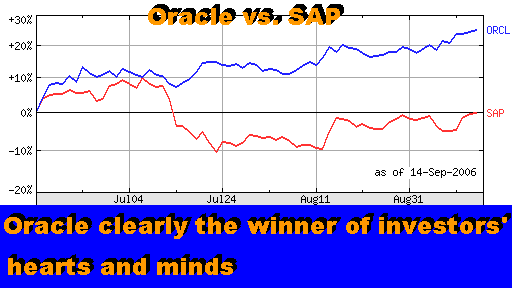
That's particularly significant relative to Oracle's $15.6 billion-gain, up 22% in the last three months. The winner of the bitterly contested 18-month takeover battle for PeopleSoft (SAP's chief competitor) is also clearly the winner of the investors' hearts and minds.

Market cap gains in the last three months were also fairly evenly distributed across the major IT industry segments. Hardware and software vendors have gained the most (Dell, EMC and SAP being the exceptions). The services sector, on the other hand, has seen meager pickings when it comes to higher valuations. Although only CSC's market cap has declined, the increases of the remaining IT services vendors were nothing to write home about as compared to other industry leaders.

Within the services segment, BearingPoint, Accenture, ACS and Capgemini ended up on top, each gaining between 10% and 15% since mid-June. EDS' shares also edged up by about 2%, while CSC's dropped by about 20% (for reasons why, check out "Ebb Tide Lowers Most Boats," Aug 2006).

It probably should surprise no one that Apple ended up on top of the heap in terms of percentage changes in market cap in the last three months. The marketing buzz the company has been able to generate only supplements impressive real (double digit) revenue and earnings gains. But the fact that Sun Microsystems placed second may raise a few eyebrows. A change of leadership at the top may be one reason that seems to have buoyed Wall Street investors.
Oracle, HP and Microsoft, of course, are the "usual suspects" when it comes to market cap gains any way you slice it, including the percentage increases. Once again, CSC, Dell and EMC are securely in the cellar.

As you have seen in our recent Annex Bulletin, Dell is still the "King of Fluff," though it has abandoned the practice (stock buybacks) that installed it on the throne (see "A Fading Fad," Sep 2006). So it should come as no surprise to our readers that Dell, however diminished, is still the leader of the pack in terms of market cap-over-equity ratio, the "fluff ratio" as we dubbed it in 1998. Nor that Accenture is second, proving one can win friends and investors' wallets on Wall Street without having to resort to stock buyback-type "bribes."
What is interesting, however, is that the next tier of tightly bunched-up top 20 companies - SAP, Apple, Microsoft, Oracle, Lexmark - have very little in common except for similar market cap-over-equity ratios. No surprise in the cellar, though. CSC, EDS and Perot are holding up the rear.

Our final stock market profile cuts across the top 20 IT companies along their (forward) price/earnings (P/E) ratios. Once again, we have perhaps a surprising leader here - Sun Microsystems. The less money your make (or the more you lose in Sun's case), the higher the P/E ratio. Assuming, of course, investors cut the company management some slack and assume profits would follow in the future. Which they did.
Ditto re. Computer Associates' (CA) ascent to the top five in this category.
The other three top companies - Apple, Capgemini and Fujitsu - are there because they have improved their earnings substantially, thus earning the higher P/E ratios relative to competition.
At the other end of the rung, CSC has now replaced IBM in the cellar. That's not much for Big Blue to cheer about, of course, as its stock remains grossly undervalued relative to its actual business performance. But there's always the fourth quarter... and a prayer, too, that Wall Street may finally take notice of some facts, and not just fluff.

Finally, who says that IT hardware business is dead? Having been practically written off in the latter part of the 1990s, the hardware sector, led by IBM and HP, is staging a strong comeback in the current decade.
As you have seen, the Apple and Sun shares have also appreciated at an even higher rate in the last three months that those of the two biggest IT industry giants. Only Dell is down appreciably.

And yet, even Dell's stock is showing a remarkable resilience despite a plethora of bad news emanating from the company in the last several weeks. As the week wore on, Dell's shares have staged an impressive comeback following a drop on Monday.
As with HP's boardroom maelstrom, which Mark Hurd has weathered virtually unscathed, certainly when it comes to the HP stock, investors seem to be giving the Dell leaders the benefit of the doubt.
Guess if there is a lesson other
CEOs can learn from Hurd's example at HP, it is the importance of building trust and credibility on
Wall Street. Had he not had that, the boardroom brouhaha might have
severely rocked, if not capsized the HP boat. As it were, his personal
prior credibility acted as a stabilizer
example at HP, it is the importance of building trust and credibility on
Wall Street. Had he not had that, the boardroom brouhaha might have
severely rocked, if not capsized the HP boat. As it were, his personal
prior credibility acted as a stabilizer  in
the crisis. In our books, that's as big a feather in Hurd's cap as
anything else he has done in his short time at HP.
in
the crisis. In our books, that's as big a feather in Hurd's cap as
anything else he has done in his short time at HP.
And now, it looks as if Wall Street is cutting Michael Dell (Dell's chairman) and Kevin Rollins (CEO) some slack, too.
Business Analysis
For a while, it was a horse race. But now, HP has edged out IBM from the top spot in the IT industry.

HP's rolling annual
revenues are $90 billion vs. $88.5 billion for Big Blue, a
a ccording to
the Capital IQ data. Guess
that makes HP now the new Big Blue (also see "Tech
Has New Top Dog," Business Week, June 2006). But don't hold
your breath about the marketplace accepting this new label any time soon;
too much brand name recognition and marketing power on IBM's side.
ccording to
the Capital IQ data. Guess
that makes HP now the new Big Blue (also see "Tech
Has New Top Dog," Business Week, June 2006). But don't hold
your breath about the marketplace accepting this new label any time soon;
too much brand name recognition and marketing power on IBM's side.
Meanwhile, Dell is now firmly entrenched as the third largest company in the industry, followed by Microsoft, Fujitsu and Intel.

When it comes to the bottom line, however, there is no comparison between the shades of blue. IBM's $8.47 billion rolling net dwarfs HP's $4.92 billion, though the latter is a quantum leap and a great improvement over last year's earnings. Towering over everybody is still Microsoft, another company with a blue logo, but with a $12.6 billion bottom line.
Intel is sandwiched in between IBM and HP as the third most profitable company in the industry. Oracle is fifth, having leapfrogged over the sliding Dell. If the current trends continue, SAP or even Apple may also surpass Dell in the foreseeable future.

When it comes to equity, Microsoft is again at the top of the heap. But in this case, it is closely followed by HP and Intel. IBM is only fourth. Being the industry leader in terms of stock buybacks has its price (see "A Fading Fad," Sep 2006). The $73 billion IBM has spent on share repurchases burned a pretty big equity hole.
Of course, all other top IT companies have been also spending billions the same way. But they've also kept proportionally more profits on their books than IBM.
Summary
Over the last couple of decades, there have been several times when business fundamentals and market valuations were at a variance. During the last three months, however, the market place has brought them more or less into balance.
There are exceptions, of course, the biggest discontinuity being Wall Street's continued under-appreciation of the IBM stock. But that's an exception that only confirms the rule. Generally speaking, the IT stock market and business are fairly well aligned. The universe is unfolding as it should.
|
For detailed tables, click
here for Top 20 stock/business stats |
Happy bargain hunting!
Bob Djurdjevic
 Click
here for PDF (print) version
Click
here for PDF (print) version
For additional Annex Research reports, check out... Annex
Bulletin Index 2006 (including all prior years' indexes)
Or just click on  and use "company or topic name" keywords.
Volume XXII, Annex Newsflash 2006-35 Bob Djurdjevic, Editor 8183 E Mountain Spring Rd, Scottsdale, Arizona 85255 The copyright-protected information contained in the ANNEX BULLETINS and ANNEX NEWSFLASHES is part of the Comprehensive Market Service (CMS). It is intended for the exclusive use by those who have contracted for the entire CMS service. |

Home | Headlines | Annex Bulletins | Index 2006 | About Founder | Search | Feedback | Clips | Activism | Client quotes | Workshop | Columns | Subscribe