
Annex Bulletin 2005-21 December 16, 2005
A partially OPEN Client Edition
Updated 12/16/05, 1:15pm MST (adds Tables)

INDUSTRY TRENDS
Analysis of Global IT Leaders’
Business and Stock Performances
A $100 Billion Gain!
HP, Intel, Fujitsu, Accenture, Capgemini - Top Gainers; Dell, IBM - Biggest Market Cap Losers; Oracle's "Pyrrhic Victory" over SAP; IBM Equity Depleted by Buybacks
SCOTTSDALE, Dec 16 – Wall Street seems to have righted some of its upside-down views of the IT industry that it held back in March (see "An Upside-Down View," Mar 2005). The result is a market cap gain of over $67 billion in the last nine months for the Top 19 companies we follow (see the chart below). But not before some $33 billion was first wiped out by the financial tsunami IBM's first quarter debacle unleashed back in April. This created a good buying opportunity for the not-so-faint at heart (see "IBM: Slammed and Dunked," Apr 2005 and "Top Wall St Firms Bump Up IT Investments," Oct 2005).

Those who had the foresight and the courage to act upon it back in April are now reaping rich awards - having a slice of about a $100 billion market cap gain that the Annex Research Top 19 stocks have produced (up 10% since April 19 vs. a 7% rise for Dow Jones).

So who were the biggest gainers? Well, HP, Fujitsu, Accenture and Capgemini topped their global IT peers in market cap percentage growth since March 15, 2005 - the last time we "took the temperature" of the Top 19 market. Lexmark, Dell, BearingPoint and IBM held up the rear in this category. They are the only four companies among the Top 19 to have actually experiences market cap declines since nine months ago.

In absolute market cap values, however, Intel topped HP, Microsoft, SAP and EMC in the last nine months. Which goes to show us that being a technological foundry isn't such a bad business if you have such marketing powerhouses as Microsoft, HP, IBM and Dell driving the engine.
Interestingly, the all-but-invincible Dell, the undisputed "King of Fluff" (market cap over equity - see the chart below), which led the stock market rally back in May, is now dead last among the Top 19 IT competitors in terms of market cap losses. Dell is joined by IBM, Lexmark and BearingPoint in that unflattering category.


That's because Dell's stock has sputtered since its August report card (see "Dell Spooks Street," Aug 2005). It has gained some ground in the last month or so, but it is still well off its year's high of $42.44 reached on Dec 31, 2004.

When it comes to long-term trends, however, Dell and Microsoft still share the IT industry's top honors. They are followed by Intel and Oracle, with HP and IBM, the two largest companies in the industry, well down the chart. The run-up in HP's stock in the last nine months (up 33%) has put some distance between itself and Big Blue. Will 2006 be the year of the IBM stock comeback? It could be if the company manages to put its sluggish services unit back on the growth path.
Business Performances
An now, from fluff to substance, from stock market to business performances of the Top 19 companies...

Microsoft has widened its lead over IBM and Intel after a 29% rise in its earnings during to nearly $13 billion (trailing 12 months). And Intel is right now nipping at the heels of Big Blue (with $8.3 billion vs. $8.6 billion net profit). Dell, Oracle, HP and SAP represent the next most profitable tier of IT leaders.
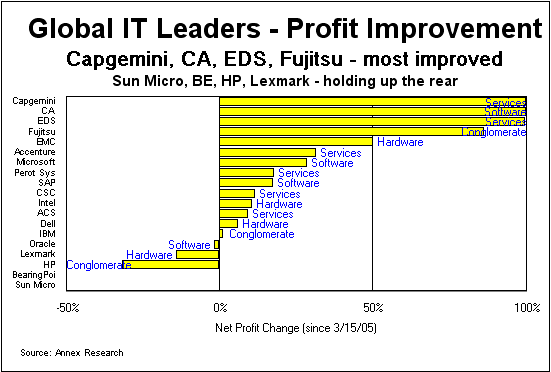
In terms of profitability improvements, however, it is Capgemini that takes the cake, followed by CA, EDS and Fujitsu. In all four companies' cases the turnaround means a reversal of losses from prior periods - thus the greatest rates of improvement.
For Accenture, Microsoft, Perot Systems and SAP, the next group of most improved profitable companies, the rise meant going from strength to greater strength.
Interestingly, HP - the most improved IT stock, is in the cellar in terms of profit changes. Such is the price that layoffs and write-offs carry on the way to "post nubilla phoebus" ("after clouds comes sunshine").
Oracle: Bigger Not Necessarily Better
That Oracle, one of the industry's most profitable and illustrious companies, is also in the cellar among the Top 19 in terms of the nine-month profit changes, only goes to show us that bigger is not necessarily better.

One year ago, Oracle acquired PeopleSoft after a bitter 18-month battle. So it got bigger. Most importantly, bigger than SAP - its chief rival in enterprise resource planning (ERP) market ($12.4 billion vs. $11 billion in revenues, and $2.9 billion vs. $2 billion in earnings). What followed was a war of words between the two software companies CEOs, back in February.
Well, words are cheap. Action speaks louder than words. And stock market action has shown what it though of the new Oracle vs. SAP match up...

It gave the German company thumbs-up, while spurning the Silicon Valley giant. This attitude was accentuated this morning (Dec 16), following last night's release of Oracle's latest financial results. On an "up day" for the overall market, Oracle shares have tumbled 4.4% to $12.27. Oracle now got its (big) size, but along with it the sluggishness of slower growth.
Microsoft, HP, Intel Eclipse IBM's Equity

Just how much things have changed around the IT industry can best be illustrated with the above Equity chart. Microsoft, HP and Intel are all now bigger than IBM in terms of shareholders equity. And EMC is the next biggest competitor in this respect. To a great extent, that's due to IBM's aggressive stock buyback program that has depleted its equity.

After a year's hiatus (in 2003), the company resumed stock buybacks in 2004, and accelerated them this year. IBM has spent $67 billion on share repurchases in the last 10 years. And 2005 is likely to set a new record high in stock buybacks, surpassing last year's total of $7.3 billion.
Defending this practice, IBM and other large companies doing it, are arguing that they are merely returning the wealth back to the shareholders. But unlike the dividends, that go to all stockholders, the proceeds from stock buybacks go only to some shareholders, principally the biggest institutional ones that account for most of the trading (vs. the "buy and hold"-type public).

Furthermore, there is no free lunch. Large stock buyback programs have a negative effect on shareholders equity, as can be seen from the above chart. Also, since the IBM market cap has declined substantially (down $66 billion since 2001) despite the stock buybacks, another argument in their favor has vanished. So they have become a lose-lose proposition. Big Blue and other IT companies that practice stock buybacks would be better served to invest in their own businesses, rather than turn their hard-earned cash over to Wall Street for reinvestment elsewhere.
Nevertheless, the Forbes Newsletter reported last month that its Buyback Index portfolio was up 415% since March 1997, compared to the 50% gain for the S&P 500. Year-to-date, the Buyback Index is up 13%, while the S&P is up less than 2% (see Forbes, Nov 15, 2005).
So clearly, it's not just IBM, Intel, Dell, HP or Microsoft. Hundreds of companies are doing it. The stock buybacks are another self-serving Wall Street-driven trend, devised and executed principally for the benefit of large institutional shareholders. The companies that participate in this scheme are basically abdicating their sovereignty and admitting a lack of investment imagination and business creativity.
If they keep doing it, or worse, accelerate the stock buybacks despite their dubious benefits, at least the general shareholders will know which masters such companies serves. It's the antithesis of the old saying, "he who pays the piper calls the tune." In this case, "he who pays the piper dances to the piper's tune." Even if it is off key.
The irony is that the practice that actually hurts the public (i.e., the small shareholders) has been actually helped and reinforced by recent government legislation that resulted in a huge repatriation of overseas funds. Here's what the "Hat Trick Letter", a financial newsletter, had to say about it on Nov 30:
"The Amendment for Jobs Creation Act is a classic misnomer, a fraud, nothing but a sweet corporate welfare conjob... Few if any new jobs were created, as over $200 billion have been repatriated to date. Planned to generate new jobs and create new business, the legislation has instead been a bonanza for big corporations to bring home vast sums of money. The record shows the bulk of foreign funds having been devoted to stock buybacks (emphasis added - Annex)... The bill is also known as the Homeland Investment Act, a more appropriate name, since homebound funds have been invested for sure, just not for business purposes. They have largely gone toward financial securities in one form or another."
The preceding also points out to whom our legislators are also beholden (i.e., the big business lobby).
Maybe general investors should consider companies such as Accenture, for example, that have not fallen for this Wall Street allure, and are still calling their own tune, and investing in their own businesses. When the buyback fad wears off, at least they will have something solid to hang on to. Alas, such companies seem to be a minority on Wall Street these days...
|
Annex Clients: Click here to view detailed a table of the top 19 IT leaders' stock market and business performances |
Happy bargain hunting!
Bob DjurdjevicP.S. Also see this writer's columns in general national media ("Bilking Main Street to Fund Wall Street," Washington Times, May 1997), ("The Great American Hoover," Washington Times, Nov 1997), and ("Wall Street Boom, Main Street Doom," Chronicles, Oct 1998), that condemned the stock buybacks concept close to its inception.
For additional Annex Research reports, check out... 2005
IT: A
$100B Gain! (Nov 2005); HP:
Best Gets Better (Nov 2005); IBM
Hardware Revival (Nov 2005); Tap
Dance Lifts EDS Stock (Nov 2005); Big
Blue Thinks Small Is Big (Oct 2005);
Global
Investments: Yin-Yang Pacific Tsunamis (Oct 2005); IBM:
Springboard Quarter (Oct 2005); Top
Wall St Firms Bump Up IT Investments (Oct 2005); Accenture:
A Whopper Quarter (Oct 2005); Global
Investments: New "Drang Nach Osten" (Sep 2005); HP:
Sweet Turnaround (Aug 2005); Dell
Spooks Street (Aug 2005); EDS
Ups Its Forecast (Aug 2005); Capgemini
Beats Forecast (July 2005); Fujitsu:
Losses Reversed; Forecast Upgraded (July 2005);
IBM:
Polaris Eclipses T-Rex (July 2005);
IBM
Bounces Back
(July 2005); Accenture:
Smashing Records
(July 2005); Merrill's
New Bull (EDS)
(May 2005);
IBM
Trumps Trump
(May 2005);
Tweaking
Big Blue
(May 2005); Hurd's
First RBI (May
2005); Dell
Rings the Bell (May
2005); Stock
Buybacks: The Phantom Is Back (May
2005); EDS Misfiring
on All Cylinders (May
2005);
HP
Surges, Dell Slumps; Lenovo Completes IBM Deal
(May 2005);
Fujitsu
Revenues Flat, Lower Net
(Apr 2005);
Capgemini
Jettisons Healthcare in N.A.
(Apr 2005);
HP:
From India to Poland (Apr
2005);
IBM:
Slammed and Dunked (Apr
2005);
Hurd
Advice: Up Mount Market Cap (Apr 2005); Accenture:
Roaring Ahead (Apr
2005); Fujitsu
Unveils New Servers (Mar
2005); EDS
Executive Suite; HP's New CEO (Mar
2005); An
iSeries Revival (Mar
2005); EDS
Booster Club Fees Rise (Mar
2005);
An
Upside-Down View (Mar
2005);
The
Worst of Both Worlds
(Mar 2005); Octathlon
2005: Accenture Wins
(Mar 2005); IBM Global Services: Smaller,
Shorter - Better? (Mar 2005); IBM
5-yr Forecast: Quality over Quantity (Mar 2005); Rumor
Lifts EDS', Fujitsu's Shares (Mar 2005); Capgemini:
Turning the Corner (Feb 2005);
IBM
Servers to Grow Again (Feb 2005);
Carly's
Fickle Fans (Feb 2005); CSC:
Gearing Down on Purpose
(Feb 2005); EDS:
Grossly Overpriced Stock (Feb 2005); IBM
Historical Update: 2004 Shot in the Arm (Feb 2005); New
HeadTurners Series #1 (Feb 2005); IBM:
A Crescendo Finale! (Jan 2005); Accenture:
Strong Finish, Better Start (Jan 2005); Annex
Coverage 2004: IT Services Dominate (Jan 2005) 2004
IT: EDS:
The Titanium Stock (and other Wall Street tales)
(Dec 2004); IBM
PC: Good Riddance (Dec 2004); Fujitsu:
Recovery Continues (Nov 2004); IBM
Server Renaissance (Nov 2004); HP
Hits Home Run (Nov 2004); Capgemini:
Revenue, Stock Soars (Nov 2004);
EDS:
Jordan's Swan Song? (Nov 2004);
To Russia with
Love and $ (Oct 2004);
IBM: Slow
Quarter No Longer (Oct 2004); Accenture:
Revenues, Profits Up, Stock Down (Oct 2004);
Capgemini:
A Takeover Target? (Oct 2004); Sellout
of America (Oct 2004); Spy
Wars (Sep 2004);
Outsourcing
Boomerang (Sep 2004);
EDS
to Cut Up to 20,000 More Jobs (Sep 2004); Capgemini
Stock Plummets on Unexpected Loss (Sep
2004); HP
Savaged by Wall Street (Aug 2004); Moody's
Lowers the Boon on EDS (July 2004); HP:
Delivering Value Horizontally (June 2004);
Accenture: Revving Up a Notch (June
2004); Beware
Your CFO! (May 2004); IBM:
Changing of the Guard (May 2004); Capgemini:
Texas-size Home Run (May 2004); Following
the Money (May 2004); EDS:
On a Wink and a Prayer (Apr 2004); HPS
Wins by a Nose! (Octathlon 2004); Accenture:
Burning the Track (Mar 2004); IGS:
"Crown Jewel" Restored? (Mar 2004); HP:
Still No Cigar (Feb 2004);
Cap Gemini: Another, Smaller Loss
(Feb 2004); CSC: Good Quarter Gets Boos (Feb
2004); EDS:
"Hot Air Jordan" Flaunts Flop as Feat (Feb 2004); IT
Industry: Whither Goeth It? (Jan 2004); Cronyism
Is Alive and Well at EDS" (Jan 2004) Or just click on Volume XXI, Annex Bulletin 2005-21 Bob Djurdjevic, Editor 8183 E Mountain Spring Rd, Scottsdale,
Arizona 85255 The copyright-protected information contained in the ANNEX BULLETINS
and ANNEX NEWSFLASHES is part of the Comprehensive Market Service (CMS). It is intended for the exclusive use
by those who have contracted for the entire CMS service. Home |
Headlines | Annex Bulletins
| Index 2005 | About
Founder | Search | Feedback
| Clips | Activism
| Client quotes | Workshop | Columns
| Subscribe 
 and use appropriate
keywords.
and use appropriate
keywords.
December 16, 2005
(c) Copyright 2005 by Annex Research, Inc. All rights reserved.
e-mail: annex@djurdjevic.com
TEL/FAX: (602) 824-8111