

Home |
Headlines | Annex Bulletins
| Index 2004 | About
Founder | Search | Feedback
| Clips | Activism
| Client quotes | Workshop | Columns
| Subscribe 
The copyright-protected information contained in the ANNEX BULLETINS and ANNEX NEWSFLASHES is part of the Comprehensive Market Service (CMS). It is intended for the exclusive use by those who have contracted for the entire CMS service.
An OPEN Client Edition
SOFTWARE COMPANIES
Analysis of Oracle’s FY04 Business
Results
Unbreakable Spirit
Early Internet Adoption, Expansion to India, Fuel Surge in Profit Margins
PHOENIX, Aug 2
– What do you get when you cross innovation and prescience?
An oracle. Apply them
to the IT industry for 27 years, and you will get Oracle, the world’s
third-largest software company. Climb
up to the pinnacle of Oracle, and you will find Larry Ellison, the
world’s 12th richest person, worth $18.7 billion, according to Forbes
magazine. Two Microsoft
founders, five Walton family members (Wal-Mart holders), and Warren
Buffett, are the only Americans ahead of him.
12th richest person, worth $18.7 billion, according to Forbes
magazine. Two Microsoft
founders, five Walton family members (Wal-Mart holders), and Warren
Buffett, are the only Americans ahead of him.
So being a visionary still has its rewards in
America. “His beliefs
have a way of becoming industry standards,” claims the company’s web
site.
Under Ellison’s leadership, Oracle has
amassed a slew of “firsts” in the IT industry.
Here are some:
·
First
commercial relational database (1979)
·
First
client/server database (1986)
·
First
64-bit relational database (1995)
·
First
open-standards, Web-based architecture (1996)
·
First
Web database (1997)
·
First
“unbreakable” database; passed 14 security tests (2002). Etc.
There have been other “firsts,” too.
The preceding is just a sampling of major ones.
Naturally, this makes Ellison proud.
“Oracle9i (referred to as the last
item above) is an unbreakable system,” said Ellison in a 2002 interview
with an Oracle internal publication.
“You can't break it, and you can't break in.
It's very secure. We've
passed 14 different certifications to prove our database is secure.
IBM DB2 has none of those certifications.
Microsoft only has one.”
If you’re getting the impression that behind
unbreakable software lies unbreakable spirit, you’re on the right track.
As
Arthur Schopenhauer (1788-1860) put it,
“truth passes through three stages.
First, it is ridiculed; second it is violently opposed; and third,
it is accepted as self-evident.”
It takes conviction and courage to act upon
prescient ideas, and to persevere despite daunting challenges.
Not that Ellison has always been right, mind
you. The “Net PC,” an
Ellison-Gerstner brainchild that we called “stillborn” in a 1999
Annex Bulletin, was a case in point.
But such “exceptions only serve to confirm the rule,” as they
say.
And the rule is – “when Ellison speaks, the IT industry listens.”
Oracle’s 18% compound annual growth during the last 15 years is one reason why. Among major IT industry players, only Microsoft has grown faster (26% annually). And even Bill Gates’ brainchild’s growth has slowed into single digits in the last couple of years.
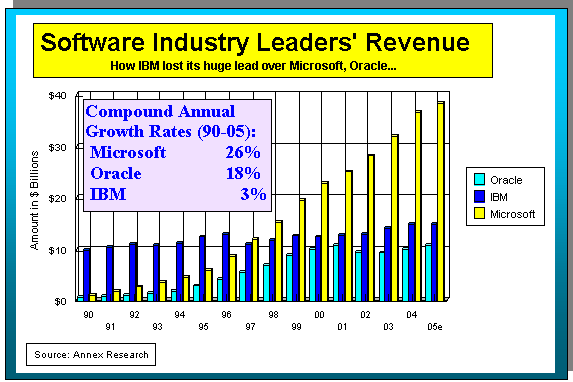
Nevertheless, it is nothing short of stunning
to see how the two software companies outgrew IBM in the 1990s (see the
above chart).
At the starting gate (in 1990), IBM had an
order of magnitude (10-fold) advantage.
Oracle’s revenues were $916 million; Microsoft’s $1.18 billion;
while IBM software generated $10 billion for Big Blue. Yet everybody thought, even back then, that Microsoft was the
largest software company in the world.
Such is the power of marketing… perceptions
win out over facts every time.
Meanwhile,
when IBM bought Lotus in 1995, the acquisition was hailed in the media as
a “Microsoft killer.”
But by 1997, the unflappable Microsoft had
easily surpassed IBM as the largest software company in the world ($12
billion vs. $11 billion). Facts
had finally caught up with perceptions.
Oracle was also nipping at IBM heels.
Its revenues were approaching $6 billion, as the company grew at
30% annually during the first seven years of the 1990s.
If it looked as if Big Blue was standing
still, it pretty much was. While
Microsoft’s and Oracle’s growth exploded, IBM software chalked up a
meager 3% compound annual rise in the last 15 years.
Some Bumps: Undervalued Stock?
Today, Oracle is a $10 billion software
company, on its way to about $11 billion in the current fiscal year
(ending May 31, 2005). But it
has not been a smooth ride all the way.
There have been bumps on the road to the exclusive double-digit
billion club; a club with only three members.
Fiscal year 2002 and 2003 represented revenue declines from the peak of $11 billion that the company reached in 2001. But Oracle bounced back in fiscal 2004, with a 7% revenue growth, led by a 15% surge in licenses updates and support, and a 16% jump in net profit to $2.7 billion.
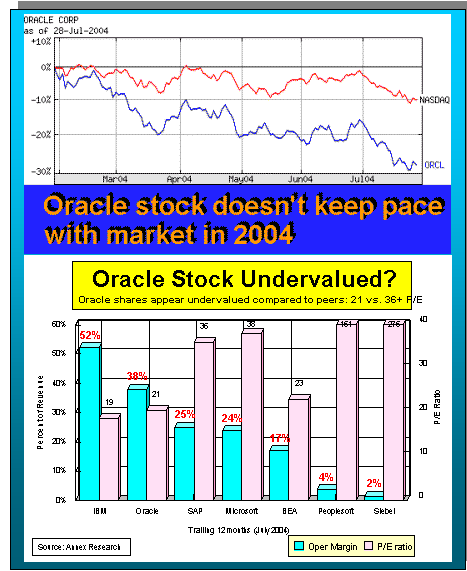
Yet the Oracle stock has not kept pace with
its solid business results. It
has under-performed Nasdaq by almost three-fold in the last six months,
even though the company boasts the best operating margins of all
independent software vendors. Yes,
better than Microsoft’s; better than SAP’s; and much better
than BEA’s, Peoplesoft’s or Siebel’s.
Only IBM software has higher profit margins (see the above chart).
Perhaps that’s the reason Ellison reached
out and grabbed Harry You,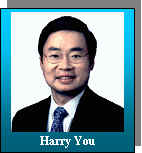 the former Accenture CFO, to take over the
same function at Oracle. During
his three years at Accenture, this former Morgan Stanley executive seemed
to have worked magic managing Wall Street expectations and his company’s
stock price. You led the
issuance of about $8 billion in equity without diluting the share prices.
As he left for Oracle about three weeks ago, Accenture’s stock
was trading near its two-year high of $28 per share, reached July 2.
the former Accenture CFO, to take over the
same function at Oracle. During
his three years at Accenture, this former Morgan Stanley executive seemed
to have worked magic managing Wall Street expectations and his company’s
stock price. You led the
issuance of about $8 billion in equity without diluting the share prices.
As he left for Oracle about three weeks ago, Accenture’s stock
was trading near its two-year high of $28 per share, reached July 2.
Like the former Accenture CEO, Joe Forehand,
You chose to leave on a high note (see “Accenture
Burning the Track Again,” Mar 2004).
Now, he has a new mountain to climb: selling his oracle about
Oracle to his former Wall Street colleagues.
With Oracle shares looking undervalued
relative to both the market and its competition, that’s a respectable
challenge. But at least You
has facts on his side and in his bag.
Oracle’s high profitability and visionary history are but two of
the most important ones….
Leading the “Passage to India”
The profitability surge started about 10 years ago, when Oracle opened its India Development Center in Bangalore. The move launched, what turned out to be, a new “Passage to India” (July 2003) trend among the U.S. IT companies.
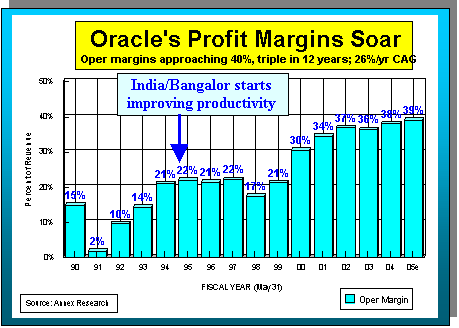
Prior to 1994, Oracles operating profit margins were in the 10% to 14% range (1992-1993). Now, they are approaching 40%, tripling since that time (see the above chart).

The significantly lower labor costs in India
(about 10 times cheaper than those in the U.S.), coupled with a highly
skilled computer programmer work force, are the main reasons for it (see
the above chart).
Calling
itself a “jewel in Oracle’s crown,” the company’s Indian web site
brims with pride about having become the “growth engine” of the U.S.
software giant. Now employing
about 6,000 people, Oracle India has been adding about 1,000 new jobs in
the last two years.
One should note from our labor cost chart that
India’s, however, is not the world’s cheapest labor force.
Computer programmers in China, for example, cost less.
Yet it was India, not China, that has become the world biggest
“software factory,” while China retains that distinction in terms of
traditional (hardware) manufacturing (see "China
Now Bigger Than the U.S.," Jan 2004).
Once
again, Oracle serves as a case in point.
Despite China’s labor cost edge, Oracle employs only 600 people
in the world’s most populous country, versus 6,000 in India.
Why?
There are two main reasons. First, the Indian work force is better educated. India produces about two million college graduates every year versus China’s 850,000. Second, about 80% of India’s college graduates are English speaking, while the Chinese ones have minimal English language skills. By contrast, the Philippines, for example, the third cheapest country in terms of software programmers, graduate about 290,000 people per year – nearly all of them English speaking.
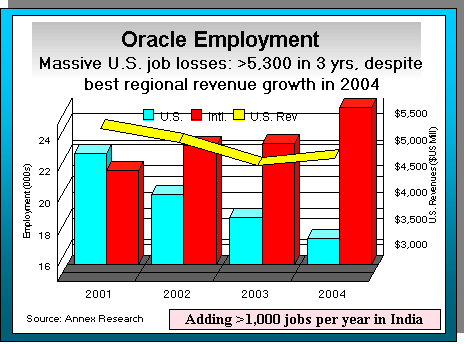
Nor has Oracle’s export of American jobs (over 5,300 in three years) been a one-way street. Just like Hewlett Packard, for example, the software company has been repatriating some revenues and profits from its Indian operations (see “A Passage FROM India,” Feb 2004).
India is now Oracle’s fifth-largest market
in Asia, up from 10th only two years ago. The company currently has about 6,000 technology and 200
applications customers in India. The
small and medium size (SMB) companies, which make up about 40% of
Oracle’s customer base in that country, are expected to become the
engine of growth for Oracle’s engine of growth (India).
Investing in Future
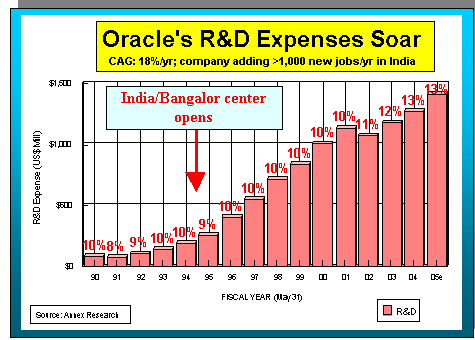
Just how aggressively Oracle has been investing in its future can be seen from the growth of its research and development (R&D) expenses. They’ve gone from $88 million in 1990, to over $1.4 billion in the current fiscal year. That’s a 20% compound annual growth, outpacing the growth of revenues during the same period by two points (see the chart below).
During the last 10 years of Oracle’s
“Indian summer,” the pace has accelerated.
The R&D spending grew faster than revenues by four points (18%
vs. 14%). As a result,
Oracle’s R&D budget now represents about 13% of revenue, more than
double IBM’s (5.9%). Such
investments are starting to pay off…
“Since we introduced the Grid technology six
months ago, our database new license sales have been growing at a rate of
15%,” said Ellison in a June 15 statement that accompanied Oracle’s
latest financial release. That’s
almost double the rate in fiscal 2004, which in and of itself represented
a rebound for the company after two sub-par years.
“The market is just beginning the move to
databases and applications servers running on Grids of low cost computers,
and Oracle is leading the way,” Ellison heralded.
And what’s so appealing about Grid
computing? It allows all
customers’ servers and storage to act in concert, as one computer.
In large enterprises, that often means hundreds, if not thousands,
of computers working together as one.
Given the incompatibilities between many different brands, that has
been a gargantuan challenge that no software vendor had been willing to
tackle.
Except for Oracle. Which is now once again reaping the benefits of being a
leader and a trendsetter. No
wonder Oracle technology can be found in nearly every industry around the
world, including in 98 of the Fortune 100 companies.
Lonely at the Top
But until such time that the adoption of a new
idea becomes pervasive, it can be lonely on a mountaintop or a desktop
where the innovation was conceived. And
sometimes dangerous, too…
Ellison says his favorite visionary of all
time was Galileo. Conventional
wisdom at the time of Galileo said the earth was the center of the
universe, and the sun revolved around the earth.
“But Galileo said this guy Copernicus (1473-1543) was right: The earth goes around the sun. He got into a lot of trouble for saying that.”
Copernicus’
diagram of the solar system



Copernicus
Galileo
(Copernicus’ De Revolutionibus Orbium
Coelestium ["On the Revolutions of the Celestial Orbs"] was
published in Nuremberg in 1543, the year of his death.
Which is why Copernicus escaped the Roman Catholic Church’s
persecution to which Galileo [1564-1642] was
subjected).
Luckily for Ellison and Oracle, people are no
longer burned at the stake for coming up with revolutionary ideas.
But as Schopenhauer also noted, they are nonetheless shunned in the
early stages of their oracles.
“When you're the first person whose beliefs
are different from what everyone else believes, you're basically saying,
‘I'm right, and everyone else is wrong’,” Ellison said in a 2002
Oracle internal interview. “That's
a very unpleasant position to be in.
It's at once exhilarating and at the same time an invitation to be
attacked.”
“There are really four phases,” Ellison
continues. “In phase one, everyone tells you you're crazy and it's the
stupidest thing they ever heard. In phase two, they say, "There is
some merit to the argument. It's still crazy, but there's some merit to
it." Phase three is, "Well, we've done it better than they
have." And phase four is, "What are you talking about? It was our idea in the first place."
Guess that’s Ellison rephrasing
Schopenhauer, and adding a phase, too, just as Galileo did with
Copernicus’ work.
“In the very beginning, people said you
couldn't make relational databases fast enough to be commercially
viable,” Ellison recalled. “I
thought we could, and we were the first to do it.
But we took tremendous abuse until IBM said, ‘Oh yeah, this stuff
is good’.”
Guess that was Big Blue uncharacteristically
playing the role of Galileo back then.
Over $100 billion (Oracle’s aggregate revenues) and 27 years
later, thousands of corporate software buyers have said the same thing:
“This stuff is good.”
Now, if only Wall
Street weren’t hard of hearing… the Oracle stock might soar again,
reflecting its trend-setting record and unbreakable spirit.
Happy
bargain hunting! Bob
Djurdjevic

For additional Annex Research reports, check out...
2004:
Oracle: Unbreakable Spirit (Aug 2004); Fujitsu: Back in the Black, But... (July 2004); Moody's Lowers the Boon on EDS (July 2004); HP: Delivering Value Horizontally (Jun 2004); Accenture: Revving Up a Notch (Jun 2004); Beware Your CFO! (May 2004); IBM: Changing of the Guard (May 2004); Capgemini: Texas-size Home Run (May 2004); Following the Money (May 2004); EDS: On a Wink and a Prayer (Apr 2004); HPS Wins by a Nose! (Octathlon 2004); Going Retro with Mainframes (Apr 8); IBM: Five-year Forecast (Apr 8); Mainframe at 40! (Apr 2); Accenture: Burning the Track (Mar 2004); "Crown Jewel" Restored? (Mar 2004); "Cap Gemini: Another, Smaller Loss" (Feb 2004); "CSC: Good Quarter Gets Boos" (Feb 2004); "Hot Air Jordan" Flaunts Flop as Feat (Feb 2004); "Cronyism Is Alive and Well at EDS" (Jan 2004); "Five Most and Least Likely Forecasts for 2004" (Jan 2004)2003 IGS: "IBM OnDemand: Different Strokes for Different Folks" (Dec 2003); "Investing in Growth" (Apr 2003)
2003 IBM: "IBM vs. HP: Spinning Global Server Market Shares" (Nov 2003); "Finally Heard, Part II," (Nov 2003), “Small Is Now Big at Big Blue” (Oct 16), “On the Nose But No Cigar” (July 16), “A Paler Shade of Blue” (June 2), “Save, Spend and Split” (May 8), “Shrunk by the Marketplace” (Apr 17), “Turnaround Continues...” (Apr 15), "Finally Heard!" (Jan 29), “Start of a Real Turnaround?” (Jan 17).
2002 IGS: "Half or Double Trouble?" (Aug. 12, 2002), "IBM to Take $500M Charge" (Sep 3, 2002), IBM-PwCC Update (Oct 2, 2002), Analysis of IBM Second Quarter Results (July 17, 2002), IBM Layoffs Confirmed! (Aug 14, 2002), Analysis of IBM Third Quarter Results (Oct 16, 2002), Boom Amid Gloom and Doom (Oct 10, 2002)
2002 IBM: “Gerstner: The Untold Story” (Dec 27), "Gerstner Spills the Beans" (Dec 13), "On a Wing and a Prayer" (Oct 21), "IBM-PwC Tie the Knot" (Oct 2), Big Blue Salami (June 19), "Looming IBM Layoffs" (May 14), "IBM 5-Yr Forecast: From Here to Eternity?" (Apr 2002), “Tough Times, Soft Deals,” (Apr 25, 2002), “Gerstner’s Legacy: Good Manager, Poor Entrepreneur” (Jan 2002), IBM Pension Plan Vapors: Where Did $17 Billion Go? (Mar 2002), "Sir Lou OutLayed Lay!" (Apr 1, 2002).
A selection from prior years: Is IBM Cheating on Taxes, Annex Bulletin 99-17 (May 1999), IBM 5-year Forecast 2001: An Unenviable Legacy (June 2001), "Break Up IBM!" (Mar. 1996), Fortune on IBM (June 15, 2000), “Smoke and Mirrors Galore,” July 2000), "Slam Dunk of Bunk" (Jan 2000), Annex Bulletin 98-14 ("Wag the Big Blue Dog"), Armonk's Fudge Factory (Apr. 9, 1999), Where Armonk Meets Wall Street, Greed Breeds Incest (November 1998), Stock Buybacks Questioned: Is IBM Mortgaging Its Future Again?, 97-18 (4/29/97), "Some Insiders Cashed In On IBM Stock's Rise, Buybacks" 97-22, 7/27/97, Djurdjevic’s Forbes column, "Is Big Blue Back?," 6/10/97; “Executive Suite: How Sweet!,” (July 1997), "Gerstner: Best Years Are Behind", Aug. 10, 1999), "IBM's Best Years Are 3-4 Decades Behind Us" (July 1999), "Lou's Lair vs. Bill's Loft" (June 1999), "Corporate Cabbage Patch Dolls," 98-39, 10/31/98; Djurdjevic’s Chronicles magazine October 1998 column, "Wall Street Boom; Main Street Doom", “Louis XIX of Armonk,” (Aug. 1996), "Mountain Shook, Mouse Was Born" (Mar. 25, 1994), “A Nice Guy Who Lost His Compass” (Jan 26, 1993), “Akers: The Last Emperor?” June 1991), Industry Stratification Trend (Mar. 30, 1990), etc.]
Or just click on  and use appropriate
keywords.
and use appropriate
keywords.
Volume XX, Annex Bulletin 2004-17 Bob Djurdjevic, Editor 4440 E Camelback Rd #29, Phoenix, Arizona 85018 |
Home | Headlines | Annex Bulletins | Index 2004 | About Founder | Search | Feedback | Clips | Activism | Client quotes | Workshop | Columns | Subscribe