
Annex Bulletin 2007-10 March 6, 2007
A CONFIDENTIAL client edition
Recent... 
The (T)ides of March Sink Markets Again - Analysis of global investment & economic trends
IGS: Growth Slows, Profit Surges - Analysis of IGS 2006 business results [Annex clients click here]
IBM CORPORATE

Updated 4/21/07, 1:00PM PDT, updates Tables & Charts...
Annual Update to Annex Research's Five-year Forecast for IBM
Profit to Grow Faster Than Revenue
Acquisitions to Supplant Big Blue's Indigenous Growth
SCOTTSDALE, Mar 6 - You have to spend money to make money,
goes an old saw. The adage also applies to Big Blue. In spades. Even
though IBM has been getting more profitable year after year (with net
income in 2006 reaching $9.5 billion, up 20% over the year before), its
organic growth has stalled in the low to mid single digits (only 1.3% compounded
annually as reported in 2001-2006, or 4.4% per year excluding the divested
PC business). 
Nor is there much hope in the future for an accelerated growth from indigenous sources. Our just completed five-year forecast for IBM has the company growing at about 5% in the next two years, and then at 4% per year in the following three. That's a compounded annual growth of 4.6% between 2006 and 2011 (right chart).
 So in order to grow faster, IBM
will need to invest in more fast-growing companies. And IBM
seems to be getting that point now.
So in order to grow faster, IBM
will need to invest in more fast-growing companies. And IBM
seems to be getting that point now.
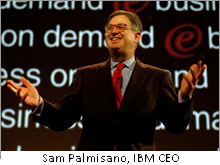
"IBM is a very different enterprise today than it was at the beginning of the decade." IBM chairman and CEO, Sam Palmisano, wrote in the company's just-released 2006 Annual Report. "We have prepared the company for growth and leadership in a radically different future."
"Spend:" Accelerate Acquisitions
Nothing new there, of course, for our clients. Growth by acquisitions has been our annual advice to Big Blue since four years ago (see "Save, Spend and Split," May 2003). The "spend"-part counseled investments in smaller, fast-growth companies, especially in the software and services arena. The only new thing this time around, IBM seems to be listening. And acting.
The company is set to step up its acquisition spree this year, India's The Financial Express reported on Mar 5, referring to IBM 10K filing, as well as quoting an unnamed "senior investment banking" source:
"IBM plans to keep up its "accelerated" pace of acquisitions this year, and has earmarked Indian IT space as a key target region. The US-based IT giant is believed to have sounded its investment bankers to scout for potential targets in the country, which could include mostly small-to-mid sized software firms, although it is not averse to acquiring large companies at the right price."
IBM has invested nearly $16 billion in over 60 acquisitions in the past five years, 13 of them in 2006 alone, making it the most acquisitive company in the technology space. The 2006 IBM acquisitions included FileNet ($1.6 billion), Internet Security Systems ($1.4 billion), Micromuse ($0.9 billion) and MRO Software ($0.7 billion), among others.
"Our net 2006 cash investment of $3.8 billion for 13 acquisitions — nine of them in key strategic areas of software — was up $2.3 billion year to year," said Palmisano.
IBM said that its early performance results from 2006 acquisitions are very strong. In the fourth quarter of 2006, IBM revenue growth from 2006 acquisitions in total was up about 50% year-over-year, with the majority of acquisitions exceeding their business cases, the company said in its filing.
"In today's rapidly changing marketplace, one must look at all sources of innovation to sustain one's value proposition to the customer," IBM CFO Mark Loughridge said. "As a consequence, IBM has become more and more acquisitive."
"Save:" Accelerate Offshoring... Especially to India
Another prong of IBM's efforts to reshape itself for a "radically different future" is its offshoring plan (or "rightshoring" as other IT vendors call it). We had already heard from the IBM CEO back in June that the company intended to spend $6 billion over the next three years in India alone, up three-fold over the past three years (see "A Tale of Two Blues," June 2006).
And where is this money going into?
The new employees, first and foremost, it would appear based on the IBM labor statistics. The company's base
in India was about 52,000 people at year end -- up from 36,000 one year
earlier, and up from 43,000 in June.
appear based on the IBM labor statistics. The company's base
in India was about 52,000 people at year end -- up from 36,000 one year
earlier, and up from 43,000 in June.
Three years earlier, IBM had only 9,000 people there, before the company dramatically stepped up its efforts to lower costs by doing more software development, services work and customer support from India.
That makes India the second-largest country for IBM, trailing only the United States, where IBM's work force rose slightly to 127,000. IBM reported that at the end of 2006 it employed 355,766 people worldwide, up from 329,373 one year earlier.
"We’ve had a sharp focus on productivity, to expand margins and drive more efficiency in our business. And we have accelerated our move to a globally-integrated company," Mark Loughridge, IBM CFO, said on Jan 18 as the company unveiled its 2006 year-end results. ""We continue to make investments in sales, delivery and business development skills across our entire set of offerings, as well as invest in strategic outsourcing infrastructure and BTO capabilities."
At the present torrid race of hiring, Big Blue may have some 100,000 employees in India by 2010, predicts AMR Research. By the same year, we expect IBM revenues to be $110 billion and its net earnings $12.4 billion. And that's without any more aggressive acquisitions.
"Save:" Reduce Stock Buybacks
Another aspect of IBM's taking our
"save" recommendation seriously is a sharp reduction in stock
buybacks
 in
the second half of 2006. Nevertheless, the heavy buying in the first
half put 2006 on a par with the record amount of share repurchases that
IBM carried out the year before (see the right chart).
in
the second half of 2006. Nevertheless, the heavy buying in the first
half put 2006 on a par with the record amount of share repurchases that
IBM carried out the year before (see the right chart).
As a result, this continues to be IBM's favorite way of deploying its capital. The chart on the left shows that share repurchases account by far for the biggest share of IBM's capital use - much more than the company spends on plants and equipment, dividends or acquisitions. And as long as that is the case, the "save" part of our recommendation is still mostly falling on deaf ears at Armonk.
Overall, since the company embarked upon the stock buybacks back in 1995, IBM has repurchased a staggering $76 billion-worth of its shares. Originally, the theory was that, besides returning money to (some) shareholders, this tactic would serve to enhance the stock prices by winning favors on Wall Street.

Well, that has certainly not been the case in the last five years, as you can see from the above chart. The IBM stock has been largely stagnant even though the company accelerated its stock buybacks and improved its earnings.
A slide in the IBM image is also evident from the just-released list of Fortune's Most Admired American Corporations. For years, IBM seemed presubscribed to the top spot as America's most admired company. Now it's no longer even in the Top 20 (see the Fortune table). Only Apple, Google and Microsoft are there from among the IT vendors.
Here's what the Fortune editors said about IBM in their introductory remarks to results of the magazine's 25th annual survey of corporate reputations...
"What America's Most Admired Companies had in common back then (1982) was mostly their sheer size. IBM was No. 1. Only two companies on that first list - General Electric and Johnson & Johnson (Charts) - appear in the current top ten. This year GE takes the top spot overall for the seventh time in a decade."
"Last year we expanded our overall Most Admired list from ten companies to 20, and that throws yet more light on some changing reputations. IBM (Charts), No. 19 in the 2006 survey, has dropped off the overall list despite ranking No. 1 in its own industry, nudged aside by the ascendancy of such high-profile retailers as Costco, Nordstrom, and Target."
But what probably hurt the most is that IBM is no longer even in the Top 10 most admired companies for innovation, something Big Blue has always prided itself on, and has, in fact, made a business out of (Technology Collaboration Solutions - see "From Little Acorns Mighty Oaks Grow," Nov 2006). This year, Apple and Google take the gold and the silver in that Fortune survey category, followed by eight non-IT companies (see the table below).
| Innovation
For the second straight year, Apple is the most admired
company for innovation.
(Source: Fortune)
|
| Rank | Company | Industry rank |
|---|---|---|
| 1 | Apple | 2 |
| 2 | 2 | |
| 3 | FedEx | 1 |
| 4 | Genentech | 1 |
| 5 | Nike | 1 |
| 6 | Whole Foods Market | 1 |
| 7 | Procter & Gamble | 1 |
| 8 | Network Appliance | 1 |
| 9 | Herman Miller | 1 |
| 10 | Starbucks | 1 |

And just in case that you think innovation is all fame and no game, think again. The above chart shows that there is a close correlation between innovation and stock prices. Apple and Google share have appreciated 800% and 300% more than the IBM stock in the last five years (Google since it went public in in mid 2004).

Other, non-IT companies on the Fortune most admired list for innovation have also bested the IBM stock by a wide margin in the last five years (above chart).
So one way for IBM to try to lift its share prices seems to be for the company to climb back up the innovation ladder. And not just by the number of patents it files every year (that's emphasizing quantity, not quality, as the new IBM should). The (relatively) new TCS unit certainly has a big role to play in this respect.
"Split:" Slow to Break Up Sluggish Units
IBM has been the slow to implement our "split" recommendation, even though the company has taken some steps in that direction, too. Armonk has disposed of some of its low-margin or money-losing businesses, such as the sale of its hard disk business to Hitachi (2002), of the PC unit to Lenovo (2004), and of its printer division to Ricoh (2007). And it split up its largest unit - IBM Global Services - into two parts (2005).
"We’ve taken a series of actions –
divesting of businesses that are commoditizing, while investing in targeted acquisitions to build capabilities in higher
value areas," Loughridge also said on Jan 18.
while investing in targeted acquisitions to build capabilities in higher
value areas," Loughridge also said on Jan 18.
All this fits neatly with the goal the IBM CEO stated on June 7 of last year in Bangalore, India (click on the right chart to read the full quote). Basically, Palmisano echoed the title of our 2005 five-year forecast for IBM - "Quality over Quantity" (Mar 2005), when he said that IBM would exit any commodity-type business (such as PC).
But is it enough? We don't think so. As you say in our last week's analysis of IBM Global Services' business results and outlook, the largest IBM business segment's growth has been rather sluggish in the last several years (see "IGS: Growth Slows, Profit Surges," Mar 2007. And one one to reinvigorate the growth, we said, was to split it up along the industry lines into smaller, nimbler and more autonomous units.
Forecast Summary
Okay, so net it out, without significant
new acquisitions, IBM revenue growth is likely to
 continue
to stay in the 4% to 5% per year range over the next five years. In
2011, Big Blue should be a $114 billion company, with services still
accounting for about half the business.
continue
to stay in the 4% to 5% per year range over the next five years. In
2011, Big Blue should be a $114 billion company, with services still
accounting for about half the business.
IBM earnings, on the other hand, will grow more rapidly. We expect them to increase by 7% compounded annually between 2007 and 2011. This means that in 2011, IBM should deliver about $13.4 billion to its shareholders' bottom line, for a 11.7% net margin (compared to 8.3% in 2006).
The fact that IBM will be that much more profitable even if it is not that much biggest in five years' time, is a direct consequence of its new emphasis on "quality over quantity." The shareholders should hail such a choice. Hopefully, Wall Street would also recognize its virtues, sooner or later.
|
Click here for detailed IBM forecast tables and charts (Annex clients only) |
Happy bargain hunting!
Bob Djurdjevic
 Click
here for PDF (print) version
Click
here for PDF (print) version
For additional Annex Research reports, check out... Annex
Bulletin Index 2007 (including all prior years' indexes) Or just click on SEARCH and use "company or topic name" keywords.
Volume XXIII, Annex Bulletin
2007-10 Bob Djurdjevic, Editor 8183 E Mountain Spring Rd, Scottsdale, Arizona 85255 The copyright-protected information contained in the ANNEX BULLETINS is part of the Comprehensive Market Service (CMS). It is intended for the exclusive use by those who have contracted for the entire CMS service. |
Home | Headlines | Annex Bulletins | Index 1993-2007 | Special Reports | About Founder | Search | Feedback | Clips | Activism | Client quotes | Speeches | Columns | Subscribe
Also
check out...
HP: Toward New Highs? (Excerpts from analysis of HP's first quarter FY07 business results) [Annex clients click here]
Capgemini Caps Great Year, Saves Best for Last (Analysis of Capgemini's fourth quarter business results)
EDS: On Sunny Side of Street (Analysis of EDS' fourth quarter business results & turnaround, Act II)
CSC: Where Less Seems More (Analysis of CSC's third quarter fiscal 2007 business results)
Fujitsu: Sales Up, Profit Down (Analysis of Fujitsu's third quarter fiscal 2007 business results)
IBM Shatters Records (Analysis of IBM's fourth quarter business results)
IBM Stock Passes Century Mark (Analysis of Big Blue's Stock Performance)
Happy Days Are Here Again (Analysis of Top 20 IT leaders' latest stock market and business performances)
"Excellenture" Excels Again (Analysis of Accenture's first quarter fiscal 2007 business results) [Annex clients click here]
Hedging the Bets (Analysis of latest institutional shareholdings of leading IT companies: IBM, HP, Accenture, EDS, CSC, BearingPoint, ACS, Perot ) [Annex clients click here]
Globalization Accelerates (Analysis of United Nation's annual survey of global investments)
IBM: A $125-Stock? (An update to "From Small Acorns Mighty Oaks Grow")
Capgemini: Longest Sustained Stock Price Rise (An update to "By Leaps and Bounds")
HP: New King of the Hill (Analysis of HP's fourth quarter business results)
IBM: From Little Acorns Mighty Oaks Grow (Analysis of IBM's "State of the Union")
Capgemini: By Leaps and Bounds (Analysis of Capgemini's preliminary third quarter business results)
Fujitsu: Good Performance Gets Better, More Global (Analysis of Fujitsu's first half FY2007 business results)
IBM: A Slam Dunk Quarter (Analysis of IBM third quarter business results)
Accenture's Emphatic Year-end Accents (Analysis of Accenture's fourth quarter results) [Annex clients click here]
IBM: Services in a Box (Analysis of IBM Global Services' Ground-shifting Announcements)
Strong Comeback by IT Stocks in Third Quarter (Analysis of top 20 IT companies' market and business trends)
Stock Buybacks: A Fading Fad (Dell, erstwhile "King of Fluff," suspends its stock buybacks)
Capgemini: Growth Continues (Revenues, net profit up in double digits, margins also improve)
HP Firing on All Cylinders (Stock sets new multi-year record following excellent third fiscal quarter results) [Annex clients click here]
Power of Manpower (While others move to India, Russia... AMD invests in New York, hailing "phenomenal" quality of its labor force)
Ebb Tide Lowers Most Boats (Analysis of EDS' and CSC's latest quarterly results)
IBM Stock Grossly Undervalued? (Analysis of stock market valuations of IBM and its major competitors) [adds latest Fujitsu, Capgemini results]
IBM vs. HP: A Tale of Two Blues (Both companies are doing well in business, but only HP is favored by Wall Street; Big Blue trying to change that now with its new "India Opus") [Annex clients click here]
Go East, Young Man! (A speech delivered in St. Petersburg, Russia, May 25, 2006; click here for slides)
IBM 5-Yr Forecast: Steady As She Goes (Emphasis on quality continued) [Annex clients click here]
Octathlon 2006: Accenture Again Wins "Gold!" (HP gets "Silver," IBM "bronze") [Annex clients click here]